Everyday Strong: Psych 101: How you can help kids in your life
Initial image description not found in image meta description...

Initial image description not found in image meta description...

Dr. Matt Swenson, MD
Everyday Strong
You may have noticed something unusual recently in the news and among your friends and family. Anxiety and depression, especially among teenagers, is rising drastically. One survey given in all three Utah County school districts suggests that it’s rising as much as 3 to 5 percent every year. That means that in 2011, about 13 percent of kids were depressed, and in 2017 it rose to 25 percent.
As a child psychiatrist for Intermountain Healthcare, I get a lot of questions about this trend. It’s scary, and it’s easy to feel helpless. One of the most common questions people ask me is, “what’s causing this?”
I’ve learned something from talking to hundreds of families over the course of my career. When it comes to identifying what causes anxiety and depression, it’s complicated. We all want to put something in a category, but sometimes it’s not helpful.
Here’s an example: when you’re facing someone you care about who’s in the middle of an asthma attack, a heart attack, or cancer, how helpful is that question about cause? If somebody tells you they’re having an asthma attack, do you say “How did you get that?”
You don’t. You say “Can I help? How can I help stabilize your breathing?” If somebody says “I have a cold,” do you say “now, where did that come from? Were you around this or that person? Were you out in the rain?” Or do you hand them a tissue and bring soup?
My experience has taught me that being helpful and being compassionate to a person with anxiety or depression is a lot more about identifying needs than identifying causes.
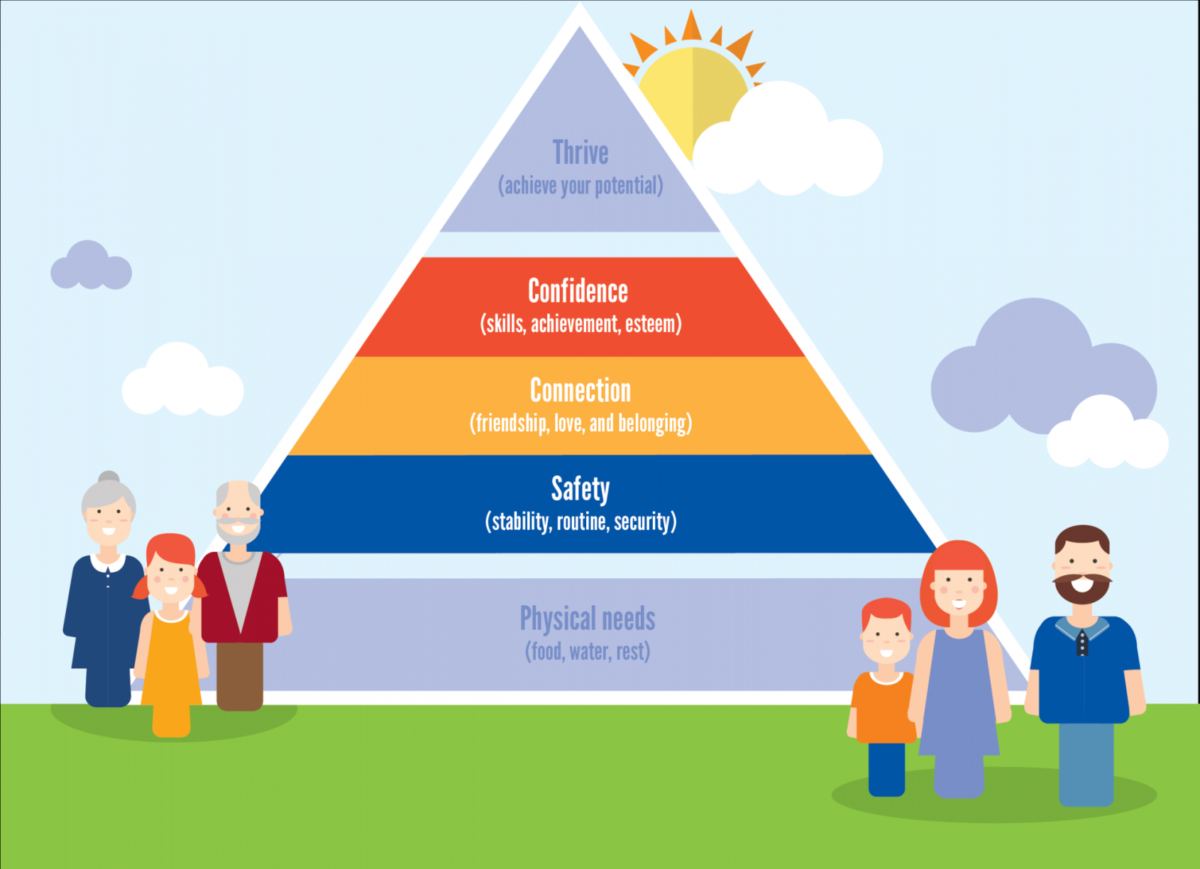
What do I mean by that? There’s a helpful framework I like to use called Maslow’s Hierarchy of Needs. You might remember this from high school or college Psychology 101. This is a brilliant and underappreciated little bit of psychology and it basically summarizes, to this day, after years of education and experience, how I still approach and think about people.
Maslow’s Hierarchy lays out the idea that someone can’t focus on certain aspects of life until an underlying need is met. Here’s what it looks like.
Basic, physical needs (like food and sleep) have to be met before you can worry about feeling safe. You have to feel safe before you can take care of friendship and love, and before you can focus on accomplishment, good performance and self-esteem, you have to feel loved and connected.
Here’s a familiar example. If you’re dying of hunger, it’s pretty difficult to think about making straight As.
But it even goes beyond basic needs. For instance, if your 10-year-old doesn’t feel safe to tell you crucial information about himself, do you think you’ll be able to have a real connection with him? Or what if your teenager knows that if she gets good grades, her peers will make fun of her? Which path is she likely to take?
A lot of parents believe they’ve got to train and motivate their kid, use carrots and sticks to mold him or her into whatever they’re going to become or to “make” him or her behave a certain way.
“If she would just try or just put her heart into it,” they think, “If I could just motivate her, then everything would be perfect.” But where does that break down? When kids can’t.
Maslow’s pyramid tells us that just like a child who’s dying of hunger can’t think about becoming a classic pianist until they get some food, a child who doesn’t feel safe, doesn’t feel connected or doesn’t feel competent can’t thrive and be on their best behavior until those needs are met. It’s not a matter of motivation.
What a person needs to be happy is the same as what they need to be resilient. It equals wellness. And it’s the beginning of overcoming anxiety, depression and the other difficulties so many of our children are going through.
I hope you will spend some time this week thinking about that little pyramid. If I could magically wish something I would wish for parents, on a daily or weekly basis, to look at their kids and ask themselves, “How are my kids doing with safety, connection, competence? What can I do this week to help improve and facilitate their sense of safety, their connections, and their competence?” That is how you build resilience in kids.