
Local game developers go retro with upcoming project
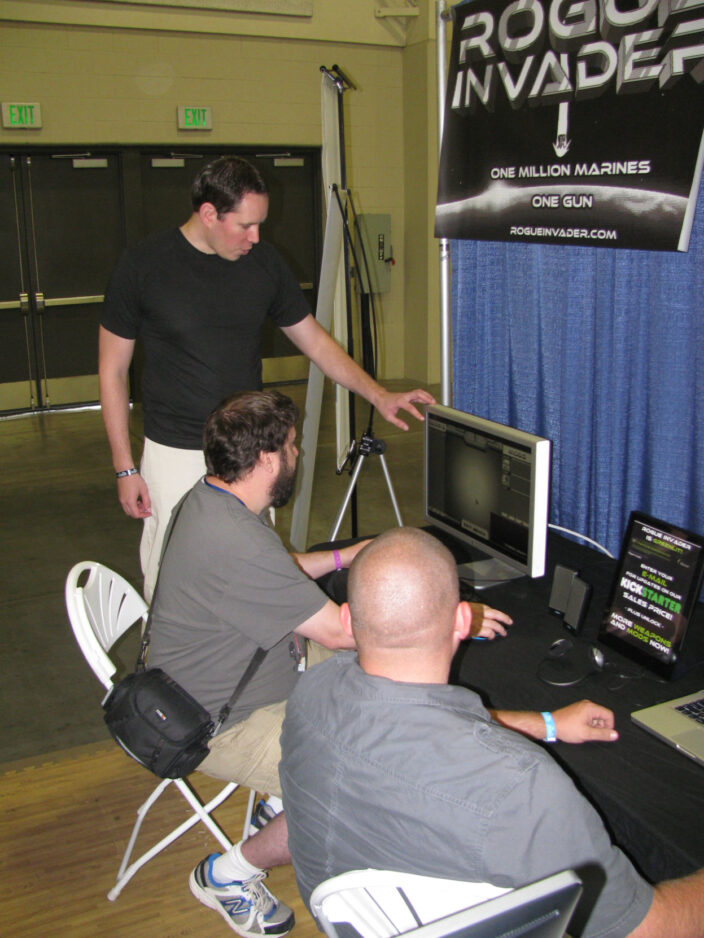
Nathan Rees, standing, co-founder of Squishy Games, talks with gamers about "Rogue Invader" at the Salt Lake Gaming Con on Saturday, Aug. 8.
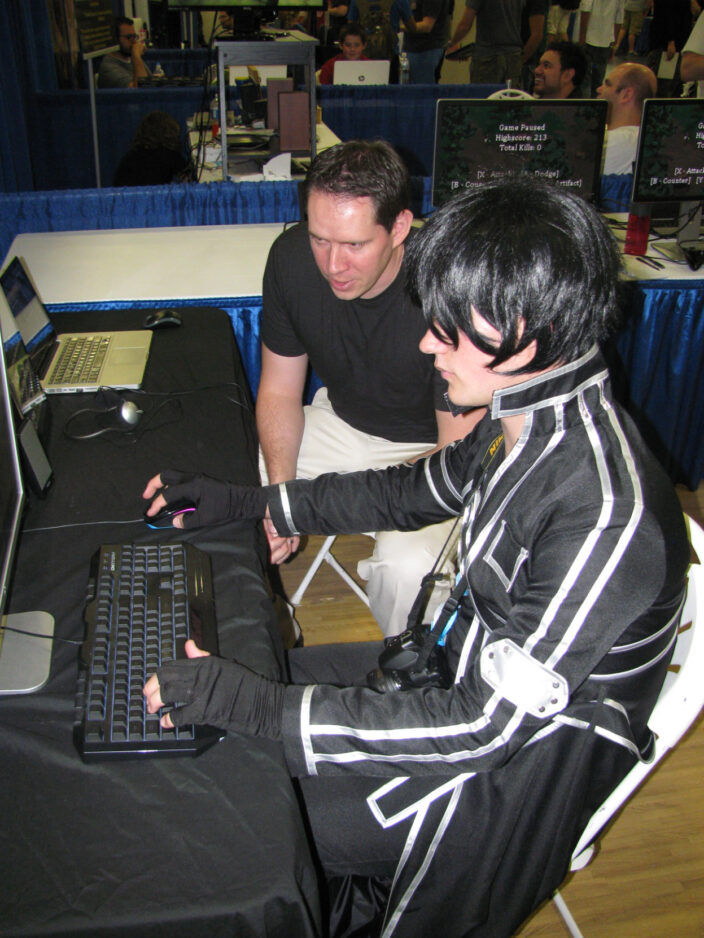
Nathan Rees, left, co-founder of Squishy Games, talks with a gamer about "Rogue Invader" at the Salt Lake Gaming Con on Saturday, Aug. 8.
Two local game developers are hoping to entice retro gamers through an indie PC game that hearkens back to the very early days of video games.
Lee J Hinkle, a Provo resident, and Orem resident Nathan Rees are friends who joined skills to create a company, Squishy Games, and their first game, “Rogue Invader,” is a black and white online game. Hinkle is the lead developer and Rees is the art director for the game. The art is based on drawings Rees developed on an old Apple Macintosh he grew up with.
“We went back really far in video games,” Rees said. “I made animations as a kid. This is the game I’d have liked to play.”
The game is a two-dimensional jaunt that pits single-players against aliens. That’s been done plenty of times before, and Hinkle and Rees wanted their game to stand out. In their game, the aliens aren’t the ones invading, the humans are. The backstory is that Earth has been in a long war with an alien species, and is now invading the alien planet, set on destroying all the aliens to end the war.
But players don’t have entire armies, or even platoons to control. They have one person and one gun — just a pistol with limited ammo. Players start with just the person and the pistol, because the invasion has been halted in orbit around the alien planet, with entire fleets and lost. The humans can only beam down one human at a time to the planet’s surface, and one item at a time. So, with a bit of dark satire, Rees and Hinkle set up an almost impossible mission for players. The game is beatable though, as gamers earn and build items to use in their assault.
“It’s believable, but it’s pushing the edge of believability. That’s about where we want to be,” Hinkle said.
For many gamers used to the high level graphics of today’s games, going really retro like this is risky. But Rees said there is a place in the industry for this because many are interested in this style of gaming. With successes like Minecraft and others, the indie gaming industry is coming into its own, and Rees may be right. There are now dedicated sites just for distribution of small, two-dimensional “pixel art”-based games. Rees and Hinkle have a goal to make it to one of them, steampowered.com.
“Pixel art games are really popular for indie game developers like us. Teams of just one to two people can get these out,” Rees said.
He compared the graphics of 2D games to more highly developed 3D commercial games like “Halo” or “Call of Duty.” Behind those games, there are teams of developers, and each team has 25 or more software engineers working on specific aspects of the game. With just a team of two, Rees and Hinkle had to focus where they spent their time, while still enhancing its playability.
With pixel art as the development level, Rees and Hinkle had to focus less on the look of the game, and were able to really concentrate their time on the story and play of the game. Because the game is also on just black and white, they needed to have a good story to keep people playing.
“We maintained the pixel art factor, but we first rendered it in 3D, to make the 2D smoother than typical pixel art games,” Hinkle said. “We wanted to have a game that was engaging enough to get players to play it and stay with it with the black and white color.”
Rees and Hinkle offered a playable demo of “Rogue Invader” at the Salt Lake Gaming Con last weekend. They were both excited about the responses of players, and are encouraged to continue development.
But developing a game, even one based on simpler graphics like this, still takes a lot of time and talent. Both men still have their day jobs — Rees is the owner of Squishy Animation, a local independent animation company specializing in projects for area businesses, and Hinkle is the owner of Shield Volleyball Club in Cottonwood Heights. Hinkle was also a high school computer teacher in West Valley, but after Rees kept coming back again and again, pitching more than 15 different versions of his game idea, Hinkle quit teaching to focus on “Rogue Invader.”
They want original music for the game to further make it stand out, so they are launching a Kickstarter campaign Aug. 18 to fund the hiring of a composer. Once that is settled, they hope to finish up the game and get it out to players, hopefully by November.
“One of the difficulties we face is getting it out in front of the younger group, and convince them black and white is fun. The Gaming Con helped build that buzz,” Rees said. “We already appeal to the older set, because they look at it and say, ‘This is the game I wanted to play when I was growing up.'”