
‘Deco Japan’: You’ve never seen Art Deco like this before
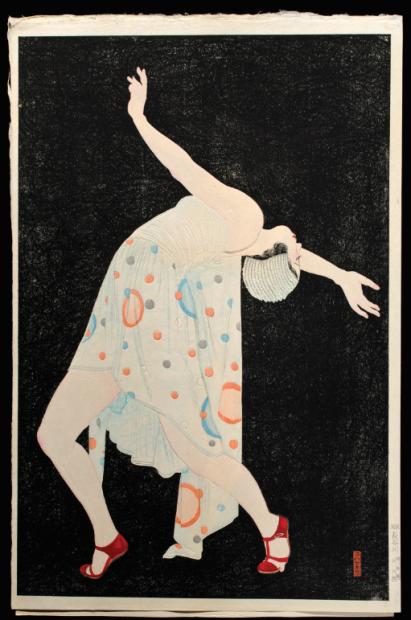
One of the many striking pieces in "Deco Japan," a new exhibit at Brigham Young University's Museum of Art.
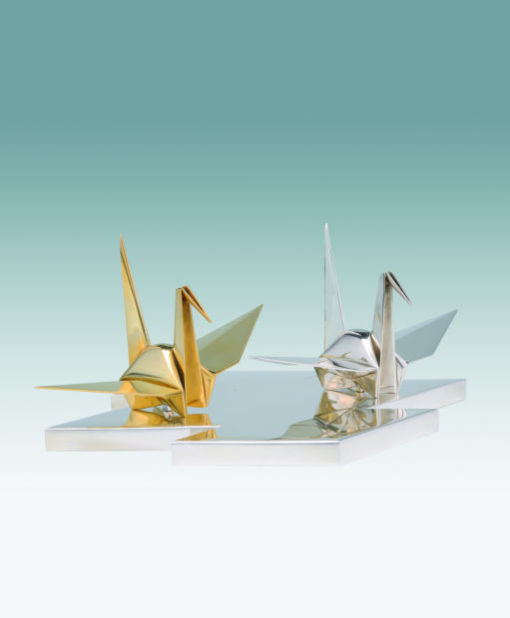
The exhibit's origami cranes sculpture segues nicely into another current MOA exhibit, "Folding Paper: The Infinite Possibilities of Origami."
Japanese Art Deco. Unbeknown to most Westerners, it was a real thing.
The dominant art style from the 1920s through the ’40s took Japan by storm at the time. Yet, to the rest of the art world, this fact was largely forgotten.
“Deco Japan: Shaping Art and Culture, 1920-1945,” a new exhibit at Brigham Young University’s Museum of Art, showcases this lost era. The traveling exhibit, distributed by Arts Services International, is the first time Japanese Art Deco has been exhibited outside Japan. It includes more than 200 pieces of evocative, angular, ultimately striking artwork — everything from statues to sports medals to kimonos. The pieces are so captivating, it’s a shock it remained a secret for so long.
“With Art Deco, we always think of New York, or the Chrysler Building, or Rockefeller Center — these iconic buildings. But it’s not just an architectural style. It kind of spans a lot of media, and it was also very international,” said Janalee Emmer, a curator and head of education at the MOA.
The unique exhibit, Emmer said, was all collected by Robert and Mary Levenson. The Atlanta-based couple spent 20 years gathering these diverse pieces. After finding their first Japanese Art Deco item years ago, the Levensons began inquiring about the style. Art dealers everywhere told them it wasn’t a prevalent or collectable style, and some said it didn’t even exist — a testament to how truly forgotten it had become.
Curators and scholars had neglected Art Deco as a whole for years, Emmer said. The style’s enormous popularity among the 1920s elite, and its eventual mass production and consumption among common people, largely drove this neglect. This, however, has changed over the past 20 years, just as the Levensons were building their collection.
“I think the two coming together are perfect timing for an exhibition like this,” Emmer said.
Art Deco’s arrival in Japan is fascinating. A 1923 earthquake decimated Tokyo and its surrounding region, destroying the architectural landscape and killing nearly 150,000 people. Tokyo needed to be rebuilt. Art Deco as a concept was in its infancy, beginning in France at the same time.
“The silver lining was that it gave a blank slate for a lot of artists and architects who came in with this new Deco style,” Emmer said.
Japan suddenly had a dominant new aesthetic — formed by a generation of Japanese artists who’d been looking increasingly outward.
“There’s something really attractive about this style,” Emmer said. “In the United States, it’s the style of flapper and the roaring ’20s. It’s a really exciting period. And to find out there’s a similar style going on — a kind of Japanese flapper (known as the moga) — has made it a really interesting exhibition for American audiences.”
If there’s one prevalent image in the diverse exhibit, it’s the moga. Through the moga depicted in Japan’s Art Deco, one sees a snapshot of the country’s artistic, cultural and political ambitions. These cosmopolitan women blended Japanese visual traditions with that of the Western world. Reconciling these powerful cultural forces — and incorporating aesthetics from China, Egypt and Europe — was common for Art Deco. In the context of Japanese life, however, it’s particularly fascinating. As Japan embraced its own political ambitions and tried expanding its empire during World War II, the cosmopolitan moga diminished. It gave way to far more nationalist imagery, including the phoenix and dragon. Weaving the world’s influences into their own identity became a contrary ideology.
Art deco had a good run in Japan. With “Deco Japan,” that forgotten fact is finally revealed. Better late than never.
DECO JAPAN: SHAPING ART AND CULTURE, 1920-1945
When: Now through July 18
Where: Museum of Art, Brigham Young University campus
Admission: Free
Info: moa.byu.edu