Garden Help Desk: Figuring out if your infestation is termites, and how to handle them
-
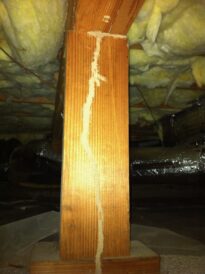
- Termites can’t tolerate exposure to warm, drying air or light. They build mud tubes to protect themselves if they need to move across open spaces between soil and food sources like drywall or lumber.
-

- Termites will feed on the paper-based surface of sheetrock and tunnel through the sheetrock itself as it feeds.
-

- Oxalis in a garden or shrub bed can often be controlled with hand pulling, but it’s important to remove the weeds before they flower so that new seeds aren’t added to the garden.
-

- When oxalis is growing in a lawn, it is mixed in with grass plants and can’t be effectively or practically controlled with hand pulling.

Courtesy Meredith Seaver
Termites can't tolerate exposure to warm, drying air or light. They build mud tubes to protect themselves if they need to move across open spaces between soil and food sources like drywall or lumber.
There are thick lines of mud on my crawlspace walls. Are bugs making these?
Without photos the best I can do is make a guess. If your lines of mud look like the photo I’ve included, then the problem is termites, insects yes, but not members of the true bug family. Subterranean termites are the most common species found in Utah and that is probably what you’ve encountered with those mud structures.
Termites are small insects that can be mistaken for ants unless you take a close look. Unlike ants, they’re soft-bodied and wide across their midsection. Ants have hard exoskeletons and pinched “waistlines.” Termites are social insects (they live in colonies) and their colonies can become quite large, which makes their feeding very destructive.
Termites aren’t the sturdiest of insects. They need warm temperatures, high humidity levels and protection from light to thrive. Mud tubes protect them from cold or drying air and bright light.
These pests feed on cellulose, a major component of wood. Cellulose isn’t just found in the studs, rafters, stair stringers and joists of a home; it’s also on the exterior of sheetrock and in a variety of paper products. Termite feeding can cause damage to anything that contains cellulose. Termites will feed on any wood product that makes direct contact with the soil and build mud tubes to cross areas of stone, cinderblock, or concrete that are between the soil and any wood products. Crawlspaces and unfinished basements are good examples of spaces where you might find mud tubes.

Courtesy Meredith Seaver
Termites will feed on the paper-based surface of sheetrock and tunnel through the sheetrock itself as it feeds.
Termite problems require treatment by a pest control professional. Most pest control companies that deal with structural pests will provide you with a free inspection and treatment estimate. Before you pay for any pest control services, it’s good to get two or three different estimates that include the same basic treatments. Estimates from a national company, a regional company and a small local company should give you a good picture of your options.
Termites prefer moist sites. You can reduce your chances of having termite problems again by taking steps to reduce moisture in and around your home. Check in your kitchen, bathrooms, utility and laundry rooms for leaks; improve ventilation in your basement; switch to drip irrigation instead of sprinklers for any foundation plantings, and of course, water deeply, but not infrequently.
We had problems with some difficult-to-control clover-type weed in our lawn last year. I sprayed trimec once a month or so, but the clover seems to be quite resistant while all the other broadleaf weeds die. I could see that it was a problem all up and down our street. Can you help me figure out why it spread so fast and how to control it this year?
It looks like your lawn has been having a problem with oxalis, also known as woodsorrel. It’s sometimes mistaken for clover.
Oxalis is a perennial, so the weeds you struggled with last year will be back again this year. You’ll also see new oxalis this year because it can spread very easily by seed. The mature seed pods open explosively, and seed can be thrown for several feet. This explains how the oxalis has spread so easily in your yard and neighborhood.

Courtesy Meredith Seaver
Oxalis in a garden or shrub bed can often be controlled with hand pulling, but it's important to remove the weeds before they flower so that new seeds aren't added to the garden.
The right post-emergent herbicide (weed killer) will help you get the overwintering oxalis under control in your lawn. A better choice than trimec for chemical control of this weed is triclopyr. It is an active ingredient in several brand name products, frequently combined with other active ingredients in lawn weed control products. You’ll have no trouble finding what you need on store shelves this spring. Including a pre-emergent herbicide in your weed control program in the spring will help to prevent the germination of new oxalis seeds.
Also make sure you’re following good lawn care practices; they’ll make it easier to control weeds in your lawn. Enough fertilizer (but not too much) and deep, infrequent watering will help your lawn stay thick and healthy, making it harder for the oxalis to thrive. Mowing your lawn taller and using a mulching mower will shade the soil reduce germination of the seeds and the vigor of the oxalis that’s already growing.
If you’re consistent with good lawn care, pre-emergent herbicides, and post-emergent herbicides you’ll get the upper hand over time.

When oxalis is growing in a lawn, it is mixed in with grass plants and can't be effectively or practically controlled with hand pulling.