
Experiment: Bullets don’t start blaze
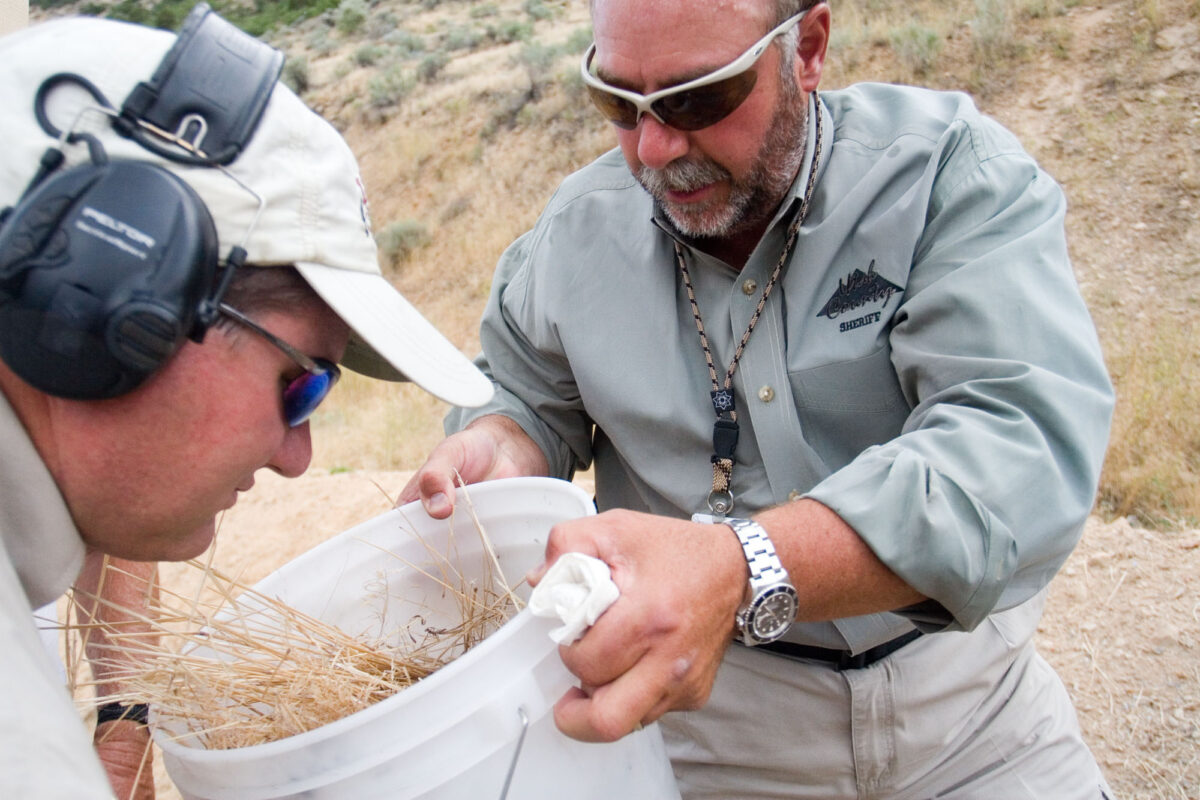
A steel file on a Lake Mountain rock sparks easily. And Utah County Sheriff Jim Tracy could produce sparks by smacking rocks together.
But at the county shooting range at Thistle on Monday, no one could start a fire with a bullet shot from a gun. Even a pure copper bullet heated to 500 degrees and dropped into dry cheatgrass didn’t work.
Nor did molten lead poured over the crispy stalks.
The informal experiments were conducted by Tracy, who was trying to find out whether wildfires can be started by shooters via ricochet, hot lead or ejected muzzle residue.
For an hour on Monday, county Rangemaster Owen Shiverdecker hammered away with a variety of weaponry — .223- and .308-caliber rifles, among others — and a variety of bullets, to see if any combination would start a fire.
County commissioners, at the urging of fire officials, renewed a ban last week on fireworks, open fires and shooting on unincorporated county land. Shooting was included because some officials have expressed concern that bullets pose a fire hazard. Many shooters are skeptical.
So Tracy headed to the range, along with an entourage of experts. At Thistle, bomb experts, a handful of deputies and a fire crew for safety — fully decked out in the hot summer sun — congregated to test some theories.
The afternoon started with an elementary ballistics lesson. Lead and copper bullets aren’t going to spark, they’re just too soft. But there is plenty of cheap ammunition on the market that employs steel-jacketed bullets with a copper wash. It’s usually Russian-made stuff that you buy by the thousand, Tracy said. It’s not hardened steel but it is ferrous, which makes it more likely to spark than lead.
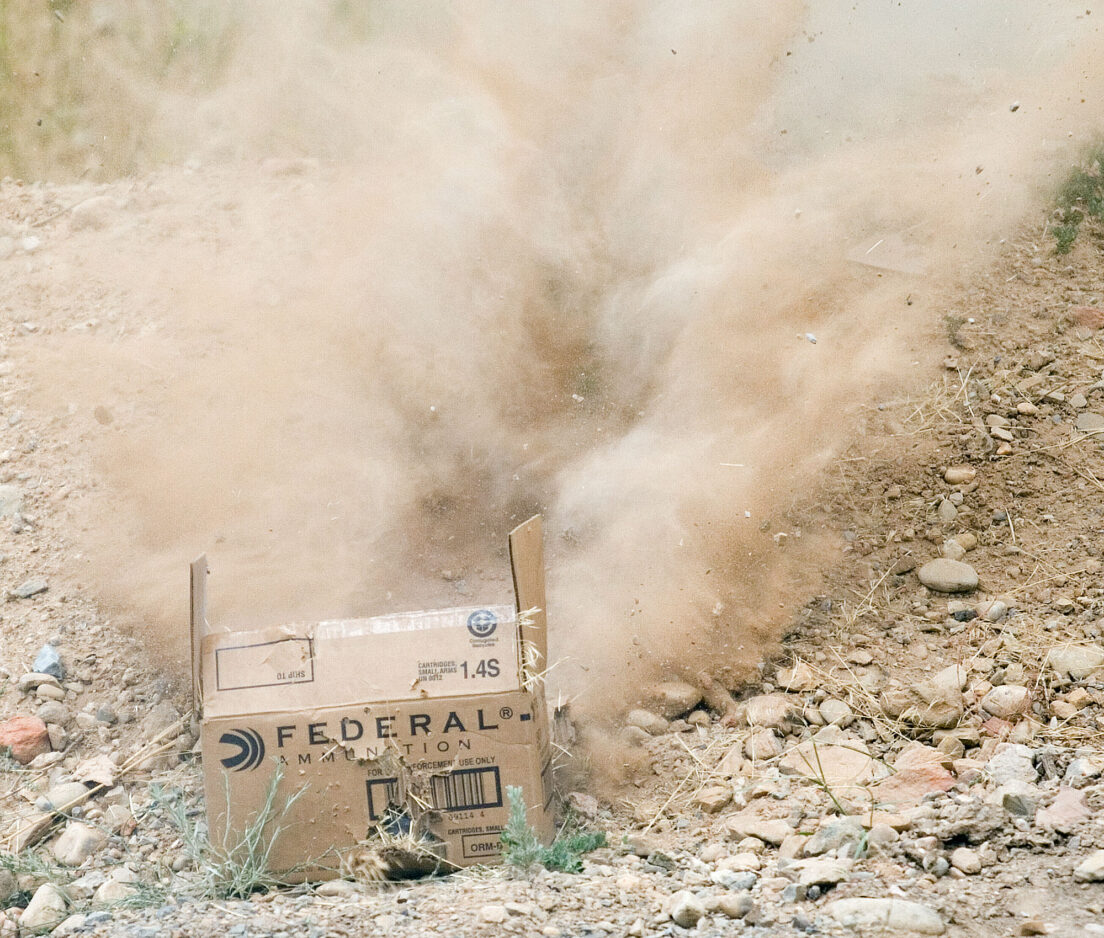
A Chinese-made SKS rifle is plenty loud, even when muffled through required ear protection. Shiverdecker squeezed off a few 7.62mm x 39 rounds, and several yards downrange rock chips and cheat grass were blasted from a cardboard box that will never again hold Federal-brand ammunition.
At the first sign of smoke, eyebrows shot up. That was easy. Bullets do start fires.
Upon further inspection, however, the “smoke” turned out to be dust from pulverized rock. The rock was a sample from Lake Mountain, a popular shooting area that was most recently on fire at the end of June.
But actual flames, which have cost the county a cool million to fight this year, remained elusive.
Before the shooting started, lead was melted and dumped straight onto cheat grass. With a melting point of more than 600 degrees, the best it could do was smolder and smoke for a bit before going cold. A pure copper bullet was then heated to roughly 500 degrees and dropped into the grass. That too produced scorching, but again no fire.
Would a breeze or denser grass or a less humid day have produced a flamefi Maybe. Or maybe not. The test was inconclusive.
Tracy thought a hot bullet could start a fire under the right conditions — and the phrase “under the right conditions” became the mantra of the afternoon.
Under the right conditions, burning powder residue from a cartridge could leap 15 feet and start a fire, Tracy said. He demonstrated how a little pile of unburned residue gathered from a water tank at a gun-testing facility and dried out again was still plenty flammable.
He lit it with an electric igniter and it flamed away.
But no bullet started a fire at Thistle on Monday.
While Shiverdecker did his best to simulate a typical shooter (including having his SKS jam twice), the experiments may not have been sufficiently well designed or extensive to reach a general scientific conclusion — a conclusion that would cover hundreds of shooters firing dozens of types of guns loaded with dozens of kinds of ammunition flying at dozens of kinds of targets.
Under the right conditions and given the sheer number of variables, Tracy said, the probability would rise that a shooter could start a fire.
“If you’ve got sparking material, the variables are going to stack up against you,” he said.
Fire officials believe the right conditions have come together at least seven times this year, resulting in more than a million dollars in firefighting costs. They don’t offer hard evidence to back up that claim. Skeptics wonder whether anecdotal evidence gathered from shooters — even those who reported starting a fire — might be tainted by a desire to cover up a dropped cigarette, illegal ammunition or negligence.
But even anecdotal evidence is not necessarily available. A fire investigator with the U.S. Bureau of Land Management told the Herald earlier that the cause of a range fire may be assigned to shooters if no other cause can be established.
On Friday, Tracy told the Herald that he would make a recommendation on the shooting ban to the County Commission based on the outcome of his testing at Thistle. “The result will be the result,” he said.
But on Monday, he seemed less enthusiastic, allowing that he doesn’t want to see the shooting restrictions in place any longer than necessary.
Asked directly whether he really believed that bullets started seven fires this year, Tracy paused thoughtfully. Then he said that he trusted the fire investigators.
Fires this year attributed to guns
Date/acreage/cost to fight
Feb. 10 – 3 acres – $2,257
March 17 – .1 acres – $50
May 26 – 4 acres – $240
May 30 – 12 acres – $645
June 12 – 10 acres – $945
June 24/29 – 8,495 acres – $1,000,000 (at least half of the acreage and cost attributed to shooting.)
July 14 – 244 acres – $200,000
The county has opened up the shooting range in Thistle to the public free of charge every Friday afternoon and all day Saturday until Sept. 7.
This story appeared in The Daily Herald on page A1.