UVU the first to use program in Utah helping students succeed in math
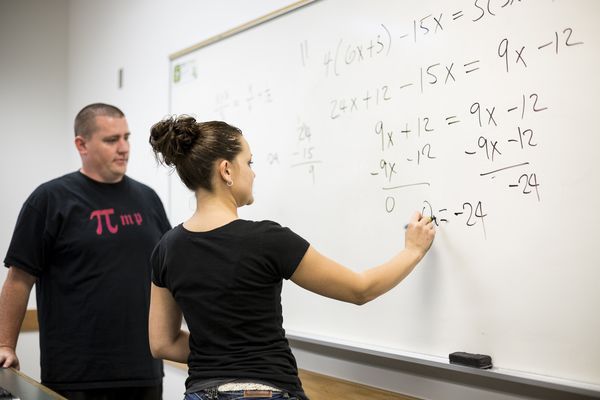
Math tutors assist students during a Math Lab located on UVU campus on Thursday, September 4, 2014.
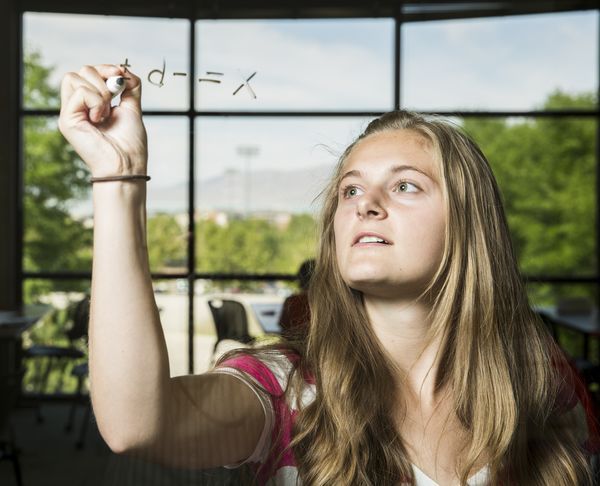
Students attend a Math Lab located in LA 201 on UVU Campus on Tuesday. July 8, 2014.
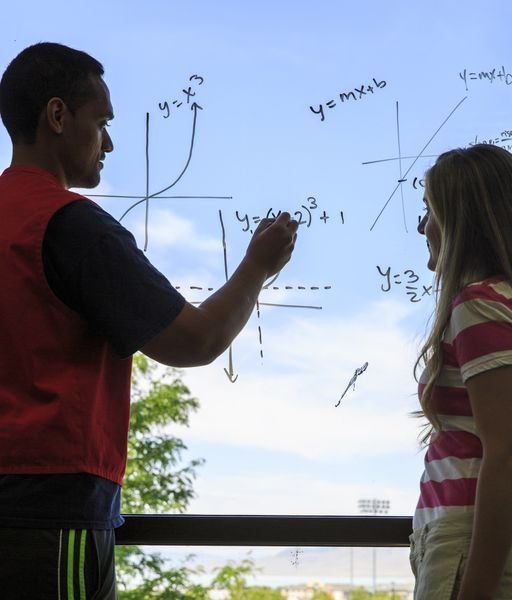
Math tutors assist students in the Math Lab located in LA 201 on UVU campus on Tuesday, July 8, 2014.
Math tutors assist students in the Math Lab located in LA 201 on UVU campus on Tuesday, July 8, 2014.
The initial results are in and adding up to big improvements. Utah Valley University has adopted technology to help students succeed in math — on their own level and on their own terms — that save time and money. Both students and faculty members are excited about it.
“Their faces light up when they talk about math,” said Carolyn Hamilton, an associate professor in the finance and economics department. “I have been teaching 25 years now and have never seen this kind of excitement from anybody who isn’t a math major.”
Hamilton is referring to the ALEKS program, an acronym for Assessment and Learning in Knowledge Spaces, the technology the program, which combines teaching and remediation, is based on. Through the program, students learn where their strong and weak points are, and are directed to resources to make improvements. The program is different from other software in that it uses artificial intelligence to continually assess each student separately and creates individualized study plans. It can be especially helpful for those who haven’t taken math for several years.
That’s the category of student UVU sought for the pilot program, which offered the assessment and assistance free of charge. Of the 130 students initially involved this summer, more than half — 77 — have already gone on to take additional placement exams, with a resulting 115 courses skipped. That is projected to save those students approximately $120,000 in tuition.
Additional sessions are continuing through the summer, and the program has been in such demand that a new section has been added for late July and early August. Response from the students who have already used ALEKS has been positive.
“I found that my biggest issue with math is that a lot of what was learned in previous classes was not ever used again and consequently not retained,” said James Delli Gatti, one of the program participants. “ALEKS has done an amazing job at jogging my memory, allowing me to refresh my memory at my pace.”
ALEKS was developed through research at New York University and the University of California, Irvine, by a team of software engineers, mathematicians, and cognitive scientists with a multimillion-dollar grant from the National Science Foundation.
UVU is the only school in the state to use the program so far, said Tiffany Evans, the university’s director of program completion, although Weber State University is beginning to adopt the program.
“I think it will go across the whole state because it is that good,” Hamilton said. “It is very accurate at identifying what students know and what they don’t know.”
“We are excited about the progress that students are making,” Evans said. “We feel it is another tool in our tool belt to help students succeed in math. The time and energy that students take in this program pays off for them in what they are learning and the success they will have in their next courses. We are excited about the opportunity.”
One group of students has already proven the benefit of ALEKS as they have completed their next math courses. They started ALEKS in January and have received their grades for the classes in which ALEKS helped them place.
“I’ve never had a group like what I had. They were outstanding,” said UVU math teacher Christine Walker. “Everyone passed, with the lowest grade being a B-minus. They were a wonderful group of highly dedicated students. I’m so proud of them I’m bursting. I think this type of program needs to continue. Sixteen lives were drastically changed, and the impact on them and their families is significant.”
Students may use the program on their own, sign up for a summer Math Leap session, or enroll in a seven-week class for credit. Nontraditional students, including those who have been away from the educational fields for an extended period, may especially benefit from ALEKS.
Without ALEKS, Wendi Jagerson may not have returned to college. She had a bad experience when she first began her studies and did not continue. “Last January my daughter and I took an orientation tour for her to start at UVU. We visited a math classroom, and I liked what I saw. I went home that night and started getting my transcript to apply for UVU myself.”
Her initial placement had her in a lower level math class, but after 47 days in the ALEKS program, she is eligible for the next stage and plans to continue with ALEKS prior to the start of school in the fall.
“This ALEKS program is laid out in such a way to encourage people,” she said. “It helps you step-by-step to learn what you need. I felt empowered and encouraged. That has never before happened in my life. It has just been an incredible two months. If I can do it, anybody can do it.”