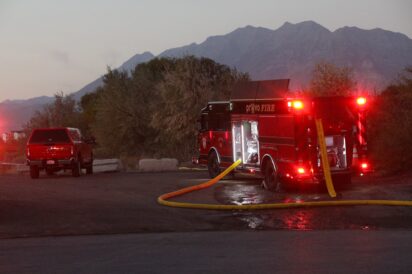
Pole Creek, Bald Mountain fire boundaries within half mile of residences as officials meet with community
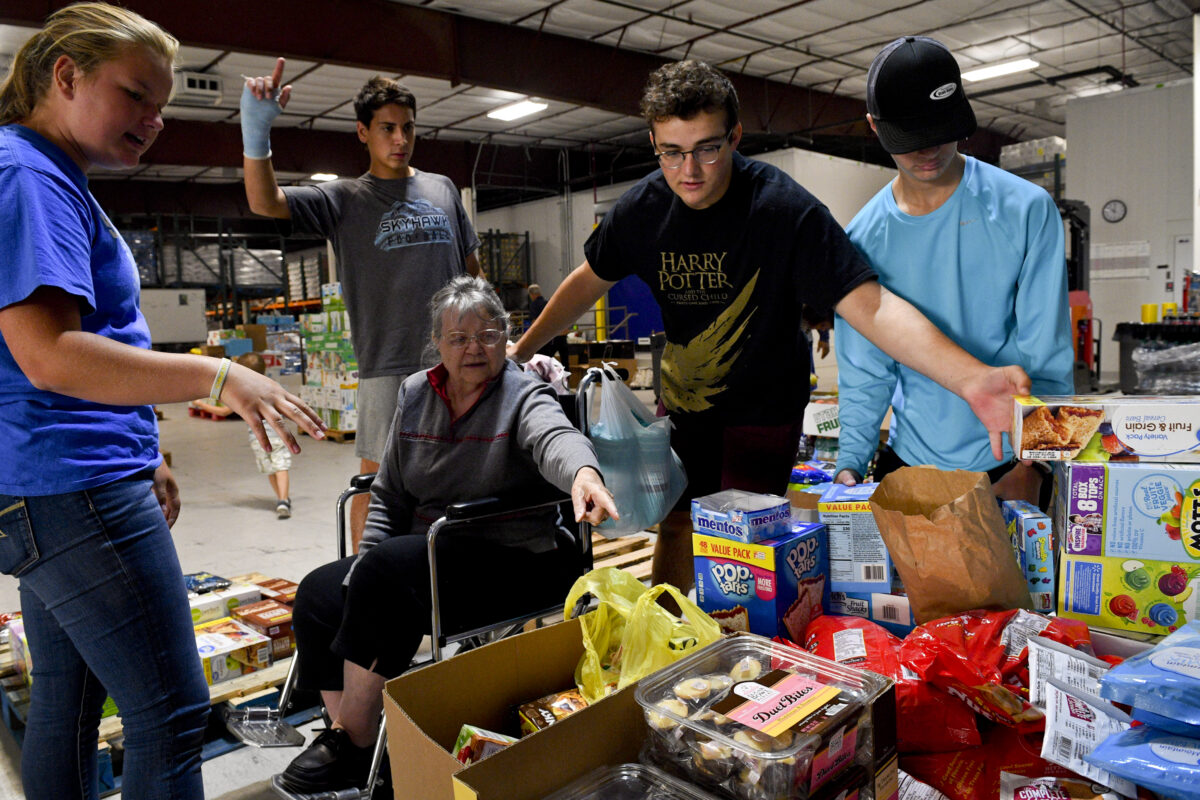
Lillie Jones, of Woodland Hills, points out items as Zane Zobell, second from right, of Salem Hills High School student council, helps pick up items along with other volunteers from the school's student government and football team at a donation center set up at 161 E. 400 N. in response to the Pole Creek and Bald Mountain fires Saturday, Sept. 15, 2018, in Salem. Isaac Hale, Daily Herald

Joshua Rohrbaugh, 12, of Payson, wears a bandanna to prevent smoke inhalation as he waits to help others at a donation center set up at 161 E. 400 N. in response to the Pole Creek and Bald Mountain fires Saturday, Sept. 15, 2018, in Salem. Isaac Hale, Daily Herald
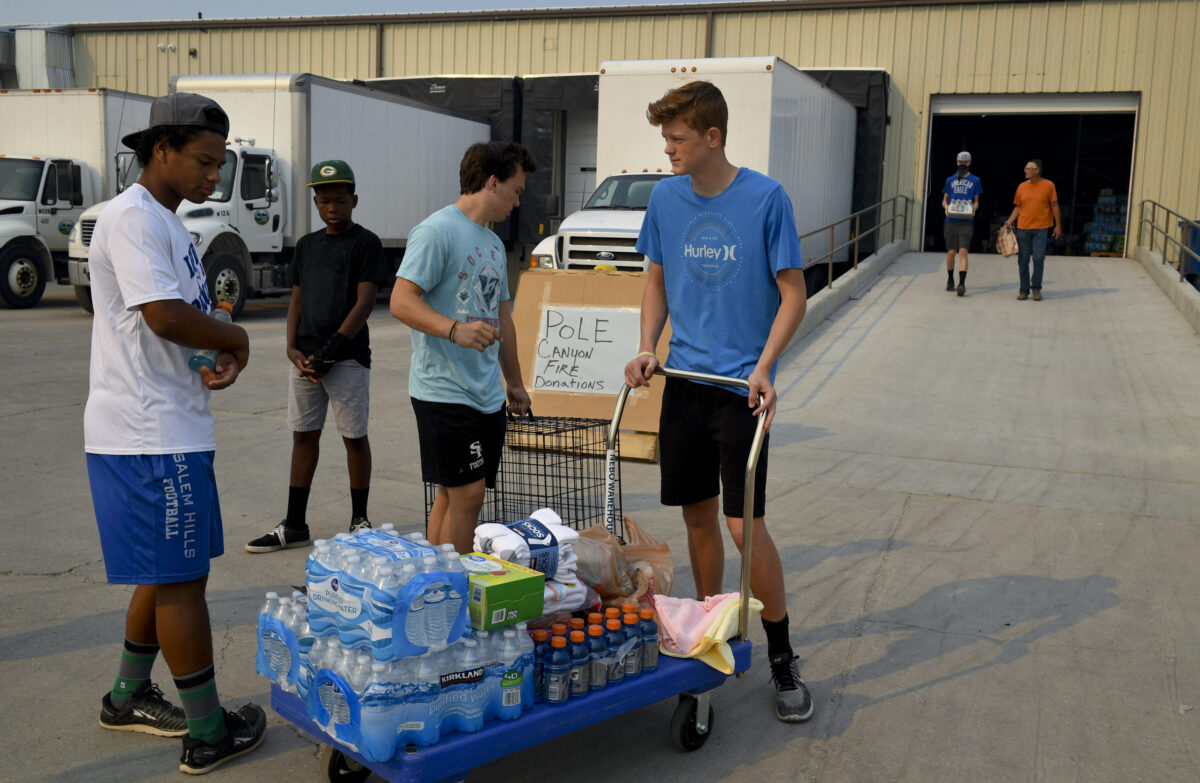
Austen Carrick, 17, right, of the Salem Hills High School football team, stands among other football players and members of the school's student government with donated goods to give to an evacuated family at a donation center set up at 161 E. 400 N. in response to the Pole Creek and Bald Mountain fires Saturday, Sept. 15, 2018, in Salem. Isaac Hale, Daily Herald
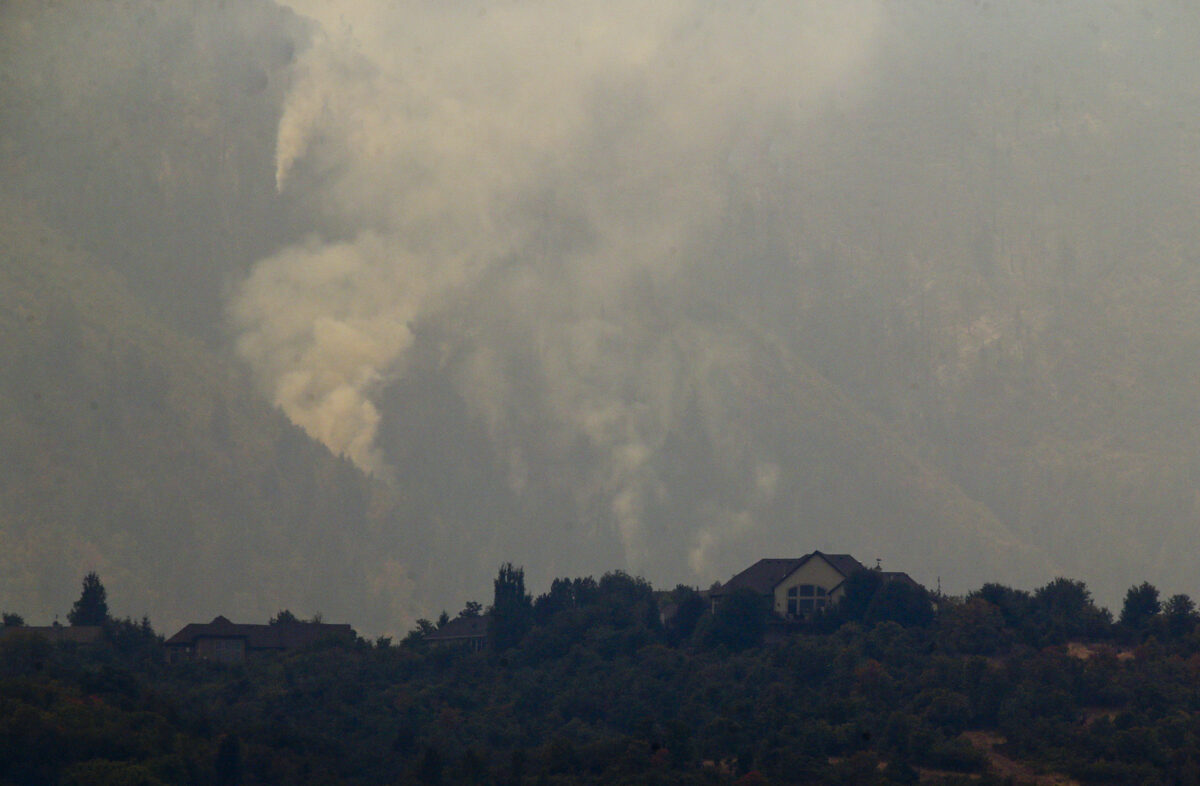
Smoke rises from the mountainside behind homes in Woodland Hills as the Pole Creek and Bald Mountain fires burn Saturday, Sept. 15, 2018. Isaac Hale, Daily Herald

Levi Mangone, 13, holds bags of items as his mother, Naomi Fox, both of Woodland Hills, checks out a shirt at a donation center set up at 161 E. 400 N. in response to the Pole Creek and Bald Mountain fires Saturday, Sept. 15, 2018, in Salem. Isaac Hale, Daily Herald
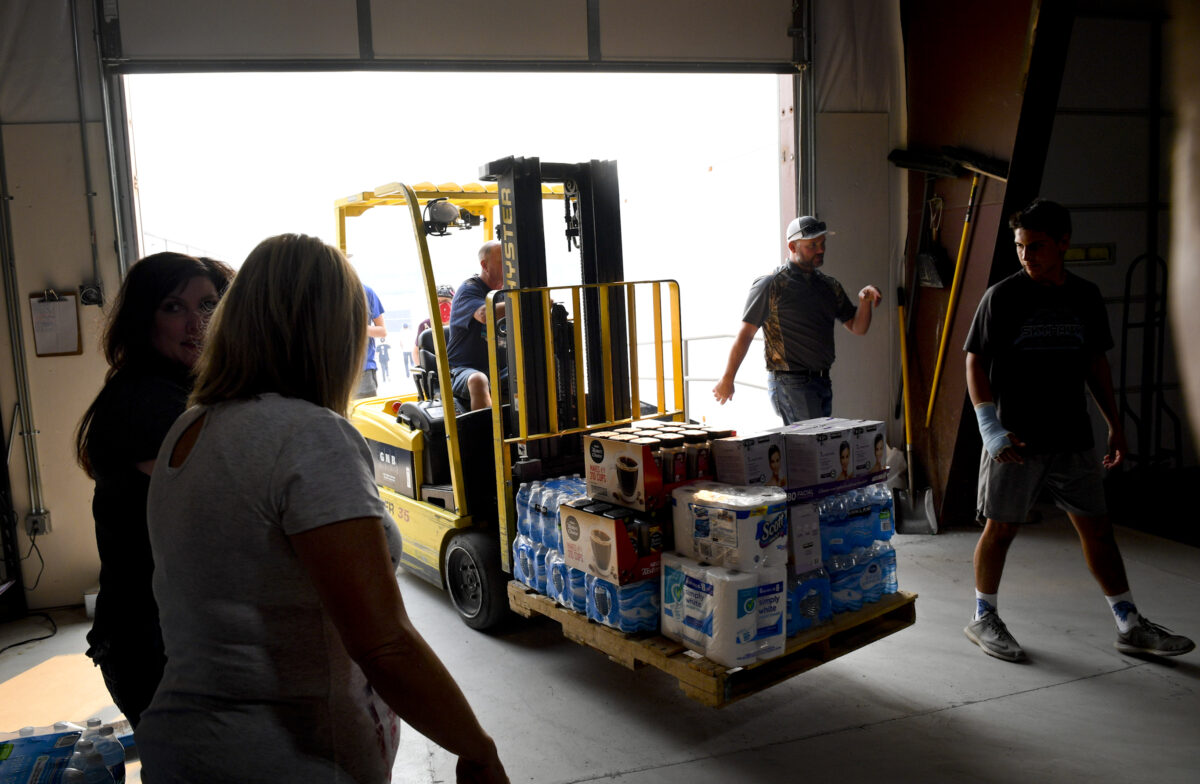
Donated items make their way into a donation center set up at 161 E. 400 N. in response to the Pole Creek and Bald Mountain fires Saturday, Sept. 15, 2018, in Salem. Isaac Hale, Daily Herald

Austen Carrick, 17, of the Salem Hills High School football team, loads donated goods with other football players and members of the school's student government into an evacuated family's vehicle at a donation center set up at 161 E. 400 N. in response to the Pole Creek and Bald Mountain fires Saturday, Sept. 15, 2018, in Salem. Isaac Hale, Daily Herald

Harry Schwenke, second from left, Salem Hills High School football head coach, waits with his players to assist evacuated families pick out items at a donation center set up at 161 E. 400 N. in response to the Pole Creek and Bald Mountain fires Saturday, Sept. 15, 2018, in Salem. Isaac Hale, Daily Herald
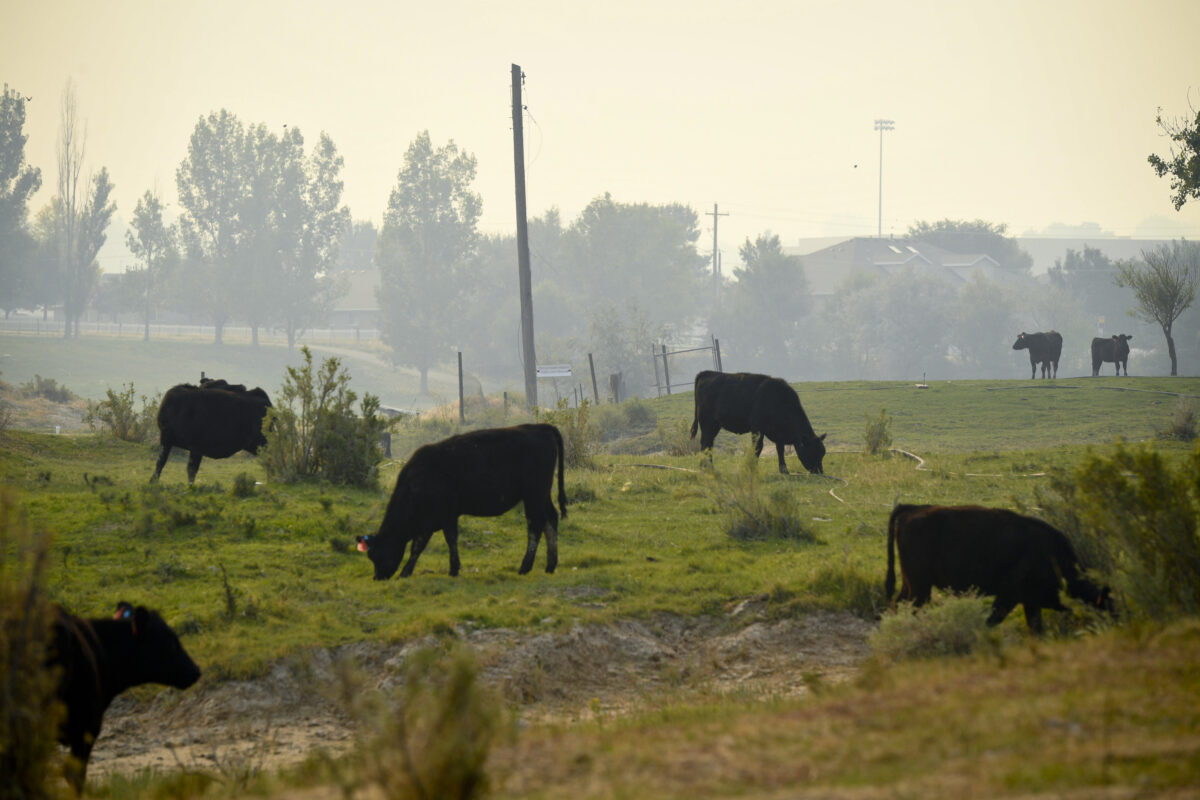
Cows graze in a pasture in Salem as smoke from the Pole Creek and Bald Mountain fires rests in the valley Saturday, Sept. 15, 2018. Isaac Hale, Daily Herald
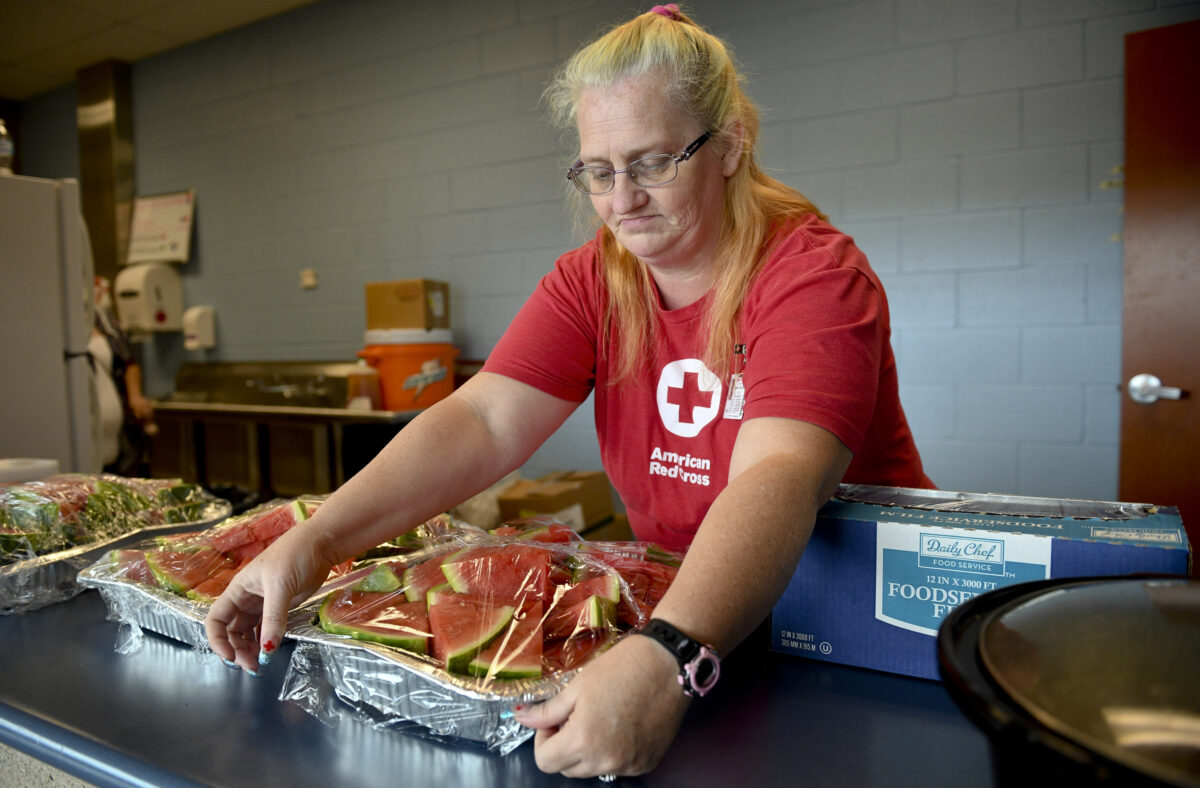
Sherene Demings, a volunteer with the American Red Cross, prepares watermelon to serve to evacuees at a shelter set up at Salem Hills High School in response to the Pole Creek and Bald Mountain fires Saturday, Sept. 15, 2018. Isaac Hale, Daily Herald
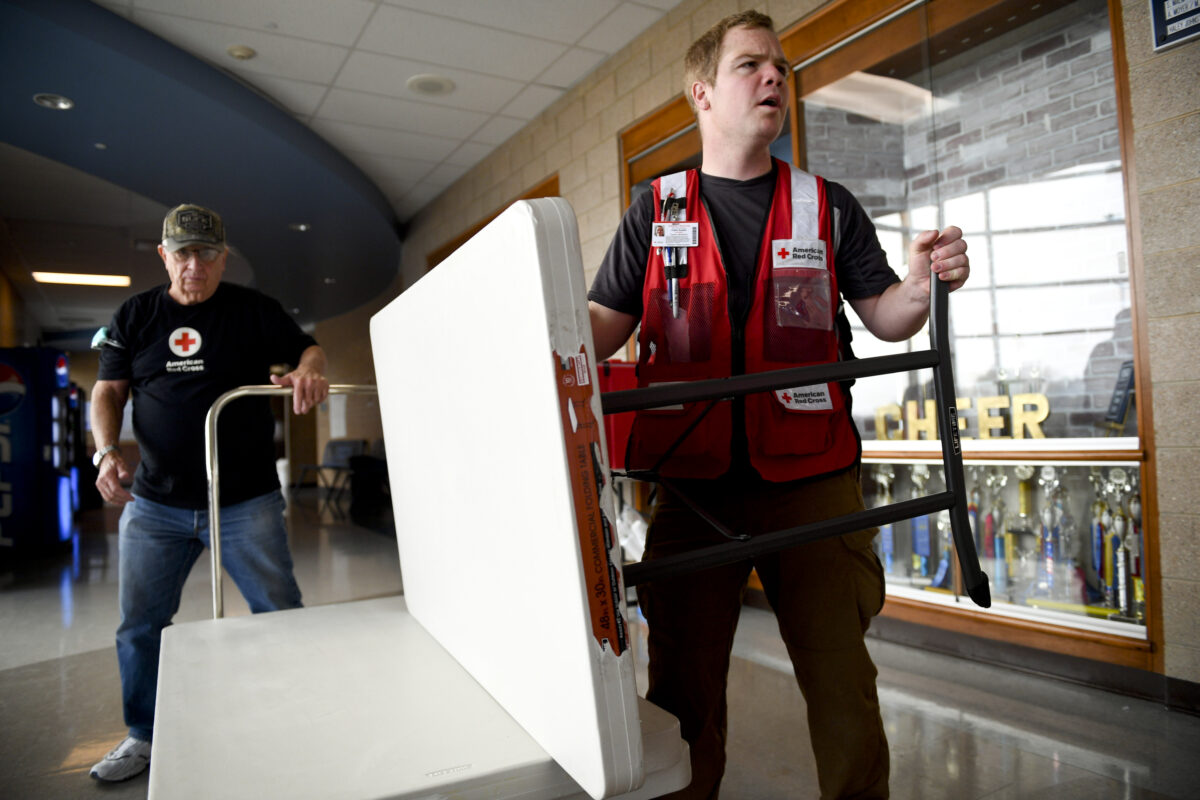
Austin Clark, a volunteer with the American Red Cross, sets up a table to serve food to evacuees at a shelter set up at Salem Hills High School in response to the Pole Creek and Bald Mountain fires Saturday, Sept. 15, 2018. Isaac Hale, Daily Herald

Dennis Roberts, a volunteer with the American Red Cross, serves food to evacuees at a shelter set up at Salem Hills High School in response to the Pole Creek and Bald Mountain fires Saturday, Sept. 15, 2018. Isaac Hale, Daily Herald
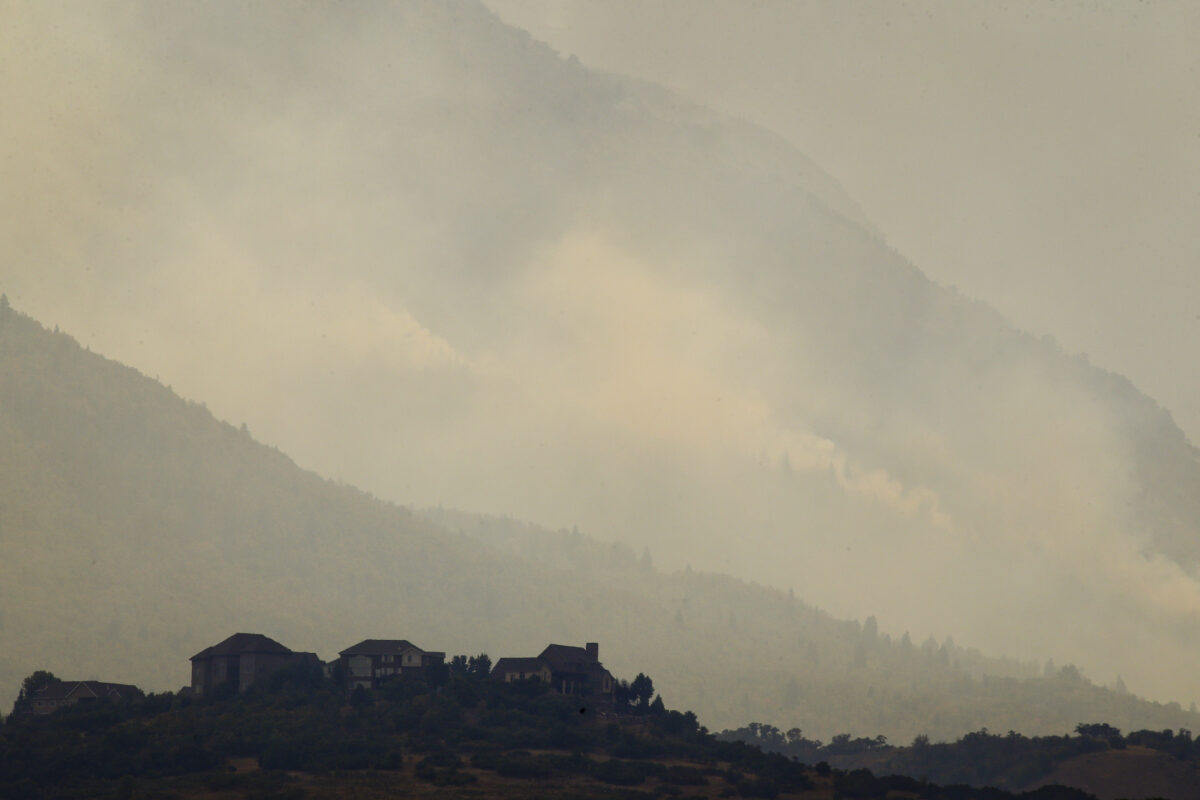
Smoke rises from the mountainside behind homes in Elk Ridge as the Pole Creek and Bald Mountain fires burn Saturday, Sept. 15, 2018. Isaac Hale, Daily Herald
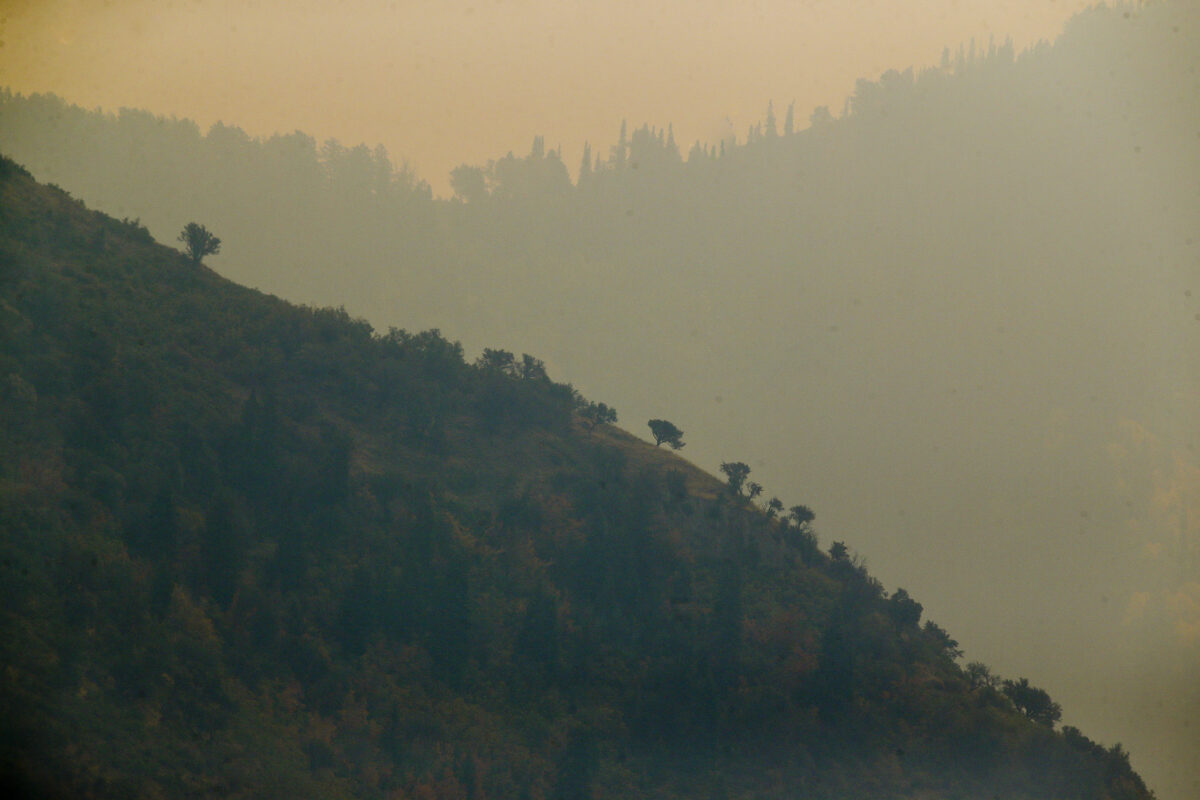
Tress line mountain ridges as smoke from the Pole Creek and Bald Mountain fires clouds the air Saturday, Sept. 15, 2018, near Woodland Hills. Isaac Hale, Daily Herald

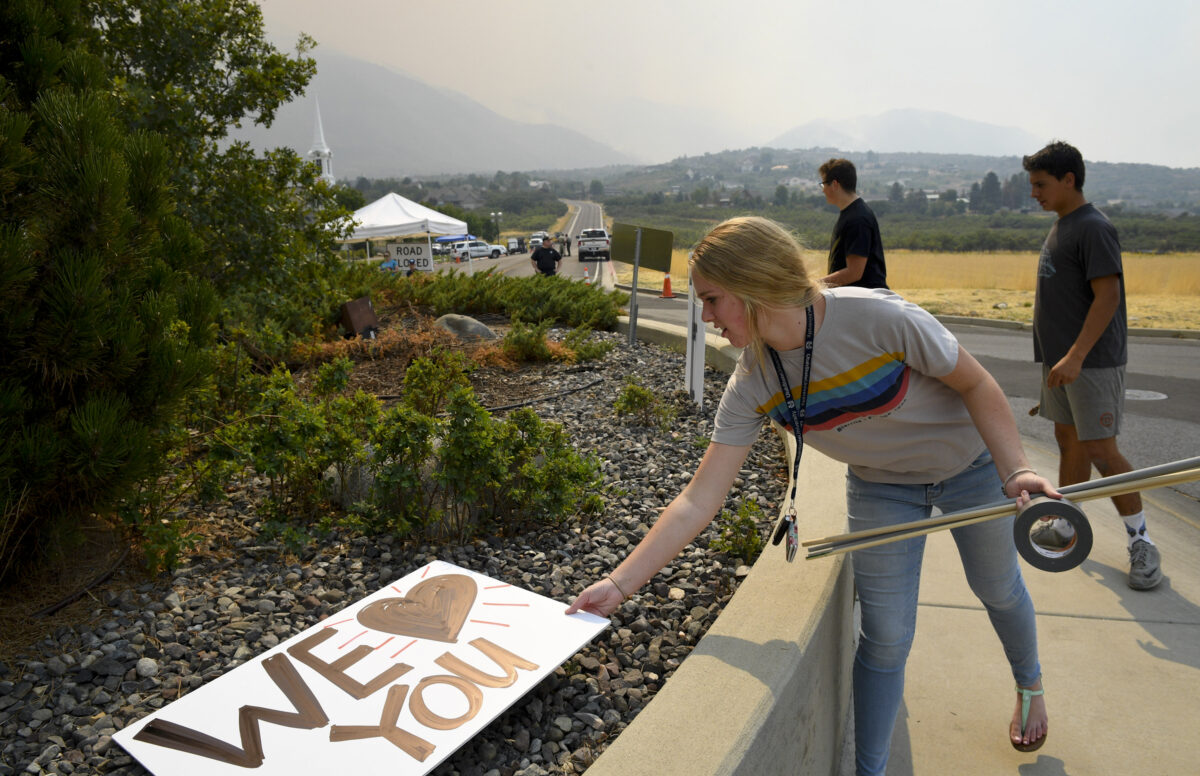
Tara Tuckett, a member of Salem Hills High School student government, is joined by fellow student leaders Isaac Barnum, right, and Zane Zobell as they set up supportive signs for those fighting the Pole Creek and Bald Mountain fires Saturday, Sept. 15, 2018, at the roundabout in Woodland Hills. Isaac Hale, Daily Herald
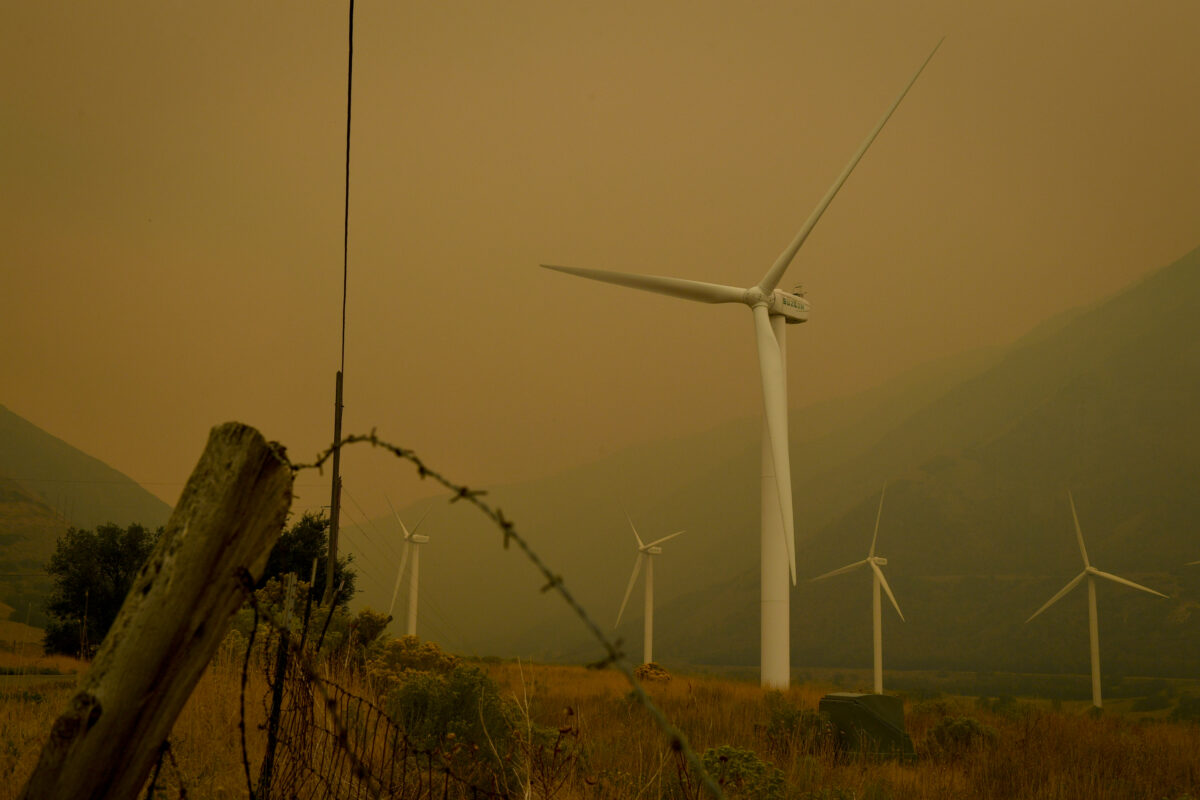
Wind turbines remain stationary as smoke from the Pole Creek and Bald Mountain fires clouds the air Saturday, Sept. 15, 2018, at the mouth of Spanish Fork Canyon. Isaac Hale, Daily Herald

A firefighting helicopter flies toward the Pole Creek and Bald Mountain fires Saturday, Sept. 15, 2018, near Elk Ridge. Isaac Hale, Daily Herald
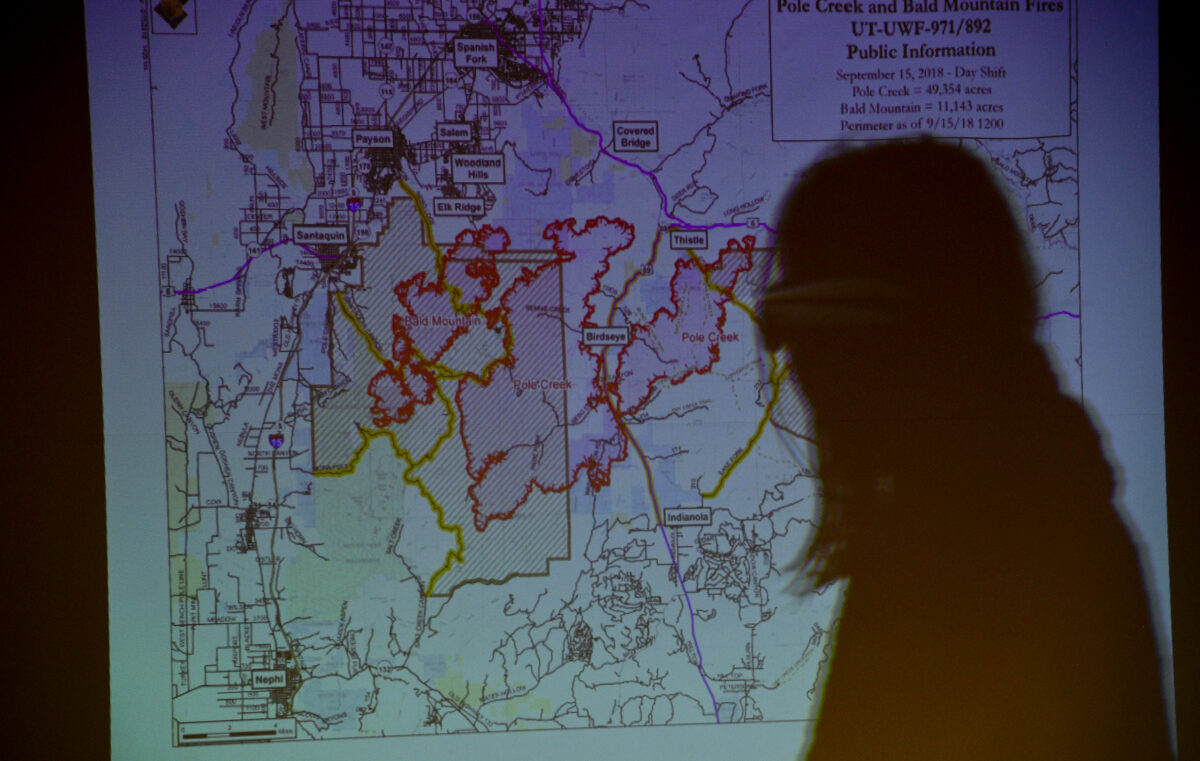
A community member passes in front of a projected map of the Pole Creek and Bald Mountain fires during a community meeting Saturday, Sept. 15, 2018, at Salem Hills High School. Isaac Hale, Daily Herald
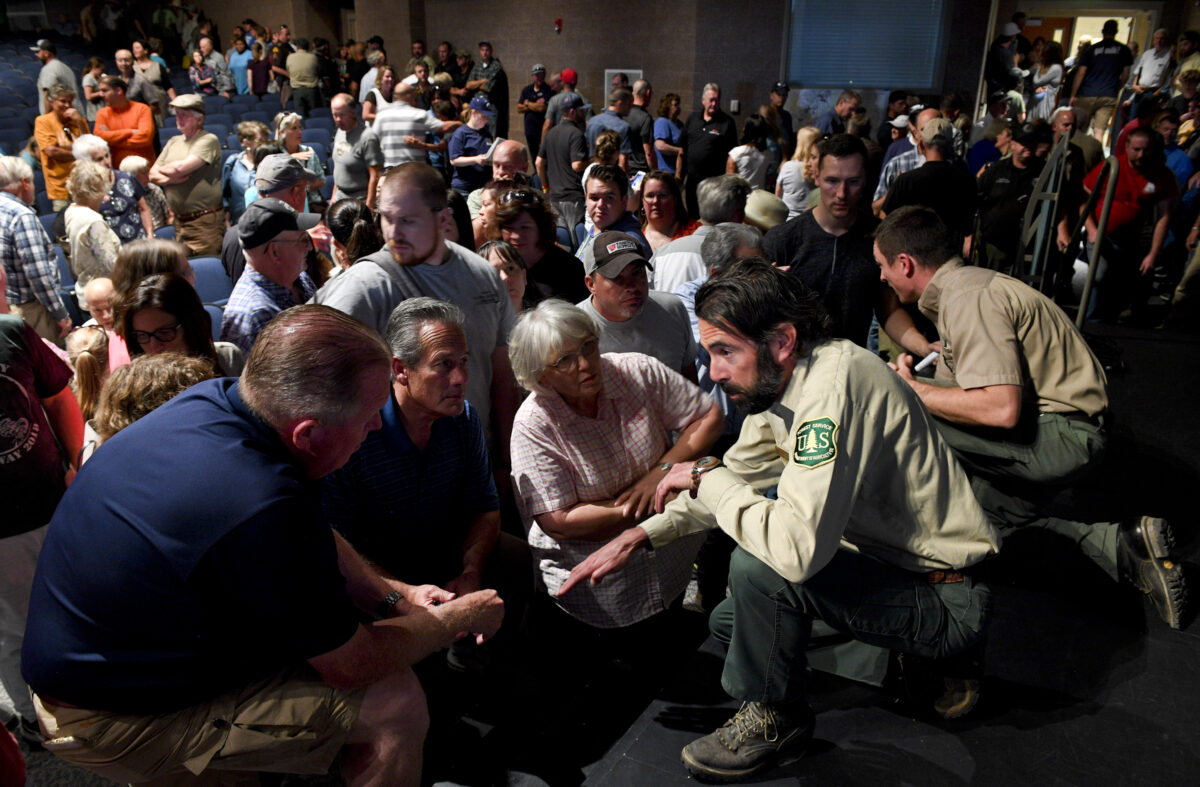
U.S. Forest Service officials answer questions from community members after a public meeting concerning the Pole Creek and Bald Mountain fires Saturday, Sept. 15, 2018, at Salem Hills High School. Isaac Hale, Daily Herald
The Pole Creek and Bald Mountain fires continued to grow Saturday, with the fire boundaries moving within about a half-mile of some residences in Elk Ridge and Woodland Hills by the evening.
The fires were mapped more accurately than previously, and according to Utah Gov. Gary Herbert, the two fires are mapped at 60,000 acres combined, as opposed to 70,000+ estimates from earlier in the day.
The fires had not yet combined by early Saturday afternoon, Herbert said after flying over both fires in a Black Hawk helicopter.
Utah County Commissioner Bill Lee announced Saturday morning that a state of emergency had been declared by Utah County, and that a written declaration had been given to Herbert.
“The Vice Chair of the Utah County Commissioners has declared a state of emergency on the behalf of Utah County and will execute for and on behalf of Utah County, the expenditure of emergency funds from all available sources, the invoking of mutual aid agreements, and the requesting assistance from the State,” the declaration says.
Herbert said Utah County’s declaration of emergency will not affect the way the state responds, but should help get more federal funding when it’s time to “pay the bills.”
More than 550 personnel are currently working the fires, with 80 percent of those concentrated at the northern end of the fires near the population base, Herbert said.
Several more firefighting crews have been ordered, Herbert said, and about 240 more personnel are expected to arrive in the next 24 hours.
No structures had been lost as of Saturday afternoon, including at the Maple Dell Scout Camp, incident commander Marty Adell said. Contingency lines are also being built close to affected communities.
Fire officials met with community members Saturday evening, and said that the fire had moved within about a half-mile of residences in the Elk Ridge and Woodland Hills areas.
Officials also informed residents that the efforts to fight the two fires were hampered by strong winds keeping aircraft out of the sky Saturday afternoon and by rugged terrain that keeps firefighters from getting to close to certain areas of the fire line.
On the east, the Pole Creek Fire is bumping up in places against the recent Coal Hollow burn scar, and firefighters are utilizing that to keep the fire from spreading further east.
Firefighters continue to draw lines to keep the fires away from residences and other infrastructure, and will continue a similar line of defense until winds die down and they can take the “fight closer to the fire.”
Adell said once the fire hit the ridges in some areas, the wind kept it in check and put it in a “holding pattern” so it didn’t travel down the other side of the ridge.
Adell said he was apprehensive about giving a date to evacuees for when they can return to their homes.
The firefighters have great plans to keep the fire at bay, Adell said, but don’t want to put any residents in harm’s way by having them return too early.
Adell assured the attendees of the community meeting that the fire is being watched and monitored closely at every moment.
Earlier in the day, Herbert said fire lines have been created between the fire and homes, and local fire engines are waiting to put out any fires should the fire break through the lines.
“We have I think reason to be hopeful,” Herbert said. “I feel better today than I did last night. I feel better tonight because I think we have a good plan in place.”
Frustration over early handling of the fire
Lee said at a press conference Saturday morning that he hopes the state of emergency declaration brings awareness that the county is in need of help, but also said that federal policies need to be looked at in regard to how this fire has been handled.
If an individual starts a wildfire, they are held accountable, Lee said, but federal entities knew that this fire was burning and didn’t put it out before it grew into a crisis.
“They knew this fire was up there,” Lee said. “It was lightning strikes, but nevertheless that fire was supposed to be contained and controlled. They let it smolder around for weeks before it just blew up into this. Where’s the accountability? We’re going to have to have those conversations after this is over with.”
At Saturday evening’s community meeting, some audience members expressed frustration at what they saw as a lack of effort by the U.S. Forest Service to put the fires out before they got out of control.
Dave Whittekiend, the Uinta-Wasatch-Cache National forest supervisor, said the Bald Mountain Fire started with just a single tree.
“We got rain the day before, it was a single tree, and we were assessing firefighter risk,” Whittekiend said. “That fire sat for a number of days, we were monitoring it, we had people paying attention to it, it didn’t move.”
Then Pole Creek started, and the Forest Service focused on that one.
“We had firefighters out there, we had 70 people on that fire when it started to move. We didn’t just sit back, we were building line, we were trying to assess the right place to put the line, the safest place to put the line, but we didn’t just let it burn.”
When the fire took off, though, it outflanked the firefighters, Whittekiend said.
“It went around the line, and it spotted over the line. They were trying to chase it, they did their best. They brought in air resources, we were trying to slow that fire down as it outstripped the firefighters.”
Not thinking Bald Mountain would move after having sat in one place for days, Whittekiend said the Forest Service managed it as they do many other small fires throughout the forest every summer.
“I realize this doesn’t give anybody any comfort,” Whittekiend said. “But we have been successful doing the exact same things throughout the entire forest.”
When asked about comments made earlier in the day by Lee about the federal government’s “crime” of not putting the fire out earlier, Herbert said he didn’t want to point fingers.
“There will be a time to be very analytical about this,” Herbert said. “We will learn a lot. Mistakes may have been made, and we’ll learn from those mistakes. And certainly everybody agrees there’s room for improvement. But this is not the time to be pointing fingers about, it’s your fault, it’s your fault. This is the time for us to unite together and put out the fire.”
New pre-evacuation area added
Diamond Fork Canyon joined other areas under pre-evacuation advisories, according to Sgt. Spencer Cannon with the Utah County Sheriff’s Office.
All other mandatory evacuations and pre-evacuation advisories from previous days remained in place Saturday.
Elk Ridge, Woodland Hills and the Covered Bridge area in Spanish Fork Canyon are still under mandatory evacuation. Parts of Spanish Fork, Payson and Salem, and now Diamond Fork Canyon are under pre-evacuation advisories.
Cannon said the UCSO has been working with evacuees who need to go back to their homes for important items like medications, but that it’s critical for people to respect all evacuation and road closures at this time.
Closures
Eastbound lanes of U.S. Highway 6 were closed at the mouth of Spanish Fork Canyon on Saturday afternoon, according to the Utah Department of Transportation. As of Saturday night, that closure remained in place.
U.S. Highway 89 remains closed from the U.S. Highway 6 junction to the Utah-Sanpete County line. U.S. 6 was closed Thursday night, but was reopened by Friday morning.
Both Payson and Santaquin canyons are closed, and the Nebo Loop Road in Nephi Canyon is closed.
Air quality poor
Utah County Health Director Ralph Clegg also said at a Saturday morning press conference that an advisory for people to stay inside if they can is still in place because the smoke and particulate matter in the air is unhealthy to breathe.
This particularly applies to those with sensitive health conditions or are very young or very old.
The Utah Department of Environmental Quality said that Utah County was listed in the “unhealthy” range throughout the day Saturday.
Donations neededfor evacuees
The Red Cross announced Saturday that they are still collecting needed donations and providing meals for evacuees throughout the day.
An evacuation center has been set up at Salem Hills High School at 150 Skyhawk Blvd. in Salem, where evacuees can get information, snacks, refreshments and other resources.
Lunch is being provided from 11:30 a.m. to 1 p.m. and dinner will be available from 5:30 to 7 p.m.
Evacuees can also use space in the parking lot for self-sufficient campers, trailers and RVs. Evacuees have access to bathrooms 24 hours a day.
Donations for evacuees can be taken to the Nebo School District Central Warehouse at 161 E. 400 North in Salem between the hours of 8 a.m and 8 p.m.
At this point, the Red Cross says the needed donations are:
- Nonperishable food that is unopened, not damaged and not expired.
- New, unused, non-expired toiletries, new diapers and other new baby supplies.
- Unopened pet food and clean kennels.
- Clean, unstained towels that are not torn.
Financial donations are also accepted.
They cannot accept torn, stained or odorous clothing; homemade food of any kind; expired, damaged or open non-perishable food; perishable food of any kind; housewares, furniture or other large items; and open, used or expired toiletries.
According to Adell, the firefighters working on the fire have sufficient supplies at this point, and donations should be directed toward evacuees.