Appeals court hears arguments in libel suit filed by former Utah County commissioner

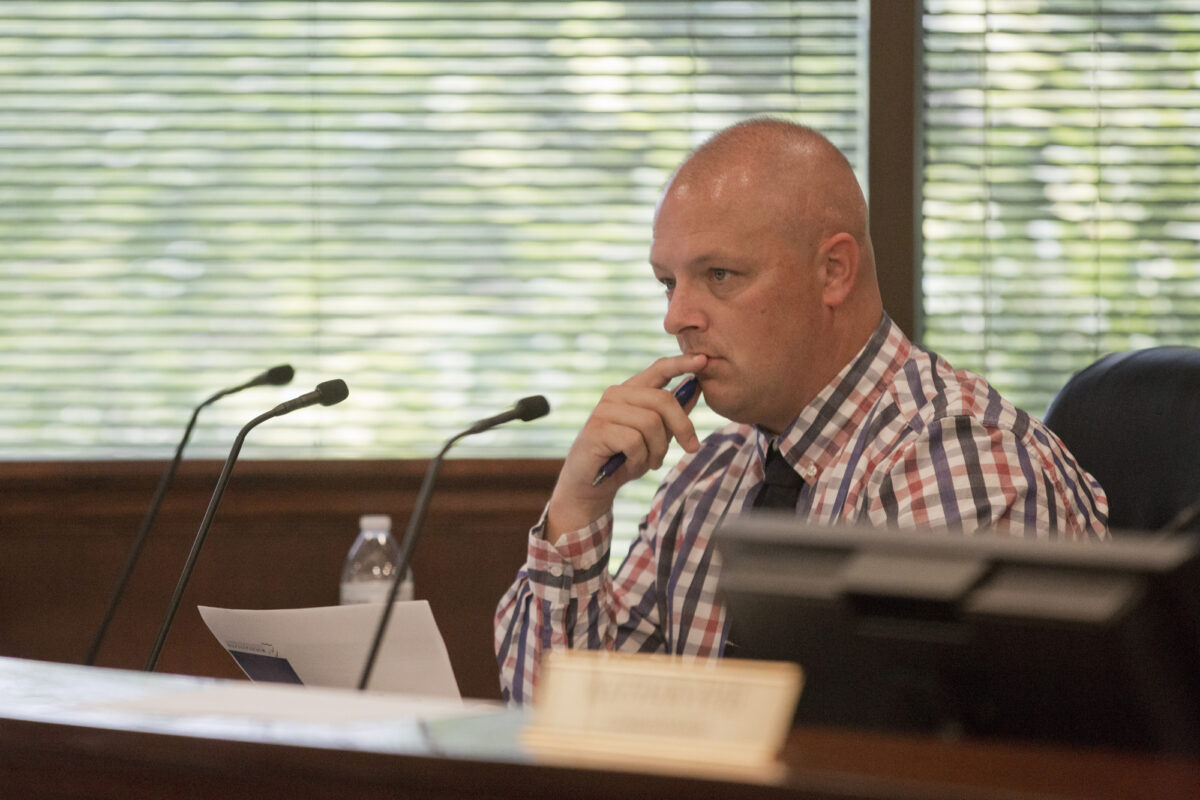
In this file photo, Utah County Commissioner Greg Graves listens to Andrew Jackson, a trustee for UTA, during the commission meeting at the Utah County Administration Building on Tuesday, July 31, 2018, in Provo.
The Utah Court of Appeals heard oral arguments on Friday in a tossed libel lawsuit filed by former Utah County Commissioner Greg Graves against his former colleagues and a Utah County employee who accused him of sexual harassment.
Graves was accused of sexual harassment by a female Utah County employee in 2017. While a third-party investigation was unable to confirm the sexual harassment allegations, it found that “based on statements from nearly all of the witnesses … (Graves) is widely viewed as a workplace ‘bully,’ ‘dishonest,’ ‘demeaning,’ ‘intimidating,’ ‘threatening,’ ‘explosive,’ and someone with whom personal interaction is to be avoided as much as possible.”
On Dec. 6, 2017, commissioners Bill Lee and Nathan Ivie held a GRAMA appeal hearing, which Graves was not present at, and voted to release redacted documents related to the harassment complaint and subsequent investigation. The redacted documents removed all personal identification and names.
After the appeal hearing, Ivie stated that the report was about Graves and called for Graves to resign on Facebook.
Graves filed a libel lawsuit against Lee, Ivie and the woman who made the complaint in June 2019, arguing that “Commissioners Ivie and Lee knew or should have known that releasing the complaints against Graves without simultaneously releasing the investigation report would portray Graves in a false light in that people would falsely believe he was guilty of sexual harassment.”
The lawsuit argued that Graves’ reputation was “irreparably damaged,” including that he “has been unable to obtain meaningful employment because of the damage done to his reputation” and his children “were bullied in school.”
It further argued that the woman who made the complaint “published false statements with the intent of putting pressure on the County to not terminate her employment and/or enter a settlement with her because she was worried she would lose her job.”
Fourth District Judge Robert Lunnen dismissed the lawsuit with prejudice in its entirety in early 2020, writing that “the statements at issue do not constitute actionable defamation as a matter of law owing to the public nature of the suit, which involves a public official.”
Graves appealed the ruling and, in April 2020, the case was assigned to the Utah Court of Appeals.
During a virtual hearing on Friday, Ryan Schriever, a Spanish Fork attorney representing Graves, argued that Lee and Ivie “acted with intentional malice” by letting news outlets and public know that Graves was the subject of the investigation, adding that “they did so to harm him and his political career.”
The attorney further said that there had already been discussion among the commissioners “about trying to force Mr. Graves out of his job before the investigation was even completed.”
But Judge Jill Pohlman pushed back against that argument and noted that “acting with ill will or wanting to hurt him is not what malice is defined (as).”
“It’s what we think of as malice oftentimes, but it’s obviously not how malice is defined,” said Pohlman.
The U.S. Supreme Court has defined actual malice as making a statement “with knowledge that it was false or with reckless disregard of whether it was false or not.”
Schriever pointed out that the sexual harassment claims against Graves were “determined to be unsubstantiated,” at which point Judge Michele Christiansen Forster stated that “unsubstantiated doesn’t equate with false.”
“I agree with you it does not mean false,” Schriever said. “But it also does not mean true. Unsubstantiated means we have a reason to doubt its veracity.”
Forster replied, “I don’t think that’s a fair characterization of the investigative report. He (the investigator) concluded that her claims were unsubstantiated because he couldn’t find any third party witnesses that were present during a time when any of the allegations allegedly took place. So I’m not sure that I agree with your characterization that unsubstantiated meant untrue.”
Andrew Roth, an attorney for Lee, Ivie and the woman who filed the harassment complaint, argued that Graves’ “name was out there and in association with the complaint” before the commissioners disclosed that he was the subject of the complaint. He pointed out that media outlets, including the Daily Herald, filed public records requests specifically for a complaint involving Graves.
“Even if they redacted his name, they could not logically disclose the report in response to those requests about him and at the same time want to keep his name private and away from public view,” argued Roth. “By disclosing the report, they had obviously already made the determination that the public should know, because the public had requested it.”
Roth further argued that it was not defamatory for the woman who filed the complaint to tip off news publications about it.
“To my mind, that does not equate to (being) defamatory, pointing somebody to the fact that you filed a complaint,” the attorney said, even if “the complaint itself may contain defamatory information.”
Forster said the three appeals court judges would take the case under advisement “and render a written decision as soon as possible, as soon as we can.”
In order to win a libel lawsuit, a plaintiff must show that a false statement was made purporting to be fact, the statement was published, the statement identified the plaintiff and the statement harmed the plaintiff’s reputation.
Graves’ lawsuit names the female Utah County employee who filed the sexual harassment claim. It is the Daily Herald’s editorial policy to not name alleged victims of sexual harassment or abuse.
Graves is one of four Republicans running for Utah County Clerk/Auditor.