
UVU receives grant to bolster accelerated Russian language program
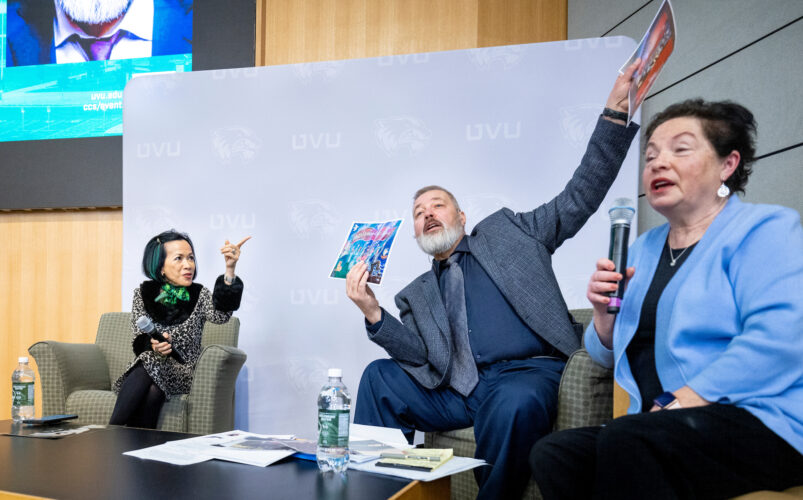
Courtesy Kennedy Evans, UVU Marketing
Dmitry Muratov, a Russian journalist and Noble Peace Prize winner, speaks at Utah Valley University on Friday, Feb. 24, 2023.A grant from the U.S. Russia Foundation will help bolster Utah Valley University’s accelerated Russian language program, which aims to prepare students to enter the workforce with language skills and knowledge of the current geopolitical climate of Eastern Europe.
The Washington, D.C.-based nonprofit gave UVU $220,582 that will be used to expand the accelerated language program through providing scholarships to students and creating diplomatic opportunities.
The foundation originally gave UVU a grant in 2022 to help start its program, which doubles the curriculum students learn in a semester so they can speak Russian at a high level by the time they graduate, according to professor Frederick White.
The first two-year grant was worth $167,225 and applied to the 2022-23 school year, when the school built the course curriculum, and the 2023-24 school year, when the first cohort of 18 students started the program.
The UVU administration provided money for scholarships to keep the program running through the current school year, and a second cohort was added this fall. The new grant will be used for the 2025-26 and 2026-27 school years, with two more cohorts added.
White, a professor in Russian and integrated studies who is in charge of the program, said it took some convincing to get the second grant.
“We knew that we wanted to get another grant so that we could continue offering the accelerated Russian language program. But when I talked to the people at USRF, they said, ‘You can’t just turn in a grant for the exact same thing you’ve already done.’ And I said, ‘OK, fair enough,'” White said.
Because the Russian landscape had changed due to the war in Ukraine, White already was working with the national security studies and homeland security studies programs at UVU to convince those students to take the accelerated Russian program. He also knew UVU had a strong relationship with the United Nations, so his new proposal to the U.S. Russia Foundation was to send the program’s students to a U.N. meeting to meet with Russian-speaking diplomats.
White submitted the new grant proposal, which included scholarships and the U.N. trip, and heard back from a foundation representative that they wanted to fund schools that were focused on pro-democracy efforts among the Russian diaspora.
“So I said, ‘Oh, we can do that too. We’ll just have a speaker series,'” White said.
The grant application was approved. Beyond the scholarships, the grant provides money for White’s students to visit the U.N. in New York City in the spring of 2026 and the spring of 2027 to meet with Russian-speaking representatives and for four different speakers to come to UVU to discuss democracy and civil society in Russia across four semesters.
White believes the timing of the first and second grant — and the development of the accelerated program — has come at a pivotal time in Russian studies due to the war in Ukraine.
He said while other universities are still reliant on an old model of teaching that prepares kids to travel directly to or do business with Russia, UVU’s module has adapted to the times.
“We took a hard pivot, and we just said, where are the jobs? The jobs are now in the State Department. They’re in the federal government. They’re in the security services: CIA, FBI, NSA. These are the jobs we’re going to prepare our students for,” he said.
White said the program also has been noticed by local cyber security companies.
“We just had (Strider Technologies) in just the other day, and they said, ‘We don’t just want kids that can do cyber. We want cyber and Russian.’ And I’m like, ‘We can do that,'” White said.
The first group of students who will receive scholarships to start the course next fall will be recruited during the upcoming spring semester.
Local News
Public scrutiny: Alleged Charlie Kirk shooter Tyler Robinson makes first in-person appearance in Provo court

Putting the ‘house’ in firehouse: New Orem fire station in Vineyard built like a residential home
