Utah homeless leaders look to focus funding on ‘high utilizers’ while not ‘backing away’ from campus
Interim homeless coordinator says the governor’s office is asking legislators to fund programs to help address repeat arrestees and returning shelter users while continuing multiyear effort to fund future homeless campus
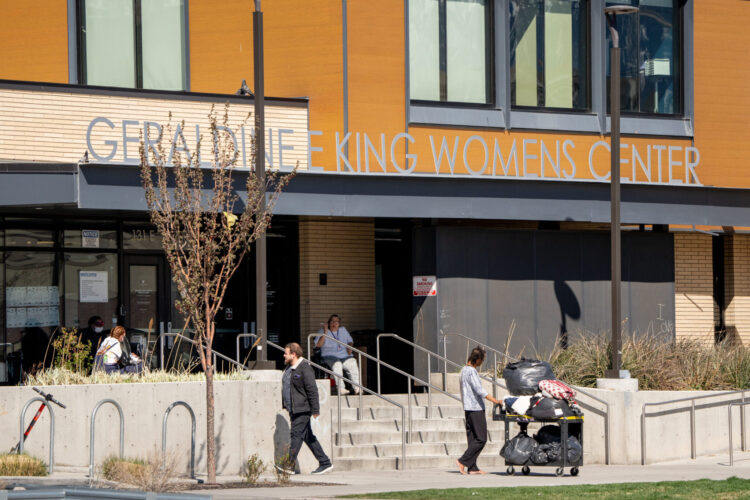
Photo by Spenser Heaps for Utah News Dispatch
People congregate around the Geraldine E. King Women’s Center in Salt Lake City on Wednesday, March 26, 2025.A top Utah homeless leader in Gov. Spencer Cox’s administration has shed light on more details surrounding the governor’s funding requests to the Utah Legislature for homelessness this year.
While a controversial 1,300-bed homeless campus currently proposed for a 16-acre property in northwest Salt Lake City has captured a lot of attention both locally and nationally, leaders of the Utah Office of Homeless Services say they’re focusing on asking lawmakers this year to fund new programs — within existing state facilities or local providers — aimed at targeting “high utilizers” of the state’s criminal justice and homeless systems.
That’s according to Nick Coleman, who is currently serving as the state’s interim homeless coordinator until Rep. Tyler Clancy, R-Provo, takes the helm in March after serving his last session as a legislator.
Coleman said state leaders aren’t abandoning efforts around the “transformative” homeless campus. But rather, by focusing first on funding these “high utilizer” programs, they’re hoping what they learn could potentially help inform programming and operations for the future homeless campus.
“We know that any sort of transformative program that we want to create in the future, high utilizers have to be a major part of that,” Coleman said.
While Coleman said his office is still seeking funding for the homeless campus, he expects that effort to take multiple years before the campus would become a reality, but in the meantime, state leaders want to act now to “get a program started.”
Meanwhile, the Office of Homeless Services still hasn’t officially purchased the land for the campus. Coleman said in addition to focusing funding for high-utilizers, his office is “simultaneously pursuing closure of the land,” which hasn’t been finalized in the months since state leaders announced in September they were under contract to buy the Salt Lake City-owned parcel.
He said state leaders are working with city officials to “make sure we’re meeting the threshold of highest and best use of the property” before closing on the land deal.
But Coleman said state officials are working on more than just where to put the future campus.
“We have become so focused on the where, especially on this parcel, that we have lost almost complete track of the what,” he said. “If we say what it is — which a key foundational pillar of it will be a high-utilizer program — then we are in effect not abandoning the campus. We are just getting started as soon as we can on a key element of it.”
By focusing on “high utilizers” first, Coleman said state officials are hoping to make the argument for more future investment from lawmakers.
“We’re saying, ‘What’s an underutilized space or program that might be able to accommodate some of this population,’ show proof of concept, show outcomes, and then come back to the Legislature and say, ‘Hey this is working really well, we feel like it could be even a bigger part (of the system),” he said.
Or, he said it’s possible that “we’ve nailed the consistency on the size of the program, that we don’t need to move forward on something else.”
In the meantime, Coleman said his office is also seeking funding to expand capacity for shelter and supportive housing, as well as mental health treatment within the state’s existing system.
3 pillars to governor’s homeless strategy
The proposals are framed under three “pillars” guiding the Cox administration’s homeless strategy, he said. Those pillars are:
- Create accountability for “high utilizers” by breaking the cycle of repeated jail, emergency room and shelter use. Their goal is to identify people who are most often cycling through and create “pathways” to link “accountability with treatment,” and reduce repeated arrests.
- Expand emergency shelter and supportive housing by ensuring “immediate, on-demand shelter as an alternative to the street,” improving flow from shelter to treatment, housing or recovery programs, continuing to create secure, drug-free environments supportive for recovery, and “providing active programming with engagement and wrap-around supports.”
- Expand mental and behavioral health capacity by building a “stronger, more accessible mental and behavioral health system.” Their goal is to expand treatment capacity across the system, reduce reliance on emergency rooms and jails as default treatment settings, strengthen Utah’s behavioral health workforce, and support tools to case manage people across the system and providers.
Cox, in his budget recommendation to lawmakers last month, proposed using $25 million in one-time money for capital development and $20 million in ongoing funding for “homelessness and criminal justice utilizers” as part of the campus proposal.
The hope is that a portion of that request this year, Coleman said, would fund “high utilizer” programs, but it’s not yet clear how much. A specific number is still being hashed out with lawmakers, he said.
For emergency shelter and supportive housing, the governor has also proposed $5 million in one-time money to add about 34 cottage homes to The Other Side Village, a tiny home community for the chronically homeless in Salt Lake City. Coleman said there are other proposals state officials are exploring that wouldn’t cost additional money, but he said more details on those are forthcoming.
And for mental and behavioral health capacity, Coleman pointed to efforts in Salt Lake County, which has explored a form of “diversionary justice” known as the Miami model that “allows individuals who are on their path towards incarceration, experiencing homelessness and mental illness and substance abuse disorder to receive a higher order of care in a structured environment,” he said, such as “boarding homes.”
“We believe this is one model we could potentially implement or help fund and sustain,” Coleman said, noting that it could also be funded using state Medicaid match dollars.
Not ‘backing away’ from a campus
It’s still possible that Utah lawmakers could decide to at least partially fund the homeless campus this year. But Senate Budget Chair Jerry Stevenson, R-Layton, told reporters this week that it’s “too early” to say whether lawmakers have the appetite to put money aside this year specifically for the campus proposal in addition to requests for “high utilizer” programs.
“Hold that thought,” Stevenson told reporters on Tuesday when asked whether lawmakers will be prioritizing funding for the homeless campus this year.
New funding requests usually don’t get publicly prioritized until the final days of the 45-day session scheduled to end March 6.
But one of the Utah Legislature’s most powerful lawmakers, Senate President Stuart Adams, R-Layton, also told reporters the campus proposal is still a priority.
“I don’t see us backing away from a campus,” Adams said. “But I think we’re going to continue to try (to tackle homelessness issues). And right now, probably the quickest way is the high-volume users.”
So what’s the idea behind these “high utilizer” programs, and what would those new programs entail?
‘High utilizers’
While presenting their budget requests in front of the Economic and Community Development Appropriations Subcommittee last week, Coleman and interim assistant state coordinator Nate Meinzer — a former Salt Lake City Police Department sergeant — painted a picture with arrest data.
In Salt Lake City, 971 people were arrested an average of 11 times last year at a minimum of four times, Salt Lake City Police Department data shows. Of those:
- 334 were arrested four times
- 202 were arrested five times
- 133 were arrested six times
- 99 were arrested seven times
- 56 were arrested eight times
- 49 were arrested nine times
- 40 were arrested 10 times
- 26 were arrested 11 times
- 13 were arrested 12 times
- 19 were arrested 13 times
“Now, I’ll be honest and contend that not all individuals who fall into this chart, in this list, are homeless at any given time,” Coleman said. “But if you’re being arrested on average 11 times a year, I would ask you to consider, is that a very stable pattern of life? I would say it’s probably not.”
That population, Coleman said, “is who the governor has asked our team, myself, and Rep. Clancy and others to consider, ‘How do we intervene into this pattern of lifestyle?'”
That 971 number doesn’t include 50 of Salt Lake City’s most-arrested people that the Salt Lake City Police Department is already looking to address through an effort called Project CONNECT, what city officials have called a “cross-agency initiative to divert high utilizers of the justice system into treatment to relieve strain on resources.”
Salt Lake City Mayor Erin Mendenhall highlighted the program in her State of the City address, when she said one man who had more than 100 jail bookings on his record is now living in the city’s microshelter community, The Salt Lake Tribune reported.
When combining Salt Lake City’s top 50 most-arrested people and the 971 people who have been arrested at least four times, those 1,021 people made up 43% of all of Salt Lake City’s arrests last year, Meinzer said. They collectively accounted for thousands of police work hours, he said.
Coleman made the case that if state officials could work with cities across the state to create programs aimed at rehabilitating those most-arrested individuals, “investment into high utilizers will be felt across systems across the state” to help relieve police and jails, as well as help people “flow” through the state’s homeless system without repeatedly returning.
“We don’t have to change any laws to hold people accountable who have been arrested 11 times a year and are on their way to homelessness,” Coleman said. “We can intervene.”
Clancy, in an interview with Utah News Dispatch on Thursday, said the number of most-arrested people in Salt Lake City is an “eyebrow raising” number — and if state and city leaders can figure out a way to cut down on the number of repeat arrests, that could help both the criminal justice and homeless system “flow better.”
To Clancy, there isn’t a “magic number” of homeless shelter beds needed to improve the state’s homeless system — but rather “what’s going to solve it is the right flow through the system.”
“We need the shelter, absolutely,” he said. “But it’s looking at all of the puzzle pieces.”
Even though the homeless campus proposal has sparked concerns from advocates and homeless providers, Clancy said he thinks there’s more agreement than not that there needs to be more resources focused on people who are cycling repeatedly through both the criminal justice and homeless systems — and to help people who already qualify for civil commitment under Utah’s current laws but have “no place to go.”
Jane Doe
In front of last week’s appropriations committee, Meinzer — who previously led a squad around one of Salt Lake City’s homeless shelters, the Gail Miller Resource Center — told a story about a woman he referred to as Jane Doe. He said she had been experiencing chronic homelessness for “many, many years.”
“She would come into shelter, and she would end up getting exited (for) multiple different reasons, whether it was drug related, whether it was aggressive and disruptive behavior that would turn criminal, a lot of different reasons,” Meinzer said.
Each time she’d get kicked out of the shelter, he said she would have to “start over again with a new case manager.” At one point, he said she reached a “crisis point.” He said she had “severe frostbite (and) her legs were seriously inflamed and had an infection.”
After she was hospitalized, Meinzer said she came back a “completely different woman” after receiving medication to help with mental health issues.
“I saw her smile for the first time,” he said. “She had a month-long moment of clarity, to where she was able to engage in services, try and actually get help.”
But he said a month later, she didn’t follow up with additional medication “and she returned to that previous cycle of behavior.”
In recent weeks, Meinzer said he learned that she’s trying to get into one of the city’s microshelters — or any type of facility that could support her long term.
“She doesn’t need another short-term placement that she can’t maintain,” he said. “She needs a level of medical, psychiatric and substance abuse care that exceeds (what) low-barrier shelter can currently provide.”
“We can’t sit by and watch her drown,” he urged, “when we have a lifeboat that (can) help.”
Local News
Utah homeless leaders look to focus funding on ‘high utilizers’ while not ‘backing away’ from campus

Remote learning on a budget: UVU recognized for the affordability of its online programs