‘Not going to become easier:’ Experts speak on outlook of Utah’s housing affordability at Lehi economic forecast event
Jacob Nielson, Daily Herald
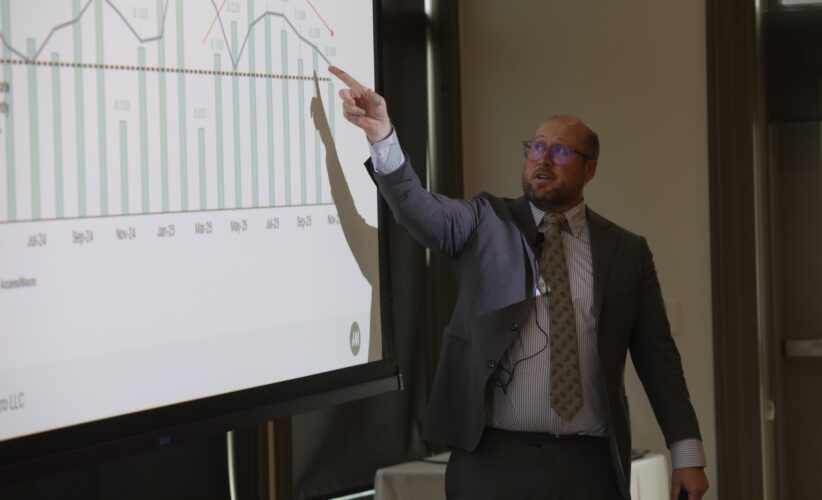
National economist Tim Mahedy speaks at a Bank of Utah economic forecast event Thursday, Feb. 12, 2026, in Lehi.The outlook on housing affordability in Utah County and along the Wasatch Front remains bleak as the calendar turns to 2026, according to two experts.
The Bank of Utah held an economic forecast event last week in Lehi, where national economist Tim Mahedy said inflation is easing and contributions to GDP growth continue to improve, but he warned there is still volatility in the labor market and that borrowing rates remain high.
This has a direct implication for Utah because population growth and a business-friendly environment are keeping demand to live here high, but high prices and financing costs are putting pressure on developers to meet that demand, according to Mahedy.
“You are in a situation where you have made it very hard to develop,” he told the Daily Herald. “I think, unfortunately, that’s going to continue at the very time that we need more houses. … It is not going to become an easier environment for homebuyers or for people trying to build things.”
According to NerdWallet, the average interest rate on a 30-year fixed-rate mortgage in Utah was 5.68% APR on Monday. Data from Zillow says the average home value in Utah County is $535,628, up 2.5% from last year.
The high rates reflect what Mahedy described as a “structural shift” in 10-year Treasury and federal funds rates. From the 1980s to 2020, Treasury and federal rates trended down, but since COVID-19, rates have risen sharply and then stagnated.
“This is the financial markets telling all of us it’s different,” Mahedy said. “Don’t expect to go back to that. We have now been hovering long enough that we are not going to go back to a world of 2% or 3% mortgage rates. I wish we would.”
Mahedy’s thoughts on the impact on the state’s housing market are in line with the perspective of Bank of Utah President Branden P. Hansen, who said he expects strong GDP growth in 2026 but doesn’t expect Treasury rates to drop, either.
“Obviously, there’s a lot of pressure for the Fed to cut the federal funds rate, but that only affects short-term rates,” Hansen said. “In fact, the last couple of times the Fed has cut rates, we’ve seen the 10-year Treasury go up.”
Hansen said that traditionally, the average mortgage payment and rent payment have been similar, and the barrier to homeownership is the down payment. In recent years, though, he said rent payments have stayed relatively flat, but mortgage payments continue to rise.
“It’s this really bifurcated economy where anybody that owned a home or had a stock portfolio prior to 2020, they’re loving life,” Hansen said. “They’ve got a 2.5% mortgage. They’ve seen their stock portfolio go up double digits for multiple years in a row.
“But then you’ve got your younger population, people that don’t own a home, that don’t have assets. I feel terrible for those people,” Hansen added. “They are up against such a monumental hill to climb with their finances because they don’t have assets that are appreciating.”
A remedy to the situation, Hansen said, is to increase supply, but he said development is not keeping up with population growth in the state.
“In terms of the amount of single-family homes that we’re producing, it’s not enough to keep up, even with the slowdown in population growth here in Utah,” he said. “Some of it is zoning issues; some of it is just the material prices and overall inflation.”
Hansen and Mahedy both agree that a contributing factor to the high rates is the federal deficit, which forces the federal government to borrow money and pushes up yields. Last year, the country saw a $1.78 trillion deficit, and national debt surpassed $38 trillion.
“I travel the country, and the only uniting philosophy in America is that Washington, D.C. loves to spend money left and right,” Mahedy said. “It’s the only thing we can all agree on. And it’s true, and they have yet to fix that.”
“We’ve got to get the fiscal house in order for the economy to improve and for inflation to really calm down to where people can live,” Hansen added.
Local News
‘Not going to become easier:’ Experts speak on outlook of Utah’s housing affordability at Lehi economic forecast event

Utah’s anti-gerrymandering law may go back to voters: Prop 4 repeal effort files 200,000 signatures