5 key Utah redistricting issues to watch in 2026
Will Utah’s new court-ordered congressional map hold? Will the effort to repeal Prop 4 succeed? And will lawmakers pursue Amendment D 2.0?
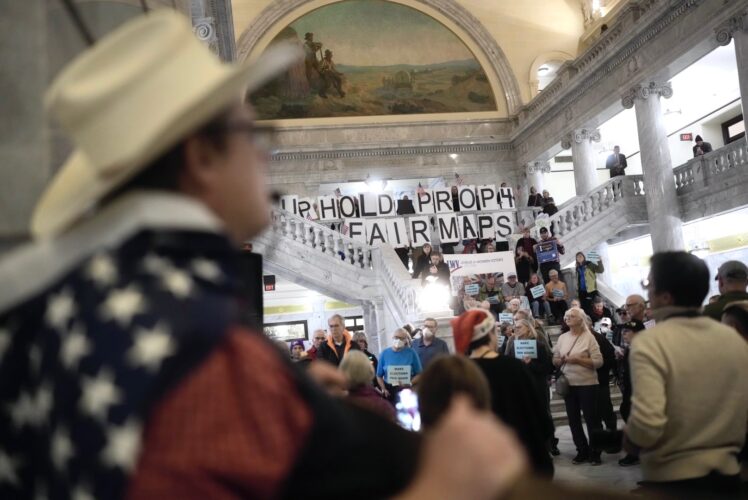
Photo by Spenser Heaps for Utah News Dispatch
Protesters rally in support of Proposition 4 in the rotunda of the Utah State Capitol in Salt Lake City on Tuesday, Dec. 9, 2025.As states across the nation broke into a redistricting arms race ahead of the 2026 elections, Utah got a new congressional map through a court-ordered redistricting process stemming from a yearslong lawsuit alleging gerrymandering and a violation of Utahns’ rights to reform their government through ballot initiative.
By the end of 2025, a Utah judge had ordered a new congressional map that included one Democratic-leaning district.
The ruling has left Republican lawmakers dismayed and defiant. They’ve accused the judge of violating the Utah Constitution and separation of powers principles, as they maintain the Legislature has the sole authority to draw political boundaries. They’ve pledged to continue to fight the ruling in court and have pushed back candidate filing deadlines to allow more time for a different map to be put in place.
Anti-gerrymandering groups and plaintiffs in the case, meanwhile, are standing firm, arguing that the courts have not only the power — but the responsibility — to step in when lawmakers have failed to pass a lawful map.
Voters in 2018 narrowly approved a ballot measure known as Proposition 4, which created an independent redistricting commission that had to adhere to neutral map-drawing criteria. But lawmakers later repealed and replaced that law with a new one to turn the independent commission into an advisory body that lawmakers ultimately didn’t need to listen to.
Though 2025 brought significant developments in Utah’s longstanding redistricting legal fight, it’s still far from being resolved.
Here are the key issues to watch in 2026 — which will have crucial implications for Utah’s redistricting process, the fate of Utahns’ ballot initiative power, and the future of Utah’s political landscape.
Will Utah’s court-ordered congressional map hold?
The lawsuit over Utah’s redistricting process is far from over.
The Utah Legislature’s top Republican leaders have repeatedly said they plan to appeal 3rd District Judge Dianna Gibson’s rulings to the Utah Supreme Court and the U.S. Supreme Court if necessary.
Late last month, Gibson issued a ruling declining to finalize the larger, ongoing redistricting lawsuit but allowing final certification of her Aug. 25 ruling that tossed out the Legislature’s 2021 map. That means the Legislature can appeal that specific decision to the Utah Supreme Court, which it’s expected to do in early January.
In that ruling, Gibson acknowledged that “until there is a final decision on these legal issues from our Supreme Court, there will be a cloud (over) Utah’s congressional elections and an open question regarding the power of the Legislature and the power of the people.”
“The Utah Supreme Court can decide now if the Legislature is the sole and exclusive authority over redistricting in Utah or if it shares that responsibility with the people,” Gibson wrote. “It can decide if the people of Utah, through the exercise of their right to alter or reform government through a citizen initiative, can also pass binding laws regarding how the Legislature performs its redistricting duty.”
Additionally, the judge said the Utah Supreme Court “should decide now” if her Aug. 25 ruling that blocked the Legislature’s 2021 congressional map should stand or not.
“These legal questions should be put to rest as soon as possible,” she wrote. “There is no just reason to delay the Utah Supreme Court’s review of those legal rulings in the (Aug. 25 ruling).”
Meanwhile, the clock is ticking.
Lawmakers in a special session pushed back the 2026 congressional candidate filing period by about two months — until March 9-13 — in hopes of getting a different congressional map in place in time for the 2026 elections. But it remains unclear whether the Utah Supreme Court will weigh in on time, what its decision will be — or if lawmakers will attempt any other legislative maneuvers between now and then.
For now, though, Utah’s court-ordered map that includes a Democratic-leaning district concentrated in northern Salt Lake County, remains.
Democrats’ crowded race for Congress
With high hopes that Utah Democrats will have their best chance in years to send a candidate to the U.S. House, the Democratic primary for the state’s newly drawn 1st Congressional District is already shaping up to be a crowded one.
State Sen. Kathleen Riebe, D-Cottonwood Heights, was the first to announce, followed closely by former congressman Ben McAdams, the last Utah Democrat to hold a seat in Congress. Former state Sen. Derek Kitchen also jumped into the race, along with current Sen. Nate Blouin, Salt Lake City Council member Eva Lopez Chavez, and a newcomer from West Valley City, Luis Villarreal. Even more announcements could be in the works.
Meanwhile, the new District 1 could force a shakeup in Utah’s current all-Republican delegation.
Because congressional candidates don’t need to live in the district they represent, it’s not yet clear which district each incumbent will run for. But if Utah’s current court-ordered map holds, whichever Republican runs for the 1st Congressional District will likely face an uphill battle to keep his or her seat.
Will Republicans’ effort to repeal Prop 4 succeed?
While Utah’s redistricting court battle continues, the Utah Republican Party and a political issues committee called Utahns for Representative Government are pursuing a ballot initiative of their own to repeal the voter-approved independent redistricting law known as Proposition 4.
To successfully place the repeal question on the 2026 ballot, the groups have until Feb. 14 to gather at least 140,748 valid signatures from registered voters and hit high enough thresholds in at least 26 out of the state’s 29 Senate districts.
As of Friday morning, 26,689 signatures had been submitted, according to the Lieutenant Governor’s Office.
A dark money group that helped finance President Donald Trump presidential campaign in 2024 is bankrolling the Proposition 4 repeal effort. The nonprofit Securing American Greatness has contributed more than $4.3 million to Utahns for Representative Government, according to the group’s received contributions report.
The anti-gerrymandering group Better Boundaries — which successfully sought Proposition 4 in 2018 — has been encouraging Utahns not to sign the repeal petition, while also accusing some paid signature gatherers of using “misleading and deceptive tactics to trick people into signing.” The group has also issued reminders that signers can go through a process to remove their signatures.
If the groups successfully place the repeal question on the 2026 ballot, Utah voters will have the final say on whether Proposition 4 stays — or gets overturned.
Lawmakers may try again to enshrine their power over ballot initiatives
When Utah’s top Republican legislative leaders announced they would be holding a special session to push back congressional candidate filing deadlines, they also said they plan to consider asking voters to consider a constitutional amendment to “clarify” or restrict the power of voter-approved ballot initiatives.
It wouldn’t be the first time Utah’s Republican-controlled Legislature tried to do this — but the last attempt failed, voided by the courts.
After a groundbreaking Utah Supreme Court ruling in 2024 made clear that the Legislature’s power over “government reform” ballot initiatives has limits, Utah lawmakers put a question known as Amendment D on the 2024 November ballot to sidestep that ruling and rewrite the Utah Constitution.
Had it been approved by voters, Amendment D would have enshrined in the Utah Constitution the Legislature’s unfettered power to repeal or alter any type of ballot initiative, including Proposition 4.
However, the Nov. 5 ballot language posing the question to voters — written by Utah’s top Republican legislative leaders — did not explain that in plain language, prompting critics to sue. They claimed Amendment D’s language was “false and misleading.”
Gibson agreed, while also determining state officials failed to meet constitutional publication requirements — so she voided the question. State attorneys appealed the decision to the Utah Supreme Court, which affirmed the district court’s decision.
But Utah lawmakers don’t seem likely to drop the issue. They may pursue a new version of Amendment D — but it’s not yet clear what its language will be. Lawmakers are likely to consider a resolution to put the question on the ballot during their 2026 general session scheduled to begin Jan. 20.
Lawmakers eye changes to the courts
As part of a brewing issue that’s related to redistricting but bigger — stemming from lawmakers’ overall recent frustrations with the court system — Utah legislators are likely to again turn their attention to Utah’s judiciary and consider making changes.
Utah’s top GOP lawmakers have said that the Legislature is expected to weigh whether to expand Utah’s Supreme Court from five justices to seven.
They told the Deseret News it’s meant to address growing caseloads and to speed up decisions, but Chief Justice Matthew Durrant told The Salt Lake Tribune in October that more justice could actually lead to more deliberation and delay timelines further.
Gov. Spencer Cox told reporters during his Nov. 25 news conference broadcast by PBS Utah that he’s in favor of adding more justices to the Utah Supreme Court and more judges to the state’s Court of Appeals.
The governor said he doesn’t see it as court packing, and that he doesn’t share the same consternation lawmakers have with the courts. Rather, he said he sees it as a way to “start moving justice quicker through the system.”
A majority of states have at least seven justices. That includes neighboring Colorado and Nevada. Idaho and Wyoming have five.
If the Utah Legislature’s 2026 session is anything like last year’s, however, it’s possible tensions between lawmakers and the judiciary could boil over again. Last year, lawmakers considered a slate of bills that legal professionals and even Durrant, who as a member of the high court doesn’t generally comment on political issues, described as a “broad attack on the independence of the judiciary.”
Many of those bills, however, fizzled or resulted in a compromise. It’s possible some could return for further debate.
Additionally, some Republican lawmakers have voiced support for considering articles of impeachment against Gibson over her rulings in the redistricting case — but it remains to be seen whether that effort will gain any traction.
Rep. Matt MacPherson, R-West Valley City, said he planned to file articles of impeachment against the judge. But when asked about that effort in November, MacPherson told Utah News Dispatch he wanted to wait and see how the Legislature’s appeal to the Utah Supreme Court goes before deciding whether to proceed.
Local News

ICE buys a Salt Lake City warehouse with plans for a new detention center

Transforming the mall: Provo Towne Centre redevelopment plan goes through the legislative process