In new deal with feds, Utah gets ‘a seat at the table’ in managing national forest land
Critics say the move benefits the timber industry and not the public
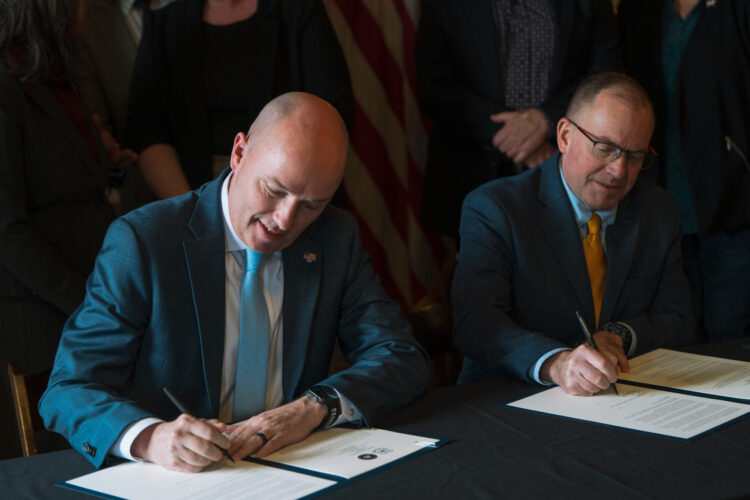
Photo courtesy of Gov. Spencer Cox’s office
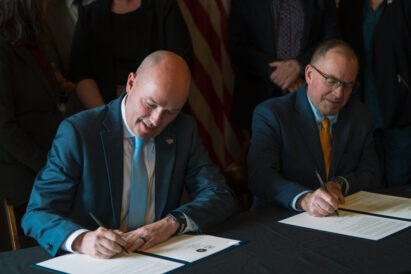
Utah Gov. Spencer Cox and U.S. Forest Service Chief Tom Schultz sign an agreement giving Utah a greater role in managing national forest land, at the Utah Capitol on Thursday, Jan. 8, 2026.Utah has had more than 7 million acres of national forest for over a century but not the say it wanted in managing them. That changed Thursday morning when the state finalized a new agreement with the U.S. Forest Service, intended in part to expand logging.
“This is something we’ve been working for — wanting — literally, for generations in our state,” Utah Gov. Spencer Cox said at the state Capitol before signing the document. “And now the moment is here where we can be involved on the front end of these decisions.”
Utah is the third state to formalize such an agreement with the Forest Service this year, following Idaho and Montana. The compacts come after President Donald Trump directed federal agencies in March to speed approval of logging projects and set goals for timber sales, calling it a way to reduce wildfire risk.
Forest Service Chief Tom Schultz joined Cox at the Capitol to sign the agreement. He said it provides the state “a seat at the table, side by side,” rather than simply a chance to give input in how the lands are managed.
“The term I like is cooperative federalism, but there’s a role for the states to manage federal lands, and that’s what we’re doing here today,” Schultz said.
Conservation groups blasted the agreement as Utah’s latest move to assume greater control of public lands. They said it sets the stage for a vast expansion of commercial logging.
“They’re just using wildfire as an excuse to manage in a way that gives money to the timber industry,” said Laura Welp with the Western Watersheds Project.
Welp said supporters of the new arrangement overstate the benefits of removing timber in reducing wildfire. She noted the influence of weather, high winds, drought and climate change. Habitat restoration, which involves smaller-scale operations, can be used to manage risk, she said, rather than big commercial logging projects.
Steve Bloch, legal director at the Southern Utah Wilderness Alliance, said the change “sets the stage for Utah officials to have both a heavy hand and the loudest voice in how our national forests are managed, crowding out all other stakeholders. That’s not how this is supposed to work, and we’ll be watching closely to see how the agreement plays out on the ground.”
Joel Ferry, executive director of the Utah Department of Natural Resources, rejected the notion that the deal is a gift to the timber industry.
“I wouldn’t agree with that,” he said. “I mean, certainly, we take our environment very seriously. We care for it. It’s part of who we are.”
In April, U.S. Agriculture Secretary Brooke Rollins declared a crisis on national forest lands, citing severe wildfires and other stressors “compounded by too little active management.” Rollins directed the Forest Service to expand agreements with states “to bring the full power of our partners to help address this emergency.”
Before Thursday, Utah and the Forest Service have long had more limited compacts, Ferry told reporters after the event.
Thursday’s version goes further than Idaho’s and Montana’s, making Utah a partner in decisions about logging, cattle grazing, recreation, wildlife and forest restoration, Ferry said.
Leland Pollock, a rancher and chair of the Garfield County Commission, attended the announcement and looked on as Cox and Schulz signed the agreement. He’s long advocated for reduced federal oversight of public lands, including the downsizing of Grand Staircase-Escalante National Monument.
Asked if he sees the new framework as a step toward greater state control of other public lands like national monuments, Pollock laughed, saying, “Oh, hell, no, don’t say that.”
“We’re not going to make the forest unhealthy or worse,” he said. “We’re going to make it better.”
The agreement applies to more than 8 million acres of national forest and adjacent land in Utah. It does not pertain to other vast stretches of federally managed land overseen by the Bureau of Land Management and National Park Service.