
Utah lawmaker wants to cut off resources for undocumented immigrants to get them to ‘self-deport’
Democrats, advocates widely oppose Rep. Trevor Lee’s HB88 as ‘cruel.’ He says he’s putting ‘Utahns First’ — and he has more bills coming. Will they survive the full 2026 Utah Legislature?

Photo by Spenser Heaps for Utah News Dispatch
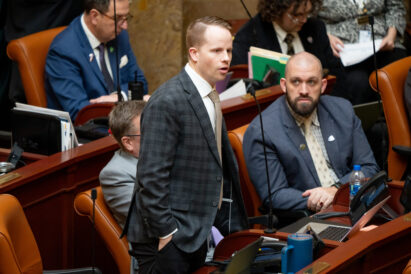
Rep. Trevor Lee, R-Layton, speaks on the House floor at the Capitol in Salt Lake City on Thursday, Feb. 6, 2025.During a time when anti-immigrant rhetoric and policies have ramped up nationally under President Donald Trump’s administration, the Republican-controlled Utah Legislature is expected to debate a handful of bills aimed at restricting people without legal status from accessing public assistance programs and other resources — like their ability to legally drive or seek shelter.
The question remains, however, whether the bills will survive both the House and the Senate — and the governor’s pen — in a state that historically has been welcoming to refugees and immigrants. The Utah Legislature’s 2026 general session, set to convene Tuesday, also comes during an election year, with 15 seats in the Senate and 75 in the House up for grabs.
One of Utah’s most hard-right Republicans, Rep. Trevor Lee is sponsoring those bills. The first to be filed — HB88 — would stop unauthorized immigrants in Utah from being able to access a wide range of publicly funded assistance programs.
“That could be housing, that could be any type of health care, it could be homeless assistance, food stamps, I mean, you name it,” Lee, R-Layton, told Utah News Dispatch in an interview this week.
If Lee’s bill is approved, it would likely restrict undocumented people from accessing the state’s Women, Infants and Children Program (known as WIC), which provides nutrition services and healthy food for pregnant, breastfeeding, and postpartum women, and to infants and children up to 5 years old. It could also restrict free vaccines, communicable disease treatments and a variety of other assistance programs that don’t currently require proof of U.S. citizenship for people seeking help.
Lee’s bill is modeled after one passed by the Idaho Legislature last year. The American Civil Liberties Union of Idaho sued, alleging it unlawfully disqualifies otherwise eligible low-income immigrants from life-saving HIV treatment based solely on their immigration status. In July, a federal judge blocked the state of Idaho from requiring immigration status verification for federally-funded health services.
Lee also said he plans to run a bill to “get rid of” the state’s driving privilege cards, which are state-issued licenses allowing people living in Utah who are undocumented or awaiting legal status to be able to legally drive.
Additionally, Lee said he’s “copying” another law from Tennessee that broadly bans anyone from providing housing to undocumented people, whether through shelter or rent. A coalition of faith groups have sued, alleging the law is unconstitutional for criminalizing providing shelter to anyone who is undocumented, even when there is no intent to conceal them.
As of Wednesday, HB88 was the only one of those bills to be publicly filed and published. Lee said he’s still working on the others.
Answering a call from the Trump administration
Though immigration is a national issue, Lee said he wants Utah to answer a call from the Trump administration to “follow what other red states have been doing” and help “crack down” on undocumented people.
“The federal side has their things that they’re dealing with, and this has been a call from the Trump administration to crack down on it,” he said. “If we do our job and we get rid of these incentives, then many will self-deport without us having to forcibly do it.”
Advocates and Democrats including House Minority Leader Angela Romero and Senate Minority Leader Luz Escamilla have criticized Lee’s proposals as “heartless” and “mean spirited” for targeting vulnerable populations.
Lee’s bills are “hurtful” and “tell people they don’t belong,” Romero said.
She added that “everyone’s family, at some point, except our indigenous communities, immigrated here.”
“I encourage my colleagues to have a little bit of compassion,” Romero said.
She also noted that many of the people impacted by Lee’s bill are part of “mixed-status families,” with kids who may be citizens but parents who are undocumented.
“It’s not like these individuals are not contributing to our economy,” she said. “They have to buy food. They also pay taxes. … So I get frustrated when there’s a stereotype (that) people who are aspiring to be citizens or aspiring for a better future for their family, that they are taking away from the system when, in actuality, a majority of them are putting more into our economy than they’re getting back.”
It’s particularly “infuriating,” Romero said, that many people who would be impacted by Lee’s HB88 are children.
Lee, who is up for reelection this year, said his aim is “putting Utahns first” while discouraging undocumented immigrants from staying in the state.
“Why on earth, when there are struggling Utahns, would we ever allocate and put those resources to someone who is not even a citizen of this country?” Lee said.
Providing public assistance to undocumented immigrants, Lee said, is “incentivizing lawbreakers.”
“We’re allowing people to break the law and then we give them free stuff,” he said. “And they’re going to go somewhere else if they don’t get it. They will self-deport.”
To those who criticize his bill, Lee said, “They love putting other people over Utahns.”
“I believe compassion stops where responsibility begins,” he said. “That’s what we’ve done in this country. We are $37 trillion in debt. And it’s because we have a third world that’s been imported here, and so many of them have broken the law, entered our country illegally, and instead of telling them to go back home, we give them free benefits. That is absolutely insane.”
While Utah’s budget is balanced every year — with Republican leaders often lauding the state as being fiscally responsible — Lee said the state still has unfunded needs that it should be prioritizing over providing assistance to undocumented people.
“We are continually criticized for not giving enough money to education. We’re continually criticized for not doing enough for air quality. There’s always something more that we could be funding,” he said. “And why are we putting someone who is not even a citizen over the needs of Utahns? What are we elected for, then? What are we doing?”
‘Diabolical’: Advocates widely oppose Lee’s approach
Gina Cornia, executive director of Utahns Against Hunger, expects the bill would have an impact not just on WIC, but also on a program that funds meal boxes for seniors in Utah and another that contributes stock to food pantries.
“I think it’s diabolical, you know, that he’s really willing to literally deny people food in an effort to force them to go back, as if people can just pack up their satchel,” Cornia said. “I mean, it’s way more complicated than that, and in the meantime, what do people do?”
Cornia said the WIC program seeks to foster healthy communities and called Lee’s proposal “a violation of our morality as a state.”
“If the very least we can do for people is make sure they have food, we should be doing that,” Cornia said.
She said the change would create a bigger administrative burden for the state government. And she said it’s not feasible to expect small food pantries with thin staffing and budgets to spend time checking into a visitor’s immigration status.
“I mean, are we going to be asking a small church pantry to verify people’s immigration status? It just doesn’t make sense to us,” Cornia said.
She noted immigrants living in the U.S. without documents are already ineligible for benefits through the Supplemental Nutrition Assistance Program, or SNAP. Under federal changes that took effect in November, refugees who aren’t lawful permanent residents no longer qualify for SNAP benefits either.
Moe Hickey, executive director of the advocacy group Voices for Utah Children, said Lee’s HB88 “is not even good policy,” noting, for example, that limiting vaccination efforts for undocumented people puts the whole community at higher risk.
“So we’re going to say children who are going to come to school unvaccinated because they’re undocumented? That’s putting other children at risk,” Hickey said. “It’s very poorly thought out legislation, and it’s clearly a message. But it’s just not good policy.”
To that argument, Lee said, “If we’re so worried about these people needing our vaccines, they shouldn’t be here.”
Hickey said the bill would also add to a “chilling effect” that’s already impacting immigrant communities under the Trump administration.
“When you start running bills that are targeting a community, then the community starts living in more fear,” he said. “And then they’re not taking advantage of benefits that they potentially are eligible for. But they’re going further into the shadows. Which, you know, good immigration policy should be the opposite. We should be providing people with safety and a path forward. Not pushing them into the corner.”
Hickey argued that HB88 wouldn’t result in savings — but rather push higher costs on emergency rooms and hospital systems.
To Lee’s arguments that resources should go to “Utahns first,” Hickey argued, “they are.” He said undocumented people don’t impact the ability of Utahns to access the benefits
“Not at all,” he said. “What impacts Utahns, for some of these services, are bad policies coming from the federal government.” Work requirements on SNAP, for example, have a much bigger impact on eligible people accessing food nutrition benefits, he said.
Aden Batar, director of migration and refugee services for Catholic Community Services, said also “we are deeply concerned” about Lee’s HB88.
“From our direct service experience, we know that policies limiting access to these essential supports do not reduce need — they simply push families into crisis and place greater strain on emergency systems, hospitals, shelters, schools, and local nonprofits,” Batar said.
Additionally, Batar said Catholic Community Services serves “many mixed status households with children who are U.S. citizens or lawfully present, but depend on shared family stability to remain healthy and housed.”
“When parents are afraid to seek food, medical care, or shelter, children suffer first,” Batar said. “Public health is also put at risk when families avoid vaccination and preventive care out of fear or confusion.”
Batar also expressed particular concern about added administrative burdens the bill would put on local providers.
“Requiring service organizations to verify immigration status diverts limited resources away from care, undermines trust between providers and families, and conflicts with the humanitarian and faith-based missions of many Utah nonprofits,” Batar said.
Batar urged lawmakers to consider the “real-world impacts of this legislation” and people and service providers across the state, and to “pursue solutions that uphold human dignity, public health and the common good.”
Will Lee’s bills find traction?
In a wide-ranging interview this week with one of Utah’s most powerful lawmakers, Senate President Stuart Adams, Utah News Dispatch asked about Lee’s HB88 and whether he supports it.
Adams, R-Layton, did not take a position on Lee’s HB88, saying he needed to look at the bill. He said the Senate will evaluate what survives the House.
Generally, though, Adams said undocumented immigrants who are “productive” should be allowed to stay, while those who are “doing things illegally, they need to go home.”
“I just want to make sure we keep America strong and keep us secure,” he said. “It seems to me that the better solution is to find a way to bring people through with less restrictions legally.”
The Senate president acknowledged immigration is a federal issue that Congress needs to tackle — and it’s a “problem” and a “disappointment” that it has failed to fix the system.
Adams said as Utah lawmakers debate immigration issues, including Lee’s bills, he’s not sure where the House and Senate will land.
“I don’t know what we’ll do,” he said. “My hope is we’ll find common sense. And we need people to work. And we need people to stay here that are productive. The people that aren’t … that are doing things illegally, ought to go home.”
Romero, the House’s top Democrat, said she hopes Lee’s bills won’t find any traction “because I think they’re cruel, they’re message bills, and I hope that the majority of the body doesn’t share that ideology.”
It’s possible Lee’s proposals will find more support in the House but hit roadblocks in the Senate. But that’s hard to predict — especially during an election year, Hickey said.
“I do think the general public is less inclined to support these,” Hickey said, though he added there may also be “a pocket of the public that would be on board.”
In the past, the Senate “has been sort of the safeguard of things like this not going forward,” Hickey said, “but that being said, it’s hard to read the tea leaves right now.”
Asked if he’s worried if HB88 could run into trouble in the Senate, Lee said: “If my colleagues want to tell their constituents they’re putting a noncitizen over Utahns, like, be my guest. But no, for the most part, the vast majority of my colleagues I’ve talked to said they will vote for this legislation.”
Contributing: Annie Knox
Local News
Utah lawmaker wants to cut off resources for undocumented immigrants to get them to ‘self-deport’

Olympic obligations: Mayor Marsha Judkins becomes new leader of Provo’s Utah 2034 preparations
