Trevor Lee, Utah lawmakers file anti-LGBTQ+ bills
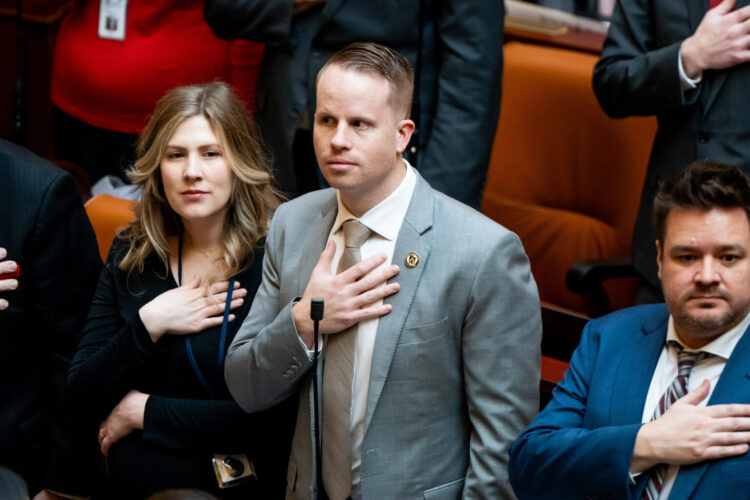
Photo by Spenser Heaps for Utah News Dispatch
Rep. Trevor Lee, R-Layton, stands while the colors are presented in the House Chamber on the first day of the legislative session at the Capitol in Salt Lake City on Tuesday, Jan. 16, 2024.As Utah lawmakers return to Capitol Hill for their 2026 session next week, LGBTQ+ advocates are on guard for what will be the fifth year in a row with multiple bills targeting transgender people.
But one bill in particular — HB183 — stands out as especially bad, said Marina Lowe, policy director for Utah’s largest LGBTQ+ advocacy group, Equality Utah.
“That is by far the most harmful and outrageous piece of legislation I have seen in a long time,” Lowe told Utah News Dispatch in an interview this week.
The bill — sponsored by one of Utah’s most hard-right Republicans, Rep. Trevor Lee, of Layton — is far reaching and would have broad impacts in a variety of areas of state code. The bill would:
- Strip out the word “gender” and replace it with “sex” in many areas of state law, including in the state’s anti-discrimination protections for housing, employment and crime victims.
- Ban changes to the sex designation field of a birth certificate.
- Require state agencies when making administrative rules to refer to “biological sex” by using the term sex instead of gender.
- Ban school districts and certain providers licensed by the Department of Health and Human Services from assigning a transgender employee to a role that interacts with children.
- In child custody proceedings, require a court to view a parent’s non-support of a transgender child’s gender identity as a “factor to favor awarding custody to that parent.”
- Remove “gender identity” from a provision that allows the Utah Division of Motor Vehicles to refuse personalized license plates that disparage a list of groups (which also currently includes race, religion, sexual orientation, ect).
To sum up the bill’s impacts, Lowe said it would “green light, by way of state law, the ability to commit hate crimes against the transgender community, to discriminate against the transgender community.” She said it would remove protections for transgender people for employment or housing.
Lowe argues the bill also “undermines parental rights in ways that are harmful for the trans community,” and requires discriminating against transgender people in jobs that are licensed by the Utah Department of Health and Human services, which is a “huge list of different entities.”
“That’s hospitals, foster care, adoption agencies, substance use, mental health facilities, youth residential,” she said.
Another provision “basically allows for discrimination” against transgender people, Lowe said, by banning them from working in schools as teachers, staff members, counselors, or “any circumstance where they would come face to face with a student for longer than five minutes.”
The bill would effectively “erase transgender people from existence under state law,” she said — except in one provision, which “allows you to disparage transgender people on license plates.”
Lee told Utah News Dispatch in an interview this week that his bill is aimed at “getting away from this idea that there are like 100 different genders out there.”
“There is no such thing as gender, it’s a made up word and term. It’s actually just two sexes. There’s male and female,” he said. “We need to get back to that basic biology.”
He said he also wants “no more changing birth certificates” because “that’s stupid and it makes it very confusing for people, as we get older, especially our children.”
Lowe said it’s one of the most egregious legislative attacks on transgender people she’s ever seen crop up on Utah’s Capitol Hill because it would basically undo years of progress to create equal protections for a class of people that do exist — whether Lee likes it or not.
Among the most high-profile pieces of legislation that Lee’s bill would impact is a 2015 law, SB296, which banned sexual orientation and gender identity-based discrimination in housing and hiring while also providing safeguards for religious freedom. The law is known as the “Utah Compromise” because The Church of Jesus Christ of Latter-day Saints and LGBTQ+ advocates all backed the bill.
“Trevor Lee’s bill takes a sledgehammer not just to the compromise, but to each and every one of the legislative solutions that have emerged over the past decade where Equality Utah and largely Republican lawmakers have come together to try and solve really complex, challenging, difficult issues, in particular facing the LGBTQ community,” Lowe said.
Lee refused to acknowledge that his bill would allow discrimination against transgender people in housing and employment, instead insisting that they don’t exist.
“You’ve got to pick one. You’re not both. See, this is part of getting away from this complete, alternate universe that people have been living in for a long time,” he said. “There’s male and female. There’s nothing in between. It doesn’t happen.”
Lowe said “it’s hard to land on any other conclusion that this is just a really cruel bill.”
“I really hope our other lawmakers will feel some of the fatigue around this issue,” she said. “This is now, gosh, the fifth straight year in a row that we’ve seen multiple bills targeting this very small and pretty vulnerable community.”
Lowe said she hopes the rest of the Republican-controlled Legislature “decides against taking this approach, which really doesn’t improve anybody’s lives, it doesn’t solve any problems, it just leaves a vulnerable group considerably more vulnerable.”
One of Utah’s most powerful legislative leaders, Senate President Stuart Adams, R-Layton, was one of three Republican sponsors of the 2015 “Utah Compromise” enacting LGBTQ+ protections while balancing religious freedom provisions.
Asked about Lee’s HB183 during a wide-ranging interview this week, Adams — who rarely takes positions on House bills before they’ve progressed to the Senate — told Utah News Dispatch “it would take a lot to convince me” to make any changes to the anti-discrimination code enacted by the 2015 law.
He noted that there’s a “nonseverability clause” in the law, which means that if “any portion is struck down by a court, that the entire bill would be struck down.” Legislative changes may not impact that provision, he said, but he still expressed concerns about changing the law.
“There were a lot of commitments made, and it was artfully crafted and balanced,” he said. “I would be very, very hesitant to try to undo that balance.”
Adams also expressed frustration with what he called “social issue” bills, which he said can be “distracting” from the important and “exciting” things Utah lawmakers hope to focus on this year when it comes to energy development, critical minerals, water, housing and other big issues that have sweeping impact in the state.
That may spell trouble for Lee’s bill, at least in the Senate. But it’s too early to tell how far the bill — or some version of it — will progress. The 2026 Legislative Session is scheduled to begin Tuesday, and will last 45 days. It also comes during an election year, when 15 Senate seats and 75 House seats are up for election.
Lee, when asked about the Senate president’s comments, said, “Yeah, well, times change.”
“You would have never asked me 10 years ago if we had to worry about keeping biological males out of female sports,” he said. “Things happen. We have issues. We have problems. … If Utah, in my opinion, made a mistake in 2015 by giving an identity to something that doesn’t exist, I think that’s very problematic to everyone.”
Lee also argued anti-transgender legislation is worth spending time on because he said “these social issues have a much wider impact on our state.”
“Whether (Adams) wants to talk about them or not, these are serious problems that we deal with, and we run significant legislation around these social issues,” Lee said. “He knows that, and it’s unfortunate we have to deal with them, but we do. It’s just the world we live in now.”
Lee added that “just like him, I wish we didn’t have to run these kinds of bills.”
“I wish everyone had common sense like we all used to agree on with this stuff, but because we don’t,” he said. “We need to bring back common sense for society, not for our sake but for our children’s sake, too. So they grow up in a world that’s not wrought with confusion and identity-type politics.”
Lee continued: “This needs to be squashed, needs to be taken out of the way, and we need to go back to common sense and the things that made Utah great, not things that made California a terrible place to live in this country with their types of politics. We want to protect ourselves from that. And that’s what these bills are doing, it’s making us go as far away from those blue-type states’ policies as possible.”
Renaming Harvey Milk Boulevard after Charlie Kirk
Though Lowe said HB183 is by far the worst anti-transgender bill filed so far this year, Equality Utah is also opposing several other bills.
Another one sponsored by Lee, HB196, has especially sparked anger from Salt Lake City leaders and residents. That bill would rename 900 South in Salt Lake City — currently known as Harvey Milk Boulevard, named after the early LGBTQ+ rights leader and the first openly gay man to be elected to public office in California. Milk was assassinated in San Francisco in 1978.
Lee wants to rename that street Charlie Kirk Boulevard, after the conservative influencer who was shot and killed last year during a speaking event in front of thousands of students at Utah Valley University in Orem.
Equality Utah and Salt Lake City leaders have opposed it as not only an attack on an LGBTQ+ icon, but also infringing on local control. Currently, cities have the power to name their roads.
“Trevor Lee has an unusual, and truly bizarre obsession with the LGBT community,” Lowe and Equality Utah’s executive director, Troy Williams, wrote in a statement condemning HB196. “And it’s so curious that he wants to memorialize Charlie Kirk on the absolute gayest street in Utah.”
Williams and Lowe added that Salt Lake City residents “know the difference between meaningful leadership and culture-war cosplay.”
“Harvey Milk earned his place in history,” they said. “Trevor Lee, despite his yearning for our attention, isn’t destined for the history books. Frankly, he couldn’t even land his name on a cul-de-sac.”
They said that if a conservative city wants to “memorialize Charlie Kirk, where he will be truly celebrated, then that is absolutely their prerogative.”
“We are not going to pit Charlie against Harvey,” Lowe and Williams said. “These two men, if still alive today, would enjoy sitting down together, and engaging in spirited and friendly debate about the issues of the day.”
When asked why Lee is targeting 900 South rather than naming a street in another city, like in Orem, after Kirk, Lee told Utah News Dispatch: “What a better street to pick than the one from the group of people who don’t seem to understand how to have a civil dialogue.”
“Charlie Kirk was the best of us,” Lee said. “He was a man of faith, he walked the walk, he was someone who wanted to engage in civil dialogue with those who disagreed with him.”
Lee also accused Milk of being a “pedophile,” and said that it’s “embarrassing for our state, that we have a street named after him.”
Lee’s comments echo accusations against Milk that have circulated for years, stemming from a biography that says Milk was involved with a teenage boy who was 16 years old when they met in New York City in 1964, when Milk was 33. Milk was never convicted of sexual misconduct.
Those accusations against Milk resurfaced most recently after Secretary of Defense Pete Hegseth ordered the secretary of the Navy to rename the oiler ship USNS Harvey Milk in June.
The ship was first named after Milk in 2016 by then-Navy Secretary Ray Mabus, according to Military.com. Milk came from a family that had a history of naval service, and he also served in the Navy during the Korean War. He left the service in 1955 with a “less than honorable” discharge “after being officially questioned about his sexual orientation,” according to his official biography.
Lowe dismissed Lee’s bill as “a petty move” that is “intended simply to stoke agitation and to get more likes on Twitter.”
Lowe also disputed Lee’s claims about Milk and whether it has anything to do with renaming a street in Salt Lake City after Charlie Kirk. “If we wanted to look back into the history about inappropriate relationships between adults and underage individuals, there are plenty in this state we could talk about as well,” she said.
Renaming the street is “not a serious policy issue,” she said. “I hope other lawmakers view it as such.”
“We just don’t view it as a serious proposal,” she said. “Lawmakers have such a limited time on Capitol Hill to really tackle the complicated and challenging issues facing our state, and to be wasting time trying to remove one street name and replace it with another, simply to stick it to the libs, seems like a tremendous waste of time.”
Other anti-LGBTQ+ bills
In addition to Lee’s bills, there are several other anti-LGBTQ+ bills. Some were unsuccessful in past legislative sessions, but their sponsors have revived them in attempts to get them passed in 2026.
They include:
- HB193, sponsored by Rep. Nicholeen Peck, R-Tooele, which would ban public funding for transgender-affirming medical care.
- HB95, also sponsored by Peck, which would prohibit consequences against a public employee, including teachers, who refuse to recognize someone’s gender identity.
- HB174, sponsored by Rep. Rex Shipp, R-Cedar City, to require health care professionals currently providing cross-sex hormones or puberty blockers to transgender minors to taper their patients off the treatment. Utah lawmakers in 2023 enacted an indefinite moratorium on new prescriptions for puberty blockers and hormone therapy to minors. Lowe said she also expects an effort to convert that moratorium into a ban.
- HB114, sponsored by Rep. Colin Jack, R-St. George, would restrict drag shows and criminalize performing them in a public space or in the presence of a minor.
Lowe said to see another year of anti-transgender bills surfacing on Utah’s Capitol Hill is demoralizing and exhausting for a vulnerable group of people who are already feeling marginalized and bullied by the Utah Legislature.
“It’s got to feel just terrible for the transgender community to sort of wait with bated breath every January to see what’s coming, and to see so many bills come out before the session has even started is kind of demoralizing,” she said.
After so many years of anti-transgender legislation, “it feels like there’s nothing else that can be legislated, and yet every year they seem to come back to the same issue area,” she said.
“These are people’s lives,” she said. “I guess my question to the Legislature would be, you know, trans people still exist, even after all of these bills get passed. And what is the Legislature doing to support these families? They’re not going away. They still need help and resources.”