Lawmakers flock back to Capitol Hill: What to expect from the 2026 Utah Legislature
Lawmakers eye changes to judiciary, a 6th year of tax cuts, another attempt at solidifying their ability to change voter-approved laws, anti-transgender legislation and more
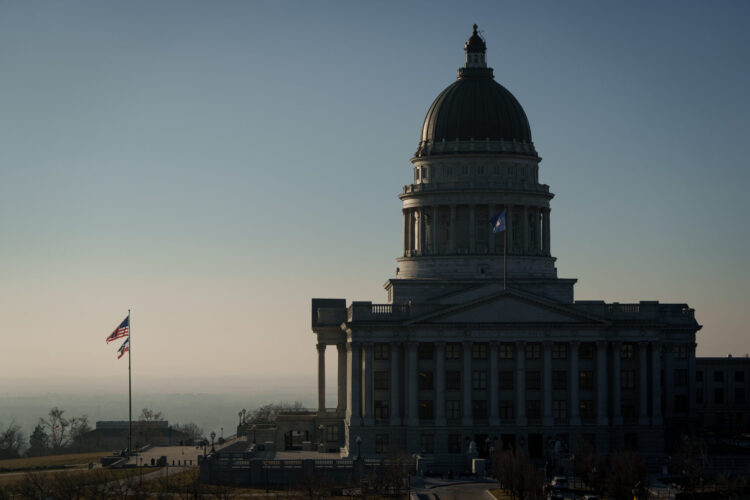
Photo by Spenser Heaps for Utah News Dispatch
A Capitol in Salt Lake City is backdropped by a thick pollution haze on Thursday, Jan. 15, 2026.Utah lawmakers will be returning to Capitol Hill on Tuesday for their 45-day 2026 legislative session — and already the list of issues they plan to tackle is long, with the number of bills filed growing by the day.
Because the Utah Legislature is controlled by a Republican supermajority, the state’s GOP legislative leaders often set the agenda while Democratic lawmakers try their best to fight against legislative efforts they oppose.
Utah’s top Republican legislative leaders — Senate President Stuart Adams, R-Layton, and House Speaker Mike Schultz, R-Hooper — told Utah News Dispatch in wide-ranging interviews last week what bills and issues are top of mind for them for 2026.
Meanwhile, the state’s Democratic leaders — Senate Minority Leader Luz Escamilla and House Minority Leader Angela Romero, both Democrats from Salt Lake City — say they’re bracing for a legislative session that’s expected to be tough on many different fronts.
Not only is the state’s more than $30 billion budget expected to be tight due to federal tax cuts — along with pressure from Republican legislative leaders to continue their streak of income tax rate cuts. But also, 2026 is an election year for all 75 seats in the House and 15 in the Senate, likely to add an extra layer of political calculus and gamesmanship.
And already, bills are stacking up that target groups including undocumented immigrants and transgender people that Democrats and community advocates are gearing up to fight.
It remains to be seen what legislative proposals survive both the House and Senate — but insights from Adams and Schultz help shed light on what they’re more likely to prioritize.
Here are some of their top priorities, along with issues that are expected to be among the most contentious this year:
More tax cuts
A sixth year of an income tax rate cut — on top of more than $500 million already slashed in 2026 and 2027 from the state’s budget due to federal tax changes under the One, Big Beautiful Bill Act — and an effort to rein in property taxes. At the same time, legislative leaders have directed all state agencies to propose ways to cut 5% from their budgets as part of a statewide efficiency exercise.
Judiciary changes
Utah Gov. Spencer Cox, Schultz and Adams are all supportive of expanding the Utah Supreme Court from five justices to seven. They say it’s to bring Utah in line with other states and help speed up decision-making, but Democrats question the timing of the move and whether it’s in “retaliation” for several court rulings that Republicans have vehemently opposed, especially in the state’s redistricting court battle. Schultz is also supportive of increasing “transparency” on judges. Several other bills have also been filed, including SB57 which would increase the number of judges for the district court, juvenile court, and the Court of Appeals. HB262 would increase the threshold of votes needed for a judge to be retained. Additionally, lawmakers have filed at least three proposed constitutional amendments related to the judiciary. HJR5 would allow the governor to select any qualified candidate to fill a judicial vacancy, even if the candidate isn’t nominated by a nominating commission. And HJR13 would empower the Legislature to initiate a “special” retention election if the Legislature decides “that judge is unfit or incompetent.”
Another attempt to solidify lawmakers’ ability to change ballot initiatives
Also tied to the state’s redistricting lawsuit — which traces back to a 2018 ballot initiative for an independent redistricting process known as Proposition 4 — Utah’s Republican leaders are expected to propose another constitutional amendment to ensure the Legislature has the ability to change laws enacted by voters. The language of what that proposed amendment would be, however, is unknown.
Homelessness
Gov. Spencer Cox has proposed lawmakers set aside $25 million in one-time money and $20 million in ongoing funding for “homelessness and criminal justice high utilizers.” At the same time the governor has been supportive of a controversial proposal to build a 1,300-bed homeless campus in northwest Salt Lake City. Adams and Schultz have said they’re open to discussions around homelessness but they didn’t commit to fully funding Cox’s recommendations. Schultz said he wants cities and counties to do more to provide funding while also saying the state wants to remain a partner.
Immigration issues
Adams and Schultz did not name any specific immigration-related bills they’re supporting as of yet, but some of the most controversial proposals to surface so far ahead of the session look to cut off publicly-funded resources for undocumented immigrants, restrict their ability to legally drive, and criminalize providing housing for people without legal status.
Anti-transgender legislation
LGBTQ+ advocates are opposing a list of bills already filed, including one that would strike the word “gender” from Utah code, effectively erasing transgender anti-discrimination provisions for housing, employment and crime victims. That’s among the “most harmful and outrageous” bills advocates with Equality Utah have seen — but that bill may run into issues in the Senate. Adams said he’d be hesitant to make any changes to Utah’s 2015 law that enacted LGBTQ+ protections while balancing religious freedom. However, other bills are in play — including one to make permanent Utah’s indefinite moratorium on prescriptions for puberty blockers and hormone therapy to minors. Schultz said he’s supportive of turning that moratorium into a ban.
Elections
Last year, the House and Senate clashed over a sweeping bill that originally would have drastically restricted voting by mail. The Legislature ultimately passed a watered-down version to slowly phase out automatic voting by mail in 2029, but Schultz said he wants to revisit that legislation — including enacting in-person ID requirements. Adams said he’s open to more changes, but he’s supportive of keeping voting by mail while reinstating vote-by-mail signature verification, which would under the current law phase out by 2029. Both Schultz and Adams also said they want to add additional requirements to ensure people without legal immigration status can’t vote (which is already illegal). Democrats question whether that’s needed, since instances of that happening are rare.
That’s not an exhaustive list. Lawmakers are also expected to continue efforts to focus on issues including energy development, critical minerals, water, housing, artificial intelligence regulations and more.
The governor is also pushing a bell-to-bell ban on cellphones in schools, and improvements to the state’s lagging K-3 literacy, including encouraging a policy to hold back third graders unless they pass a reading test to advance to fourth grade.
Here’s a full list of Senate Republicans’ priorities, and here’s the House GOP’s. Senate Democrats’ priorities, Escamilla said, are aimed at going “back to the basics” by focusing on unmet needs for education, health care, child care, housing and other issues while “defending democracy.” And House Democrats’ priorities, among other issues, promote inclusion and representation, education and environmental protections.
Another income tax cut — plus an effort to limit property taxes
For a sixth year in a row, the Senate president and House speaker want to cut the state’s income tax rate, currently sitting at 4.5%, as part of an effort they say is to help keep Utah affordable, competitive with other states, and a place where people will want to live, work and do business.
But the governor notably didn’t include an income tax rate cut in his 2026 budget recommendations, pointing out that Utah already won’t collect about $300 million of corporate and individual income tax in 2026 and $200 million in 2027 due to federal changes to tax policy in Congress’ One Big Beautiful Bill Act .
That’s on top of the more than $1.4 billion in tax cuts lawmakers have approved over the past five years, much of which has come from income tax reductions. Under the Utah Constitution, income tax is largely required to fund the state’s public education system, which advocates and Democrats have argued continues to go underfunded. Despite significant increases in education funding in recent years, Utah is still among the lowest-ranking states for per-pupil education spending.
Meanwhile, lawmakers on the powerful budgetary oversight body, the Executive Appropriations Committee, last month directed budget subcommittees to propose 5% cuts across state agencies as part of a statewide efficiency exercise.
“You know, will those 5% cuts stick across the board? No. But I think it’s good for everybody to go in and look at their budgets,” Schultz said.
The Legislature won’t put its finishing touches on the budget until the final days of the session, scheduled to end March 6, so it’s not yet clear what programs will or won’t get funded, but Democrats including Romero and Escamilla are concerned about Republicans prioritizing yet another tax cut while needs for child care, education, deeply affordable housing, homelessness and others continue to go unmet.
“I have major concerns about what’s going to be cut and how that is going to impact our most vulnerable,” Romero said.
In past years, the Executive Appropriations Committee has preemptively set aside a pot of money ahead of the session for a tax cut — but this year it didn’t. House Republicans, however, listed in their priorities $200 million for a tax cut.
Adams said $200 million is the number needed to reduce the state’s income tax rate from 4.5% to 4.45% — but he acknowledged that whether lawmakers are able to do that depends on how the budgeting process goes.
“We’ll be scraping the top of the paint can lids to try to find a way,” Adams said, but he added it’s a “high priority.”
“We want to do it smart. We want to be responsible. We want to make sure all the state needs are being met. That’s super important,” Schultz said, but he added that reducing “cost of living” is a top priority for House Republicans, and that includes lowering the income tax rate again.
Escamilla argued Utah can’t keep up its streak of foregoing hundreds of millions of income tax revenue year after year.
“We’ve been consistent in opposing any income tax cuts. That’s problematic,” Escamilla said. “I mean, I really do not know where they’re going to get the funds from.”
Additionally, Schultz said he’s supportive of efforts to reign in property taxes at the local level and prevent the tax burden shifting away from commercial properties and on to Utah homeowners.
He pointed to a proposed constitutional amendment and accompanying bill being sponsored by Rep. Jill Koford, R-Ogden, that would increase the percentage of the fair market value of a home that is exempt from property tax, from 45% to 60%. He said that’s expected to drop people’s property taxes “a couple hundred bucks a year.”
While state agencies look for 5% cuts, Schultz said he also thinks local governments should go through a similar exercise, so he’s supportive of legislative efforts to limit their ability to enact property tax hikes. Sen. Dan McCay, R-Riverton, also has a bill to limit taxing entities from adopting a budget that exceeds 5% of the previous year’s property tax budgeted revenue, excluding new growth.
Pointing to Salt Lake County’s recent 14.65% property tax hike to address inflation and rising costs, Schultz said “people are losing their minds over that.”
“If our local governments don’t recognize what’s happening and get their budgets in order instead of just increasing property taxes, they’re going to see more and more of these types of bills,” Schultz said, though he added he’s not sure what bills will pass. “But I’ll tell you, it’s widely popular, and it’s something that we absolutely need to consider.”
Romero expressed concerns with limiting cities, counties and school districts’ ability to oversee property taxes, both as a matter of encroaching on local control but also how that could impact services and school districts.
Moe Hickey, executive director of the advocacy group Voices for Utah Children, expressed similar concerns, but especially when thinking about pairing that with income tax reductions.
“If you’re cutting income tax, which leads to cuts in services, which local communities want to keep, then they have to raise their property tax,” he said. “They don’t operate separately. There’s a relationship there … If you cut the income tax enough, you’re either going to lose services or you’re going to have to increase local tax, plain and simple.”
Expanding the Utah Supreme Court and other courts
When asked why it’s a priority to expand the Utah Supreme Court from five justices to seven, Adams responded with a question: “When did Proposition 4 pass?”
That was in 2018, more than seven years ago. “Do I need to say any more? We’re in 2026,” he said, arguing it’s taken far “too long” to litigate the state’s lawsuit over redistricting, which alleged lawmakers overstepped when they repealed and replaced the independent redistricting voter-approved law.
So far, the courts have agreed, which led to a restoration of Proposition 4 as law, but also a new court-ordered map that included one Democratic-majority district and three heavily Republican districts — a ruling that Republicans including Adams have ardently opposed.
Adams also said expanding the court may lead to more nuanced decisions.
“I haven’t seen many split decisions come out of our court,” he said. “And the other side, even if you disagree with it, deserves at least a minority opinion. And I believe having an expanded court probably gives an opportunity to have maybe a little bit of diversity there.”
The Senate president said also he thinks more justices will help speed up court decisions. That’s even though Chief Justice Matthew Durrant told The Salt Lake Tribune in October that adding more justices could lead to more deliberation, delaying timelines further.
“I think it will actually help them,” Adams said. “I can’t imagine it’s going to bog it down.”
Adams also said part of that conversation will include increasing funding for the Utah Supreme Court, as well as more money to expand the appellate courts, which he noted has been a “high priority” for the judiciary.
Schultz is also supportive of expanding the courts, but he said he also wants to increase “transparency” on judges so it’s easier for Utahns to look up their rulings.
“We want them to have the same type of transparency to the public that we as legislators have,” he said. “When we look at retention elections, the No. 1 thing I hear from constituents is ‘We have no idea who these judges are … we can’t find any information.”
Escamilla said she’s concerned about expanding the Utah Supreme Court in a time when Republican lawmakers have clashed with the courts on their redistricting rulings.
“It’s an issue of timing. It feels like retaliation,” Escamilla said, adding that her constituents have said “they don’t want to see retaliation against the judiciary as they’re exercising their responsibilities and checks and balances of our government.”
Lawmakers’ power over ballot initiatives
While vowing to appeal Utah’s new court-ordered congressional map to the Utah Supreme Court, Adams and Schultz in November also said lawmakers would consider proposing another constitutional amendment — subject to Utah voter approval — that would “clarify” when lawmakers can change voter-approved laws enacted by ballot initiative.
It won’t be the first time Utah’s Republican-controlled Legislature has tried to do this — but the last attempt failed, voided by the courts.
After a groundbreaking Utah Supreme Court ruling in 2024 made clear that the Legislature’s power over “government reform” ballot initiatives has limits, Utah lawmakers put a question known as Amendment D on the 2024 November ballot to sidestep that ruling and rewrite the Utah Constitution.
Had it been approved by voters, Amendment D would have enshrined in the Utah Constitution the Legislature’s unfettered power to repeal or alter any type of ballot initiative, including Proposition 4.
However, the ballot language posing the question to voters — written by Utah’s top Republican legislative leaders — did not explain that in plain language, prompting critics to sue. They claimed Amendment D’s language was “false and misleading.”
Third District Court Judge Dianna Gibson agreed, while also determining officials failed to meet constitutional publication requirements — so she voided the question. State attorneys appealed the decision to the Utah Supreme Court, which affirmed the district court’s decision.
Adams, however, balked at characterizing their new attempt as Amendment D 2.0.
He said the goal is to make clear that laws passed by the Legislature and enacted by ballot initiative are on a “level playing field” or “co-equal.”
“We just want to reinstate the co-equal status,” he said. “It’s really important people understand that there’s no intent to do away with initiatives. It just needs to be co-equal status.”
Adams argues that the Utah Supreme Court’s ruling that says the Legislature must satisfy “strict scrutiny” or assert a compelling government interest in order to change “government reform” ballot initiatives was too ambiguous and left the door open to a flood of ballot initiatives that lawmakers can’t change. That, he argues, could doom Utah’s future.
“The Supreme Court ruling will destroy Utah. It’s basically changed our entire form of government,” he said. “We live in a republic. … (U.S.) Supreme Court (Thurgood) Marshall said the difference between a democracy and a republic is order and chaos. We have chaos right now.”
Pressed on what the language of the proposed amendment will be, Adams said “we’re not anywhere close” to determining that, “but there will be a constitutional amendment.”
“And we will find a way,” he added, “to make sure that we put together language that our Supreme Court is happy with.”
Escamilla said Senate Democrats will be on guard for any attempt to weaken voters’ ability to enact laws via ballot initiative.
“That is a top priority,” Escamilla said. “Protecting citizens’ initiatives is critical.”
Escamilla argued the Utah Supreme Court’s interpretation of the existing Utah Constitution made clear that lawmakers can change “government reform” ballot initiatives — but they can’t undermine them.
“It’s when it gets ridiculous, actually undermining the entire intent behind what the citizens of Utah voted for,” she said.
She added that she’s concerned about any attempt to change the Utah Constitution in ways that could empower the Legislature to make changes to voter-approved laws in more ways than they already have the ability to do.
“You’re either going to say we will change and undermine, or not,” she said. “If you’re going to allow that, I think there will be opposition. The public is exhausted and tired of being undermined by the government when it comes to citizen initiatives and decisions being made by the public.”
Local News
Lawmakers flock back to Capitol Hill: What to expect from the 2026 Utah Legislature
BYU: Cougars rank ahead of Princeton, Yale with one of the top admission yield rates in the country