Rising costs of living and health care are consuming Utahns’ budgets. Here’s what lawmakers propose
Families urge legislators to consider housing woes and exorbitant health care prices when considering social services cuts
Alixel Cabrera, Utah News Dispatch
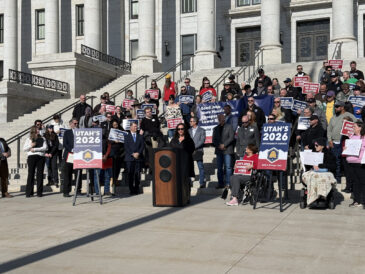
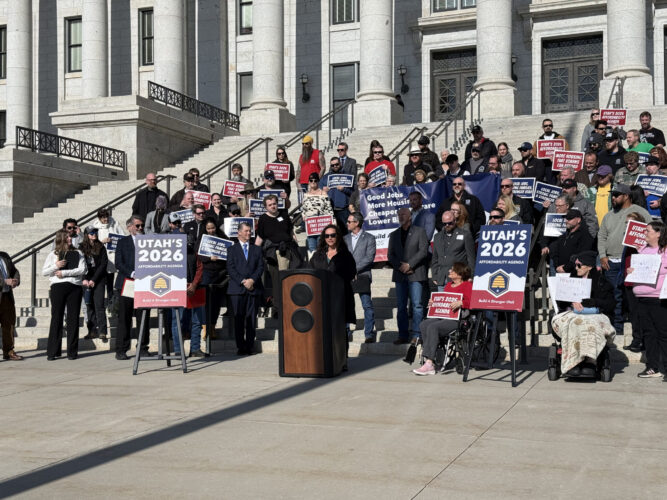
Brittany Bringhurst with United Today, Stronger Tomorrow, speaks about housing and health care affordability issues in Utah at the Utah State Capitol on Thursday, Jan. 29, 2026.Brittany Bringhurst has been climbing a ladder since 2009 when she bought her starter home in Las Vegas for $150,000, which eventually led to her move to her multi-generational, $500,000 Kaysville home. But that path doesn’t exist for her children, she said at a news conference in front of the Utah State Capitol surrounded by lawmakers and community leaders advocating for affordability solutions in the state.
Now, legislators are debating cuts to Medicaid and other social services that would impact families like hers, she said.
Bringhurst’s mother-in-law, for example, will soon need Medicaid to afford long-term memory care while she battles Alzheimer’s disease, and her oldest daughter relies on Medicaid through the Division of Services for People with Disabilities’ “limited supports waiver,” which offers financial aid to people on the disability waitlist while they wait for full services. That program is facing possible elimination this year.
“Without it, families are forced into impossible choices. Do I quit my job to provide full-time care? Do we drain our retirement savings, or do we just simply go without support?” Bringhurst said on Thursday. “Medicaid is not a handout. It is the infrastructure that allows families to stay afloat.”
With housing becoming increasingly unaffordable and health care support facing cuts in federal government spending packages, “families are squeezed from both sides. Caregiving becomes harder. Workforce participation drops. Communities weaken,” Bringhurst said, urging lawmakers to look at affordability and health care issues through the lens of real Utah families.
Angela Turner, also a Utah mom, thought that caring for her two daughters with epilepsy couldn’t get more expensive — until her family’s health care premiums and the prices of essential medicines increased this year.
“I do have a daughter that is on the waitlist for DSPD (Division of Services for People with Disabilities), hopefully to give her extra help as she grows and gets older,” Turner said. “I know myself, along with other Utah families, are concerned about the possible cuts to this funding.”
The event happened the same week that hundreds rallied at the Capitol during Disability Advocacy Day urging legislators to reject possible cuts to disability support programs, especially a 10% cut to DSPD waivers, which Nate Crippes, public affairs supervising attorney with the Disability Law Center, said “would be pretty devastating to people with intellectual developmental disabilities and people who are aging.”
Groceries are higher, going out to dinner as a family has become too expensive, property taxes and utility bills have also increased, Turner said.
“While everything around us is climbing to an all-time high, everything is increasing more and is more expensive, we have to cut back and pick and choose what’s important,” she said. “But I know other families are going without staples, so I feel fortunate to just decrease to less, but I’m worried about affordability for the next few years.”
Legislative proposals
During the event, Provo Republican Rep. Tyler Clancy said the ticket to the middle class used to be a good union job, and then, to go to college and get a four-year degree.
“When I talk to young people today, they feel like that ticket to the middle class is a lottery ticket, because they’re unsure if they’re going to be able to make ends meet,” Clancy said. “Even when they’re doing everything right.”
This legislative session, his last before he becomes the state homelessness coordinator, Clancy is sponsoring legislation banning hidden fees by requiring a clear disclosure of the total price in an offer or advertisement for a product.
“The average family of four is subject to about $3,000 of these types of hidden fees every single year,” he said. “For some, that might be pocket change, but for others who are working to make ends meet, that could be the difference between food on the table or not.”
He also has proposals to restrict non-compete agreements to expand the work marketplace and to establish wage standards for construction projects.
“I’ll tell you that the best social program is a good job, that there’s nothing like the dignity of work, being respected on the job site and making enough money so that you’re not worried,” Clancy said, “that after you’ve spent your your blood, sweat and tears on the job site, that you can come home and take care of your family.”
Taylorsville Republican Rep. James Dunnigan, however, also emphasized the importance of investing in services like Medicaid and the Children’s Health Insurance Program, which, he said are “smart investments (that) protect our safety net.”
In addition to the new initiatives, a program that would provide six months of rental assistance for people facing housing challenges has been approved for the state, Dunnigan said, with the federal government paying up to 90% of the assistance.
Jefferson Burton, R-Salem, also said the Legislature is exploring allowing building eight small homes on an acre, to make home buying more affordable for young people.
“We believe local communities should make local decisions, but we have good ideas we’re going to share and work together to get this solved once and for all,” Burton said.