Judicial confirmation committee endorses Gov. Cox’s 2 Utah Supreme Court picks
The nominations of Jay Jorgensen and Stephen Dent now go to the full Senate for a vote. Republican lawmakers voiced support, while Democrats raised questions of whether Jorgensen meets 5-year residency requirement
Katie McKellar, Utah News Dispatch
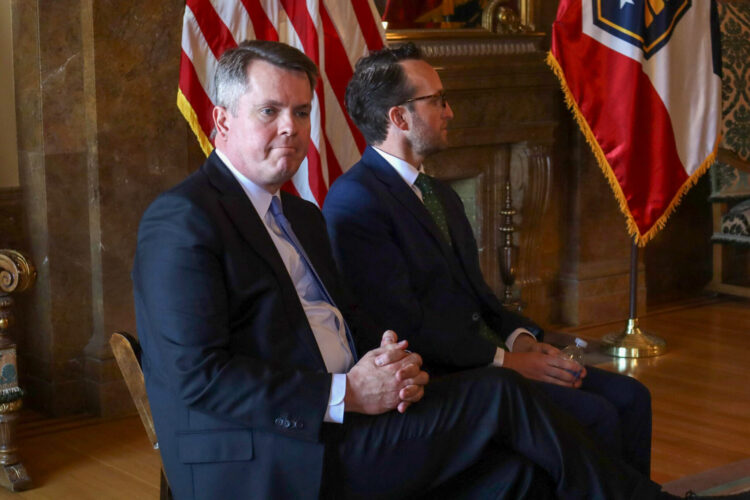
Jay Jorgensen, left, and Stephen Dent listen as Gov. Spencer Cox announces their nominations to the Utah Supreme Court during a news conference at the Utah Capitol in Salt Lake City on June 2, 2026.After spending two hearings grilling Utah Gov. Spencer Cox’s nominees to fill two new seats on the expanded Utah Supreme Court, a panel of lawmakers has given its stamp of approval.
The Senate Judicial Confirmation Committee voted on Monday to endorse both Jay Jorgensen and Stephen Dent, advancing them for consideration in front of the full Senate, which is scheduled to vote on their confirmations Wednesday.
Republican and Democratic lawmakers on the committee questioned both Jorgensen and Dent for hours on Friday and Monday during their two-day confirmation hearings. The questioning was cordial, and Republicans warmly received both nominees.
Jorgensen and Dent spent much of the hearings discussing their judicial philosophies, both emphasizing their focus on “originalism” and “textualism,” which the governor said were key to him as he interviewed potential justices. Both approaches call for interpreting the law and the state constitution based on the original intent and plain meaning of the words at the time they were written and enacted.
The two Democrats on the committee, however, raised some concerns — particularly with whether Jorgensen met the constitutional five-year residency requirement to serve on the state’s highest court.
Jorgensen’s residency
Jorgensen, who currently works as a senior attorney for the state’s predominant faith, The Church of Jesus Christ of Latter-day Saints, served a mission for the church in Chile for three years, from July 2022 to July 2025.
Jorgensen told lawmakers he clearly meets the constitutional five-year residency requirements because serving a mission is a “classic” example of being abroad only temporarily while he owned a home in Provo the whole time, always with an intent to return back to Utah.
“We were Utahns. No matter where we lived, we remained Utahns,” Jorgensen said.
Before serving a mission in Chile, Jorgensen had also been living outside of Utah from 1999 until 2020, save for several years in the early 2000s when he ran an unsuccessful campaign for Congress as a Republican.
“It’s a beautiful process,” Jorgensen said of his congressional run, “but I’m not cut out to be a politician.”
After graduating from Brigham Young University in 1997, Jorgensen spent many years based in Washington, D.C., first as a clerk for the U.S. Court of Appeals for then-Judge Samuel Alito, who is now a U.S. Supreme Court associate justice, and then as an associate and partner with Sidley Austin, a global law firm.
Then from 2013 to 2019, he lived in Arkansas while he worked as executive vice president of Walmart where he oversaw the retail giant’s global ethics and compliance program. Walmart hired Jorgensen to help build an anti-corruption program while dealing with the fallout from an international bribery scandal involving its unit in Mexico.
From 2019 to 2021, Jorgensen also worked as counsel for the e-commerce and technology company Coupang while living in South Korea before moving back to Provo in December 2020.
Though he lived outside of Utah for many years since 1999, Jorgensen emphasized he visited frequently.
“During that time I spent every summer, every Christmas, most Thanksgivings in Utah,” he told Sen. Stephanie Pitcher, D-Salt Lake City, while she questioned him about his residency. “We’re Utahns, all of our families are here.”
Pitcher told Jorgensen there have been some questions raised about “your qualifications, given that the Utah Constitution requires residency in Utah five years preceding your confirmation.”
“If that were challenged, do you believe that originalism and textualism should apply to that question?” Pitcher asked.
“Yes. And I think the law on this is settled and clear,” Jorgensen answered. “I don’t mean to contradict you, senator, but it doesn’t actually say what you said. It says a nominee to this position must have been a Utah resident for five years, but not — the key word — preceding. So it’s actually unclear and unsettled, I’m not aware of a case, is that five years ever or the immediate five years before. But it doesn’t say immediately or preceding that, that word’s missing.”
The Utah Constitution says Utah Supreme Court justices shall be “Utah residents for five years preceding selection.”
Jorgensen also argued the question of residency boils down to whether it was a permanent move or only temporary. “And if they do intend to return, then while they’re gone, that temporary absence, they remain a resident of the original place.”
“We always intended to return,” he told lawmakers.
Pitcher and the committee’s other Democrat, House Minority Whip Karen Kwan, D-West Valley City, voted against recommending Jorgensen’s confirmation to the full Senate.
“I just don’t see a way around it,” Pitcher said of Jorgensen’s residency. “I think it’s important that we have individuals on the bench, especially the Supreme Court, that actually live, have lived in Utah and have practiced in Utah. Barring any other issues that have been raised today, it’s simply my concern … that that requirement has not been met.”
Sen. Brady Brammer, R-Pleasant Grove, disagreed with Pitcher, saying the “law is clear. It’s five years. There’s not a discount for residency when the intent is to return.”
“He’s lived in Utah since 2020. It’s now 2026. The requirement is five years. The requirement has been met. That’s what it is. And it doesn’t require specific home ownership, although there was home ownership for at least five years during that time,” Brammer said. “There was intent to return at every step of the way.”
Brammer also expressed concerns about the questions raised about Jorgensen’s residency and that “none of it is related to qualification.”
“This is one of the most qualified potential jurists we’ve had apply in the history of the state of Utah,” Brammer said, pointing to Jorgensen’s clerkship for Alito. “I worry that the questions about residency are partisan under the pretext of residency.”
Brammer said he “fully” supports Jorgensen’s appointment, saying he’ll be “a fantastic jurist.”
Kwan said she opposed Jorgensen’s confirmation because he comes from a “business background” with no previous judicial experience, on top of how many years he spent living outside of Utah. She questioned whether he “knows Utah” and the “cultural changes” the state has seen over the years.
The committee’s chair, Sen. Todd Weiler, R-Woods Cross, noted Jorgensen would not be the first person appointed to a high court with no previous judicial experience, pointing to former Utah Supreme Court Justice Jill Parrish and U.S. Supreme Court Justice Elena Kagan.
The committee voted 5-2 to endorse Jorgensen’s confirmation.
Stephen Dent
Dent, a federal prosecutor who works as deputy criminal chief in the U.S. Attorney’s Office for the District of Utah, also faced questioning — most of which was focused on his judicial philosophy.
Like Jorgensen, Dent said he’s an “originalist” and a “textualist,” and he would “shed being a prosecutor” to ensure “that I am fair and neutral regardless of the parties involved or the issues.”
On Friday, Kwan asked Dent about the Legislature’s recent expansion of the Utah Supreme Court from five to seven justices and about rulings in the redistricting lawsuit that has been a massive point of contention between lawmakers and the judicial branch.
“Many people believe that adding new justices opens the door to abandoning the court’s analysis of the citizens’ right to make law through initiative,” Kwan said. “In your mind, is that unanimous decision settled? Is it done? Is it binding precedent that you will honor?”
Dent said that ruling is indeed “precedent,” but court rules “prohibit me from speaking on what I would do and how I view that case.”
“But what I will say is I’m committed to looking at every single case from an independent lens and to working hard and bringing the rigor that I’ve brought with me my entire career — and to applying the principles that I’ve talked about, of originalism and textualism, to every single case,” Dent said.
Kwan also asked Dent about recent controversies in Utah, including a proposal for a massive data center in Box Elder County, and the courts’ reinstatement of Proposition 4, a 2018 voter-approved law that created an independent redistricting process. She asked “how do you plan to work within the public opinion” on those issues and “what role does it play, if any, in judges’ decision-making?”
Dent noted the judiciary’s role is to “rule with neither force nor will, and so public opinion does not play a factor.”
“The judicial power requires judges to interpret the law based on the text of the statute or of the constitution,” he said. “So I would pledge, if confirmed, to do my level best to be a neutral judge, without consideration of my own preferences or other people’s policy preferences.”
Sen. Don Ipson, R-Cedar City, motioned to endorse Dent’s confirmation, telling him “you presented yourself very well (and) answered the questions very forthrightly.”
The committee voted 6-1 to forward Dent’s confirmation to the full Senate, with only Kwan voting against.