Utah lieutenant governor says SAVE Act would ‘hurt Utah voters’ as Sen. Lee leads its charge
Utah’s top election official says the bill would be ‘impossible to implement.’ Gov. Spencer Cox says he supports bill’s ‘goals,’ but has concerns
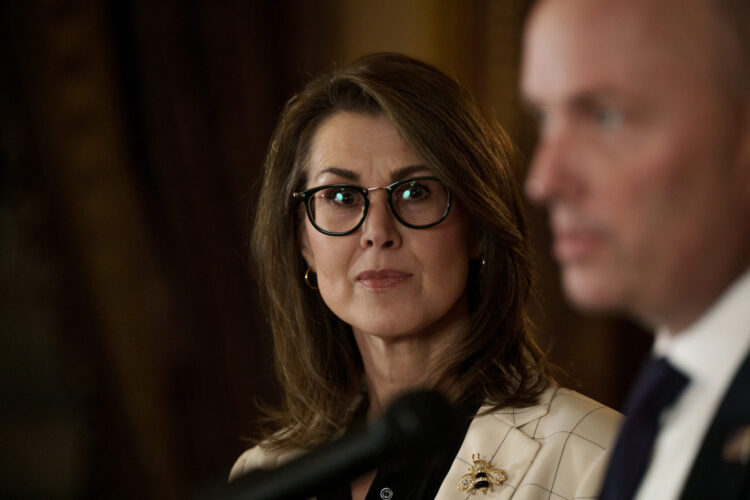
Photo by Spenser Heaps for Utah News Dispatch
Lt. Gov. Deidre Henderson listens as Gov. Spencer Cox speaks during a press conference at the Capitol in Salt Lake City on the final night of the legislative session, Friday, March 6, 2026.As Utah’s senior U.S. senator helps lead a Republican charge to make sweeping changes to voting, the state’s top election official this week has raised numerous red flags about the bill, saying it could violate constitutional secret ballot rights and federally preempt states’ rights.
Lt. Gov. Deidre Henderson, a Republican, shared a series of posts on multiple social media platforms on Wednesday expressing frustration with Sen. Mike Lee and his push for the legislation, called the Safeguard American Voter Eligibility Act, or the SAVE America Act.
“I can count on zero fingers the number of times Sen. Lee has reached out to ask how his bill will affect our state,” Henderson wrote in a post on Threads.
In another Threads post, Henderson referred to a 2022 op-ed Lee and Henderson jointly wrote for the Deseret News at the time, and said: “POV: That one time your senior senator wrote a joint op-ed with you touting the trustworthiness of your state’s election system and lauding the virtues of federalism before running a bill demanding we throw it all out the window three years later.”
“Utah law already requires both voter ID and American citizenship to vote,” Henderson wrote in a post on Facebook. “The SAVE America Act would hurt Utah voters and preempt state laws in ways that don’t make sense.”
Henderson’s post also blasted the effort to pass the voting bill quickly, ahead of the November midterm elections. President Donald Trump has called the bill his top legislative priority, and he has said it will be crucial for Republicans to keep control of Congress after the midterms.
“If we want a federal law mandating voter ID or Documentary Proof of Citizenship, and it’s really not about disenfranchising a bunch of voters, then states and voters need an onramp with time to prepare — get the documents, obtain the right ID, set up the system,” Henderson wrote. “That’s not what’s happening with the SAVE America Act. This bill would be effective immediately in the middle of an election year.”
The bill, Henderson said, “would be impossible to implement, on top of all its other problems.”
Henderson lists problems with SAVE Act
Henderson listed several facts about Utah’s voting landscape. It’s long been a vote-by-mail state, where the Utah Constitution guarantees the right to a secret ballot for both federal and state elections.
The SAVE voting bill, Henderson noted, would require voters to include photocopies of their IDs in the return envelope of a by-mail ballot, “violating our Constitutional right to a secret ballot.”
Utah already uses signature verification on by-mail ballots — and in 2029, Utah voters will be required to write the last four digits of their driver license or Social Security number along with their signature to verify their identity “in a way that preserves ballot secrecy,” Henderson said.
The SAVE America Act, she wrote, “would preempt that.”
Additionally, Henderson said that if Congress passes the bill, county clerks would need to change how they currently verify voters’ citizenship, which they currently do through the state’s Driver License Division and the state’s REAL ID system.
“Remember when you had to dig up all your documents and show them to the DLD when we switched to REAL ID?” Henderson wrote. “For the SAA, you’ll have to do that all over again to register to vote.”
She said only five states — Washington, Minnesota, Michigan, New York and Vermont — currently offer the “enhanced” REAL ID system required in the SAVE voting bill.
Sen. Mike Lee responds
Lee, in response to Henderson’s posts, wrote on X that “Utah has never been the problem,” but rather “other states are.”
“Federal law is needed to protect federal elections,” he said.
However, in another post, Lee added: “Utah itself has plenty of its own problems. What I meant to say is that it was the federal government, not Utah, that created the particular set of problems making the SAVE America Act necessary.”
The U.S. Senate on Tuesday voted to begin a long debate on the bill that has the potential to span days or weeks. This week, Lee and other Republican senators have held multiple press conferences expressing their support for the legislation, including one Thursday afternoon.
Lee, during Thursday’s news conference, told reporters he was “open” to changes to the bill — which the House passed — in order to “help us get it passed easier” in the Senate.
“We have an obligation to do everything we can to get this passed,” Lee said. He added that a drawn out debate could help muster support, similar to the 60 days it took to eventually pass the 1964 Civil Rights Act.
Lee and other Republican senators argued that voter ID requirements are popular with the American public, and it shouldn’t be something Democrats oppose.
Democrats have ardently argued the bill would add unnecessary obstacles to voting, especially for those who don’t have access to their birth certificates or passports to prove their citizenship when they register to vote.
Utah Gov. Cox says he supports the ‘concept,’ but the bill has implementation problems
Henderson’s boss, Utah Gov. Spencer Cox, told reporters during a press conference broadcast by PBS Utah on Thursday that he and Henderson are supportive of the concept behind the SAVE Act — to ensure only U.S. Citizens are voting — but they have some concerns about its implementation.
“I think we’re all supportive, including the lieutenant governor, of the goals of the SAVE Act,” Cox said. “It’s just on how it’s practically implemented. So we can do it and keep people safe and make sure we’re not preventing American citizens from voting.”
Cox said that Henderson was understandably “frustrated” by the SAVE Act, while also pointing out Lee’s posts in response, which Cox characterized as Lee “defending” Utah. Cox said the state is “constantly improving elections.”
Henderson is “entitled to be frustrated,” Cox said, since Lee hasn’t communicated with her about the SAVE Act.
“Look, running elections is very hard. The lieutenant governor has the hardest job in the state,” he said. “And so she is entitled to be frustrated when there is a lack of communication. We should have more communication with our federal delegation. Sometimes that’s on us … Sometimes that’s on them, they should be reaching out to us just to talk through some of the issues.”
The governor pointed out that Utah started voting by mail more than 10 years ago — before the COVID-19 pandemic — and he said other states haven’t spent the same amount of time or effort as Utah leaders have improving security around voting by mail.
Cox also noted that Utah lawmakers this year passed a law that would require voters to prove they are U.S. citizens for local elections if election officers lack confirmation and get in touch seeking documentation. That law bifurcated federal elections from local elections, since the state has the authority to make the requirement for local elections, but not federal ones.
The Utah Legislature this year also weighed a bill to further unravel Utah’s automatic vote-by-mail system and require in-person ID for voting with a by-mail ballot, but it hit a dead end. Instead, they passed a bill to commission a Utah Valley University study on “the security of in-person voting versus voting by mail” and “best practices” for ID requirements.
Pressed on Henderson’s concerns about the federal government infringing on states’ rights to administer elections, Cox said the federal government has “always” had some election restrictions, but it can only go so far to tell states what they can or can’t do.
“Federalism matters, but again, immigration is in the purview of the federal government,” he said. “So the federal government does have a role (to) make sure that noncitizens are not voting.”
In January, Henderson’s office reported that an ongoing review of Utah’s voter rolls hasn’t found any cases of noncitizens voting in a Utah election. That most recent review resulted in one noncitizen registered voter being removed, in addition to four that were found last year.