
Utahns say their quality of life is at a 15-year low, new report says
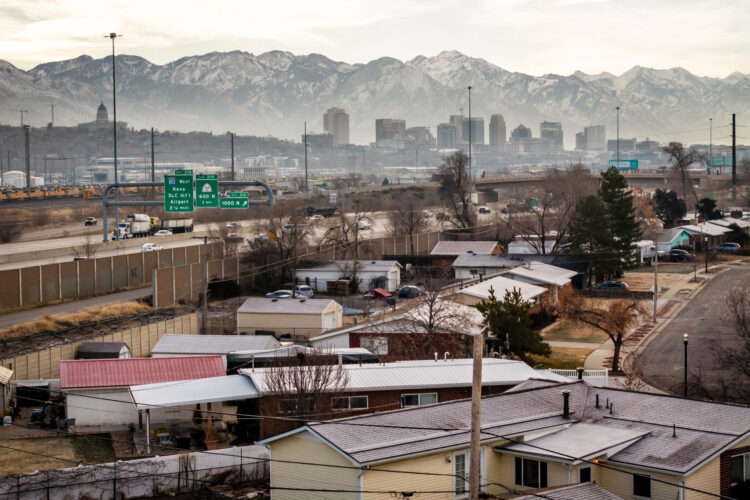
Traffic moves along I-15 near neighborhoods in the Rose Park neighborhood of Salt Lake City on Jan. 3, 2024. (Photo by Spenser Heaps for Utah News Dispatch)
Utahns’ perception of their quality of life is the lowest it’s been in 15 years, according to a new report.
The report issued last week by the nonpartisan research nonprofit, the Utah Foundation, says Utah’s quality of life index measured an “all-time low” of 63 out of 100 based on a statewide survey that measures 20 factors of Utahns’ experience in their communities.
“This is the lowest point since the survey began in 2011,” the report says.
Shawn Teigen, president of the Utah Foundation, said in a prepared statement that the quality of life index was created 15 years ago “as a way to gauge when Utah’s livability has gotten a bit off track.”
“Utah is amazing, but we’ve seen a decade of decline in our quality of life,” Teigen said. “To turn that around, we’ll need to maintain the support we provide to our neighbors, improve Utahns’ ability to earn enough to pay for their needs and ensure that Utahns have opportunities for good jobs. By focusing on these, Utahns will enjoy future improvements, together.”
All but two quality of life factors have declined in Utah since 2013, the report says. Concerns about housing unaffordability and cost of living were the highest contributors to the decline, while opportunities for good jobs was the only factor that dipped significantly from 2022 to 2026.
“Housing affordability, cost of living, and opportunities for good jobs sit among the poorest-performing factors in the 2026 results, along with traffic, public transit, and air and water quality,” the report says. “When asked what would most improve the quality of life in their communities, Utahns mentioned each of these issues and the need to manage growth at a higher rate than other factors.”
At the same time, surveyed Utahns had higher ratings for other aspects in their communities, including religious activities, natural surroundings and parks and recreation. They also rated community support as the “most important factor in determining Utahns’ overall quality-of-life rating.”
“However, not all Utahns share the same experience,” the report noted.
Those who are actively religious and higher earners (those earning a salary of at least $79,000) reported higher quality of life than others, according to the survey, while other factors varied widely across different demographics.
In recent years, Utah Gov. Spencer Cox and the Republican-controlled Utah Legislature has tried to incentivize developers to build more homes in order to alleviate the state’s housing affordability crisis, but home prices remain high and progress on home-building goals has been slow going.
At the same time, with an eye toward economic development and keeping the state business friendly, state leaders have prioritized keeping Utah competitive with other states by lowering income taxes for six years in a row.
That has amounted to more than $1.5 billion in cut taxes over six years — with the vast majority of those cuts going to the wealthiest earners.
Meanwhile, critics including Democrats and advocates for public education and low-income Utahns have said that tax revenue could be put to better use for schools and services for the state’s most needy.
The quality of life survey was conducted in partnership with the Utah Chamber and the University of Utah’s Kem C. Gardner Policy Institute. In a post published Oct. 13, the Kem C. Gardner Policy Institute said the long-term trend showing Utah’s quality of life is slipping “underscores the importance of continued action to preserve Utah’s strengths as the state grows.”
“Utah’s tremendous strengths continue to make our state an exceptional place to live, work and raise a family,” said Natalie Gochnour, director of the Kem C. Gardner Policy Institute. “This research also reminds us that a high quality of life should never be taken for granted. Utah’s continued success depends on how well we address pressures such as housing affordability, the cost of living and economic opportunity while protecting the community assets Utahns value most.”
Spencer Eccles, chair of the Utah Rising Steering Committee (an initiative led by Utah business leaders with the Salt Lake Chamber) said the “states that offer the best quality of life, not just the best jobs, will be the ones that thrive, thus making livability one of the most powerful economic advantages Utah has.”
“Through Utah Rising, our business-led initiative to keep Utah the top-performing economy in the nation, we set a goal to protect and improve livability for individuals, families and communities across our state,” Eccles said. “This index provides the tool to measure our progress and help Utah thrive.”