Garden Help Desk: Difficult to identify growth on Magnolia tree
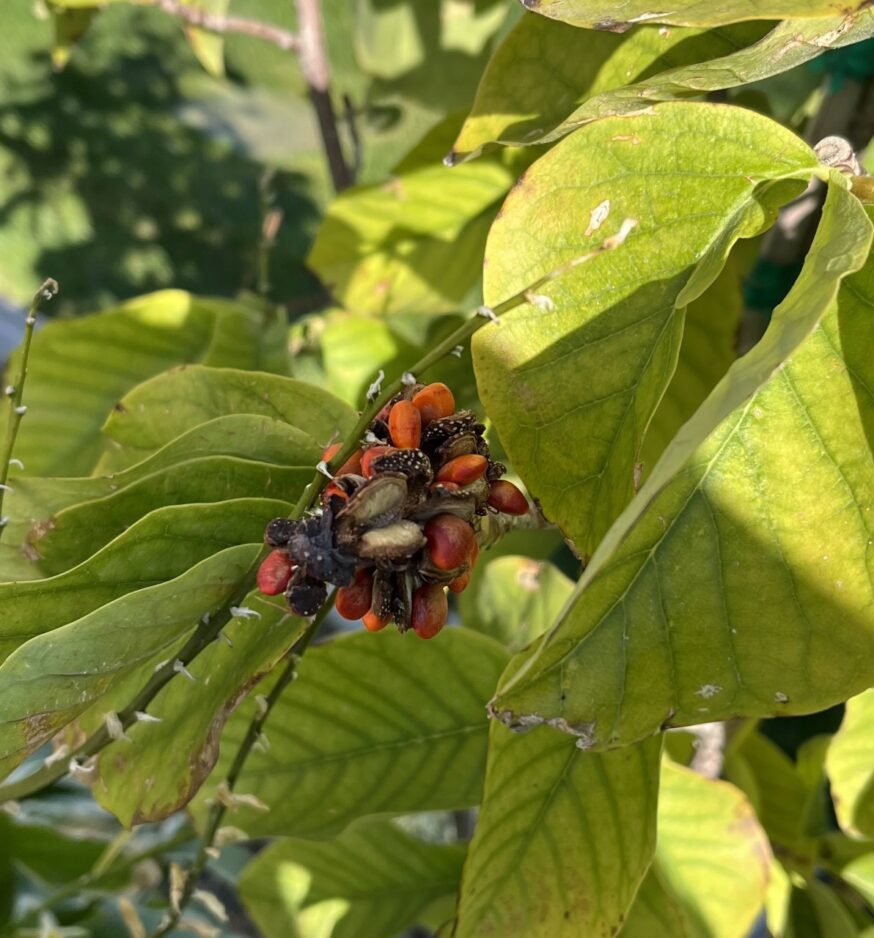
I’m wondering if you can tell me about this growth that opened into seeds on my Susan Magnolia tree. I’m also wondering if the leaves look diseased (I took this picture in the fall).
The strange-looking “growth” is a magnolia fruit. The red objects are the seeds.
The pale leaf color with darker veins is typical of an iron deficiency called Iron chlorosis.
Iron chlorosis is caused by an iron deficiency in the leaves. Our soils have plenty of iron, but it isn’t readily available to plants because of our alkaline soils. Iron sensitive can’t get as much iron as they need. Without enough iron the leaves can’t make enough chlorophyll, which they use to make food for themselves, and their leaves are pale. If the iron chlorosis is chronic, affecting a plant year after year, a tree won’t have enough carbohydrates and will decline. The canopy will thin, or random branches may die back. Eventually, trees with chronic iron chlorosis can die.
Magnolias are healthiest growing in a slightly acidic soil, well-drained soil. If your soil is like most Utah County soils, it’s at least slightly alkaline and slower to drain. That means your magnolia tree needs a little extra attention and careful water management.
Water your tree deeply, but not more than once a week during the summer and less often in the spring and fall. Also consider getting some chelated iron into the root-zone soil in the late winter or very early spring.
I’m concerned about these bumps I saw on my oak leaves last month. What are they? Should I spray the tree with something next spring?
The galls on the leaf look like Cynipid wasp galls. I opened a couple of the galls while checking with my microscope and there were tiny wasps inside.
There are quite a few insect groups that cause galls, and cynipid wasps are one of those groups. Their eggs are laid in plant tissues, the larvae hatch and feed in plant tissues and plants respond to their feeding by creating galls. The larvae eventually pupate inside the galls and emerge to produce a new generation.
There are many species of Cynipid wasps and they’re very common gall insects, especially on oaks and roses. These wasps are very tiny, so they’re not usually seen by gardeners in the landscape. Even though Cynipid wasps are seldom seen, their feeding causes galls that are sometimes hard to miss. The galls on your oak leaves are small but some galls are large enough to be seen from several feet away.
Chemical control isn’t normally recommended for these insects because these galls don’t affect the health of the tree, and because the timing of an insecticidal spray for cynipid wasps is a challenge. The timing must be precise to be effective- an application must be done while the adult wasps are active but before galls can begin to form. A more practical approach with small leaf galls like these is a thorough cleanup under the tree in the fall and then again in the late winter, if needed, to remove any more leaves with pupating wasps from the area.
Something is wrong with one of my poinsettias. I was going to keep them and try to get them to bloom again next year. The one in my kitchen looks like it has a disease. There are dry, black spots on the leaves, and a few holes, too. Should I just throw it out?
There are a few diseases that can show up in poinsettias at home. The most common one is powdery mildew, which doesn’t fit your description. Without a photo to look at, all I can do is make a couple of “best guesses.”
One possibility is cold injury. If your kitchen poinsettia has been near a window where the leaves have touched the cold glass, those parts of the leaves will turn black.
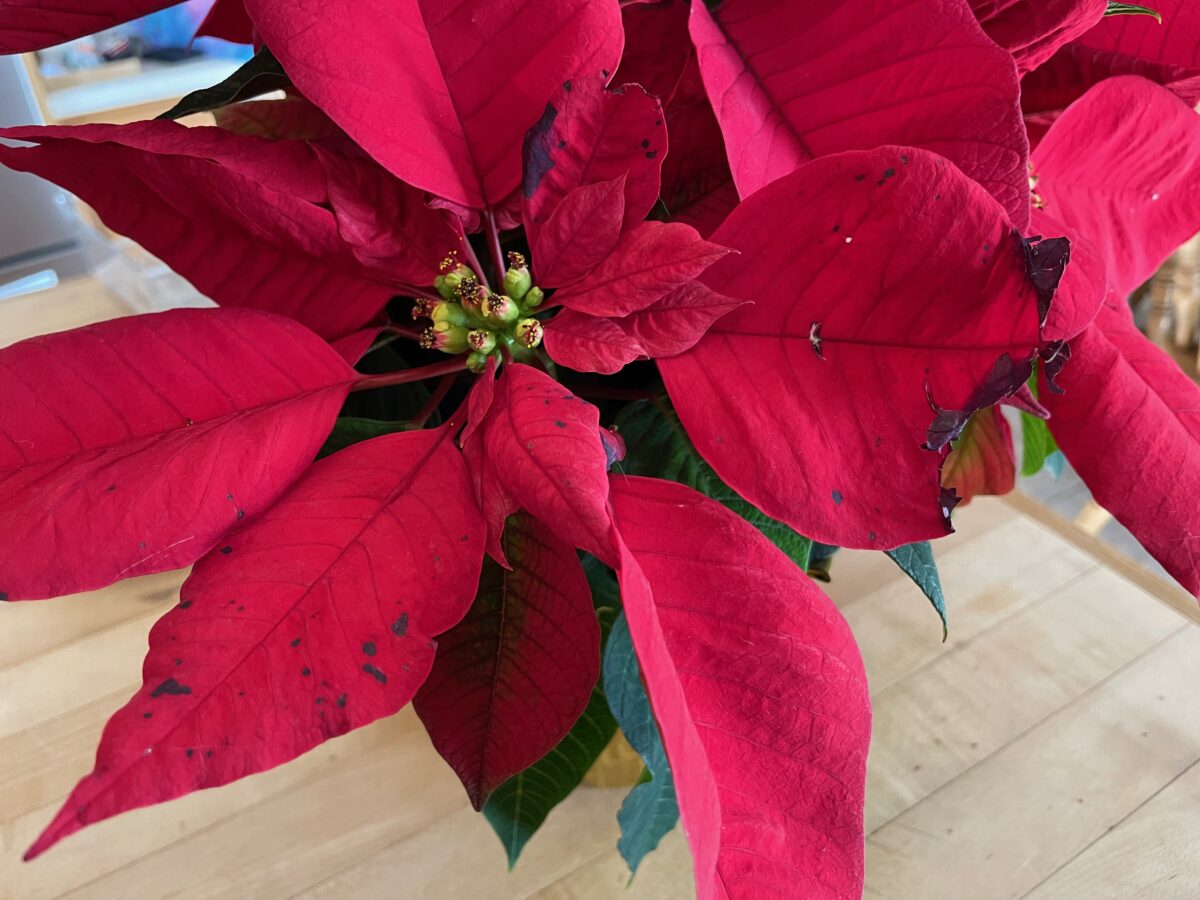
Another possibility is damage from a pet or child. Your description sounds a lot like what I’m seeing on one of my poinsettias. After I saw our cat giving the plant a little too much love, I realized that she was getting little spots of saliva on the leaves. Those spots turned black later. Take a look at the photo I’ve included today and see if this looks like what’s happening with your poinsettia.
Neither cold injury or pet/child injury are diseases that will spread to other plants or affect the general health of your poinsettia. Don’t throw out your plant; with time it will put on new leaves and look better.
By the way, poinsettias aren’t toxic, but their sap can be irritating.
-
- Magnolia fruits don’t look like the fruits we’re used to seeing. The maturing seeds make the fruit look even more unusual.
-
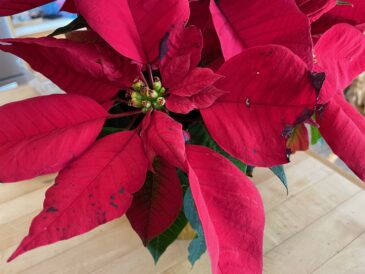
- Pets can cause damage to plants beyond just breaking stems or branches.