Money Matters: The unseen changes companies made during the pandemic
Steven Senne, Associated Press
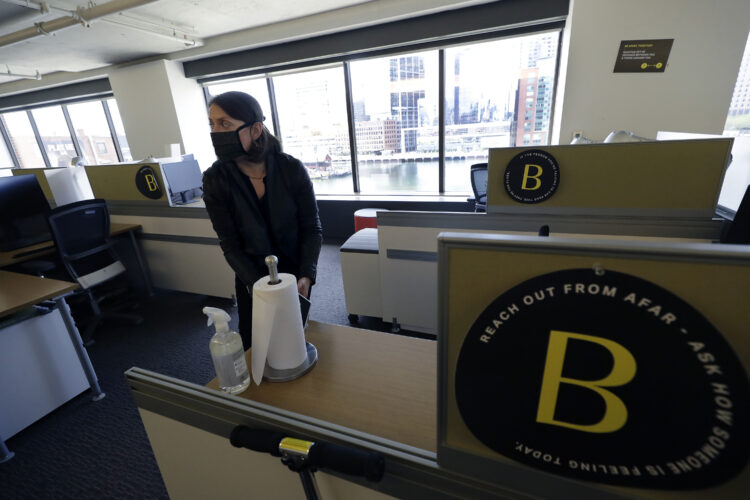
This Thursday, May 7, 2020, photo shows Vice President Rachel Zsembery at the design firm Bergmeyer organizes sterilizing equipment at the firms offices in Boston.The hybrid workplace has become a defining aspect of the post-pandemic business. With work-from-home options, new company communication methods and an undeniable shift in culture, many companies will never be the same again. But incorporating a hybrid work model is not the only way businesses have changed. Many companies, large and small, have refocused on resilience and restructured their internal managerial systems, hiring practices and more.
One such company in Lehi, Kahoa, exhibited this post-pandemic change by restructuring their middle management. Formerly known as SolutionStream, Kahoa is a provider of digital strategy and business consulting services. Across industries, companies have become more globalized, meaning team management has to be more flexible. And others have expanded their pool of contingent workers. These examples are just a few ways internal structure has changed in response to the pandemic. As resilience becomes a renewed priority, the changes may be here to stay.
No more middle management
When the effects of the pandemic on employees became clear, the Kahoa team knew they needed to emphasize the employee experience, their quality of work and their ability to work independently. So they reorganized their internal structure to create a blended work environment with a flat structure. What did this look like? There was no more middle management, and employees across the company were organized into small, collaborative squads instead of being siloed in specific disciplines. Squads also were charged with maintaining and encouraging company culture, even in a remote or hybrid environment.
“We wanted to make sure our employees were experiencing support and unity in their work,” said Chad Atkinson, a partner at Kahoa. “We considered several solutions, but eliminating middle management roles and organizing employees into squads emerged as the best path forward for us. So far, these changes have made an enormous difference in the lives of our employees and across the company as a whole.”
Customized performance management
“The COVID pandemic has forced businesses to focus on building resilience in their supply chains and operations,” according to a report by McKinsey. “Not everything that can go wrong actually does go wrong, but businesses and governments cannot afford to be caught flat-footed when disaster strikes.” The pandemic and ensuing financial crisis accelerated global mergers and acquisitions, and many companies nationalized or became more geographically diversified to avoid failure.
As organizations become more complex, business leaders should encourage separate units to customize performance management because a one-size-fits-all approach likely won’t work across more-complex enterprises. For example, career pathing will probably look very different from one branch to the next. That may mean that providing reskilling and career development support should become a priority so that all employees know how to develop in their role, no matter where they are based.
More flexibility in workforce management
Through the economic uncertainty of the pandemic, many workers lost their jobs, and many others were exposed to nonstandard work models for the first time. A lot of organizations responded to these economic changes by reducing their contractor budgets, but now that the economy is more settled, this budget choice seems to be shifting.
According to a Gartner analysis, “organizations will continue to expand their use of contingent workers to maintain more flexibility in workforce management post-COVID-19, and will consider introducing other job models they have seen during the pandemic, such as talent sharing and 80% pay for 80% work.”
Replacing full-time employees with contingent workers can be an effective cost-saving measure. It provides the company with greater flexibility in workforce management, which can make all the difference in times of economic uncertainty.
The hybrid workplace isn’t the only sweeping workplace change to come out of the pandemic. Many companies are increasing their focus on resilience by restructuring their internal managerial systems, hiring practices and more. Some companies restructured their middle management or removed it altogether, changed their team management practices or expanded their hiring of contingent workers. The pandemic shined a light on the importance of business resilience, and management changes like these are helping companies survive and grow into the future.