Everyday Strong: Talking with your child’s doctor
Wilfredo Lee, Associated Press
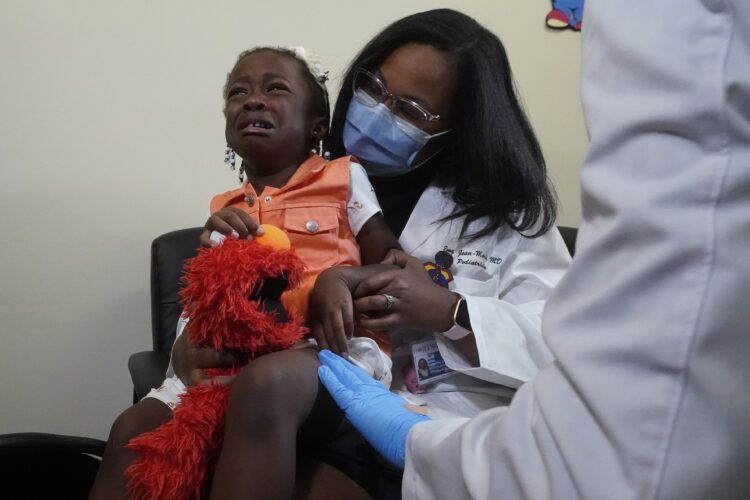
Pediatrician Emy Jean-Marie, right, holds her daughter Emiola Adebayo, 3, on her lap as the girl reacts after receiving a vaccine on Tuesday, June 28, 2022, at the Borinquen Health Care Center in Miami.We’ve all heard the proverb, “It takes a village to raise a child.” As parents we so appreciate the help others give us in raising our kids. Teachers, neighbors, religious leaders, doctors and extended family can provide valuable support to parents and children.
We strive for a safe and healthy environment in which a child or teen can thrive. It stands to reason that communication and working together with other “villagers” is key in this endeavor.
In a podcast from January 2022, EveryDay Strong Director Michaelann Gardner interviewed Family Physician Dr. Dana Munn to get his perspective on parents and doctors working together for the good of youth.
Dr. Munn says that the first thing he would want parents of struggling preteens and teens to know is that they are not alone. Raising children with mental illness “is a struggle that a lot of parents go through and it’s probably something that has existed for a long, long time. But luckily, our world is becoming more open to these types of things.”
He goes on, “You are dealing with this as well as many other parents are. And it’s often around this time where we start seeing these things pop up in the preteen or the teenage years.” Dr. Munn explains that mental illness is a medical disease.
“It is not something that just happens because things aren’t going good, but just like high blood pressure is a medical diagnosis, depression, anxiety, all are also medical diagnoses and there’s often something else going on,” he said.
What is the best way to communicate with your child’s doctor about a diagnosis or treatment? Munn says that sharing background information is very helpful to a doctor. “Has there been a divorce? Has there been a death in the family?”
According to Munn, the more information a parent shares “the more clear of a picture I’ll have in order to help out appropriately.”
When meeting with a doctor it is also important to let the child talk. Dr. Munn advises parents to “not overwhelm your child and jump in with (talk of) depression and anxiety. Sometimes it’s hard to get your child to talk to me but often a time of awkwardness is okay. If there’s a quiet moment, let them think about it, let the child get a little awkward so they feel the need and the urgency to break the silence and say what’s on their mind.”
When a parent feels that their child has been misdiagnosed or has a concern about prescribed medication they should speak up. If the child is not progressing the doctor needs to know that. Parents and doctors working together is going to work in the child’s favor more than either one alone.
Parents should also be aware that treating mental illness requires patience. Improvements from behavioral and medical interventions may take weeks to become apparent. If substantial progress is not being made after that time, the patient may have to begin again on a different regimen. Even finding the right therapist may take several tries.
If a child begins treatment and their depression or suicide ideation worsens, they should get help immediately. But if the situation is not that urgent, exercising patience and persistence are essential to getting the child the best treatment.
Munn advises parents to, “be there for the patient and don’t allow them to end this journey early. I see lots of patients who get sick and tired that things aren’t working and they’re not feeling better and they kind of give up. And we need someone there to help push them through that point. Often it takes a couple of tries, but we usually find either a medication that works for them or a psychologist that works for them.”
Ultimately, Dr. Dana Munn urges, “Get help. This is never anything that someone should do on their own, meaning the patient but also the parent. Sometimes you, as the parent, don’t even want other people to know that your child is struggling with these things. But the more people that you have helping, you’re gonna find a lot of good support. And more than likely you’re gonna see another parent that is also struggling with a very similar situation.”
Allowing other “villagers,” such as doctors, to help in raising a child is extremely beneficial to parents, but most importantly to our precious children.
United Way of Utah County is on a mission to help every child in our community feel safe, connected, and confident. You can listen to our latest podcast episode at anchor.fm/everydaystrong (or on Apple Podcast and Spotify). Learn more about us at everydaystrong.org.