
Everyday Strong: How do I respond to my child’s negative self-talk?
Matt York, Associated Press
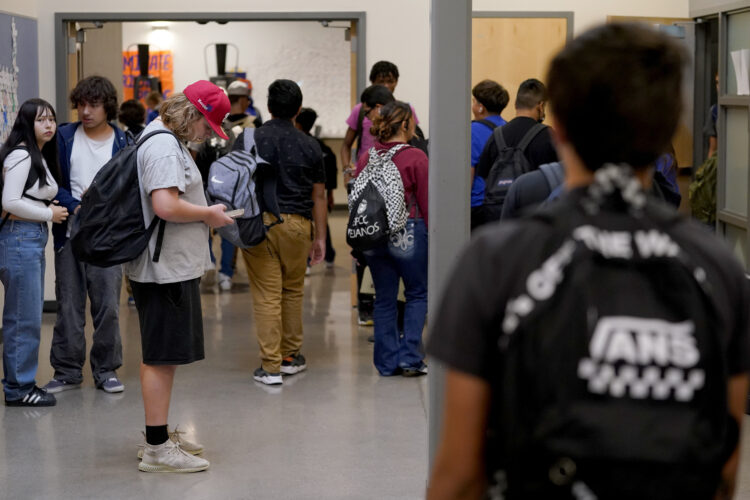
Westwood High School students make their way to classes on Oct. 18, 2022 in Mesa, Ariz.We can be our own worst critics. What we might see as something harsh to say to someone we love, we readily tell ourselves. The same can be said for children.
In this week’s EveryDay Strong Podcast, Allen Pauole, a therapist at Revere Health, discusses negative self talk. When it comes to talking with teenagers about what they may be thinking, it is definitely easier said than done.
It’s important for parents and caregivers to keep in mind that these are essentially young adults in the making, and they’ve got all of the same stress and responsibilities that anybody else has, but on a different level. The biggest difference is that they’re trying to navigate it for the first time while adults, typically, have past experiences to fall back on.
Pauole recommends that parents be very clear with the child, and establish the kind of relationship where they feel free to talk about the issues that are bothering them. When given the chance to talk or vent about whatever is on their mind, a teen feels validated. At EveryDay Strong we like to emphasize how important it is to meet someone’s physical needs when it comes to problem-solving.
Making sure a child gets enough sleep and has enough to eat will help them be more resilient. After those needs are met, simply showing up and being with them will help strengthen that parent-child relationship.
“As a therapist and as a father, one of my favorite qualities to building up that self-esteem and that resilient child is independence,” Allen Pauole said. Giving them opportunities to complete tasks on their own “helps build a sense of safety and helps them see that they are capable. They will feel they have more control over their life and show that you trust them to get things done on their own.”
“I’m really a big fan of what I refer to as the what questions and not the why questions.” Pauole added. “Because anytime you ask another person and especially a child, ‘Well, why did this happen?’ Or ‘why did you do that,’ the response is almost always going to be very universal with the classic ‘I don’t know’ or shrug of the shoulders. It starts with asking the child to take their life in their own hands and give them the power to decide for themselves what they must do to feel better about themselves, while in a safe place.”
“Moms and dads have the single biggest influence on what kids are gonna do or not do.” Pauole said, “Siblings tend to be a distant second, and then contrary to popular belief, pop culture figures are going to come in way down the road.”
Making sure they have a strong foundation in the home, where the parents are talking to themselves in a healthy way helps the child feel more confident and comfortable speaking themselves.
Most people don’t like to be told exactly what their problem is and what they need to do. The same goes for children. They need space and encouragement from their parents to figure out the issue on their own. This empowers them more than fixing whatever seems to be the issue.
One way to do this is through creating emotional security with your child. At United Way, we like to explain that keeping your mouth closed half the time, and allowing your child to carry the conversation is one of the best things that can be done to foster that security. When they are speaking, be careful not to minimize their issues. What seems insignificant to you, can mean the world to them.
“The best gift we can give others is the gift of humanity.” Pauole concludes. “We forget that everybody has good and bad days, and everybody is allowed to be tired and happy and experience a wide range of emotions.”
United Way of Utah County is on a mission to help every child in our community feel safe, connected, and confident. You can listen to our latest podcast episode at anchor.fm/everydaystrong (or on Apple Podcast and Spotify). Learn more about us at everydaystrong.org.
Community

Veteran’s Stories: Lehi’s Jim Slade helped when he could and saw tragedy in Vietnam

Making a Difference: Blankets distributed to ill children, others through Covered with Love
Utah Valley Calendar: Things to do – April 11
AMERICAN FORK "The Fantasticks" — Timp Arts Theater presents the musical "The Fantasticks," featuring story of a ...