EveryDay Strong: Understanding how child development affects behavior
-

- Taking time to listen to a child and show you care helps build their self-confidence.
-
- Maslow’s hierarchy of needs
-

- Understanding the role of executive functions in a child’s thinking can help adults assist the child through challenges in their life.

Courtesy United Way of Utah County
Taking time to listen to a child and show you care helps build their self-confidence.
Does it ever seem like your child’s only mission is to embarrass you in public? Or make you pull your hair out every time they forget their lunch at home and call you to bring it to them?
Maybe it has nothing to do with a diabolic plot to cause premature aging but is actually related to their executive functioning.
What is executive functioning?
Executive functions are the important skills we use to handle the demands on our time. They include:
- Inhibitory control (self-control or being able to control impulses).
- Holding things in our working memories.
- Being able to shift our attention from one to thing to another.
They also include planning and reasoning — skills that we are using all the time without even thinking about it. Skills we all pray our children will develop overnight.
How do executive functions develop?
People develop executive functions at different rates as they grow. Because of this, it’s important to note that one child’s ability to use certain executive functions may be a little different from another.
Courtesy United Way of Utah County
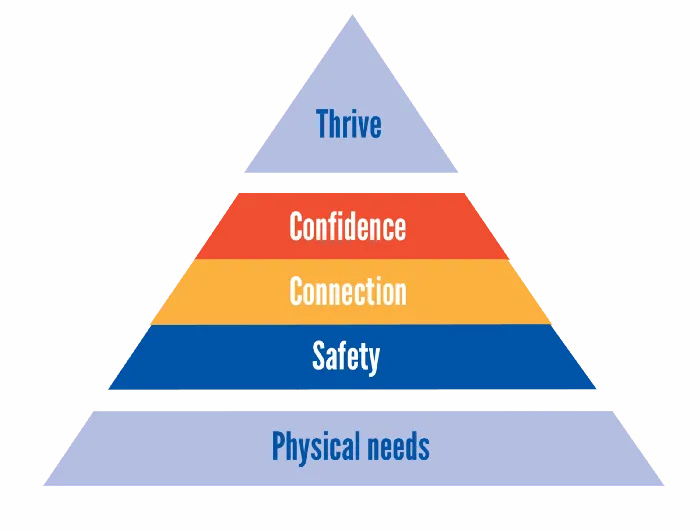
Maslow’s hierarchy of needs
We need to be patient with the development process, even with ourselves.
Our brains reach maturity around age 25 to 30, and our ability to use executive functions grows as we do.
We used to believe that that was “it” — that once the brain reached maturity, everything went downhill from there. But there has been really encouraging research that shows you can continue to “train” your brain and improve executive functioning even as an older adult.
How do emotions affect behavioral functioning?
When we are sad, depressed or stressed, our emotions impair our prefrontal cortex, which is what controls our executive functions. So, often, when we get frustrated with ourselves — or our children — or we feel like “basic things” aren’t getting done, it may be partly related to our emotions and experiences.
This is important as we work with children. Why are they so vulnerable, and why do we struggle to help them get out of tough situations?

Courtesy United Way of Utah County
Understanding the role of executive functions in a child's thinking can help adults assist the child through challenges in their life.
Emotional regulation and managing emotions can be linked back to executive functioning, and I think sometimes we’re not giving the developing brain enough credit.
We frequently get caught up in the heat of the moment with our children and ask ourselves, “Why are they doing this?” or “Why don’t they just listen to me and stop misbehaving?” Our parenting efforts would be more effective if we kept in mind that there might be impaired executive functioning.
But in Maslow’s hierarchy of needs, confidence also plays a role.
How can I help a child develop confidence?
“Children need to feel a sense of mastery and growth. Having the skills required to learn, manage emotions, self-motivate, make friends and solve problems will build confidence, and so will reassurance from caring adults,” states “Confidence,” a school resilience handbook.
Helping others gain confidence is complicated. There is no quick fix.
Sometimes we think if something is not showing immediate results, it’s not working. But we need to realize that things take longer than we think (and usually want).
For building up confidence, it means taking the time to really listen to a child and show that you care as well as encouraging them in their efforts. Your support can go a long way.
We can also build up their capacity and ability. For example, instead of saying, “These should be your goals,” we can help children set their own goals, going step-by-step, making sure they are clear and attainable.
We also need to brainstorm what potential barriers exist for our child first, then figure out how we are going to overcome them together. Learning to foresee barriers helps build confidence, self-efficacy and executive functioning.
We all want to fix things and problem-solve and feel like we are helping others, yet reactions that try to suggest immediate solutions are not empowering because children need to feel like they are in control. Part of building up children’s confidence is helping a child realize they can come up with solutions themselves rather than relying on others for every solution.
Check out our EveryDay Strong Resilience Handbook or our School Resilience Handbook for more ideas on how to recognize and develop confidence.
Can I help even if I’m not a parent?
Absolutely!
It’s true that the more we can do to strengthen communities and facilitate strong families, the better. All of our research shows this; if we can support healthy, connected families, it’ll make a world of difference.
Even when a solid family framework does not exist, there are things the community can do. A strong family can have a hard time existing when the community around them is not strong.
So, whether you’re a teacher, somebody at church or a neighbor, know that you can help. You can make the much-needed difference in a child’s — or in anybody’s — life.
United Way of Utah County’s EveryDay Strong is on a mission to help every child in our community feel safe, connected and confident. To see how you can help, check out our community resources, find us at everydaystrong.org or follow us on Facebook and Instagram. This column was originally published at heraldextra.com on March 25, 2018. Edited and reformatted August 2020 by Thalia Pope, EveryDay Strong community outreach specialist.