Veteran’s Stories: Lehi’s Jim Slade recounts dangers of Vietnam mission that had to be aborted

-
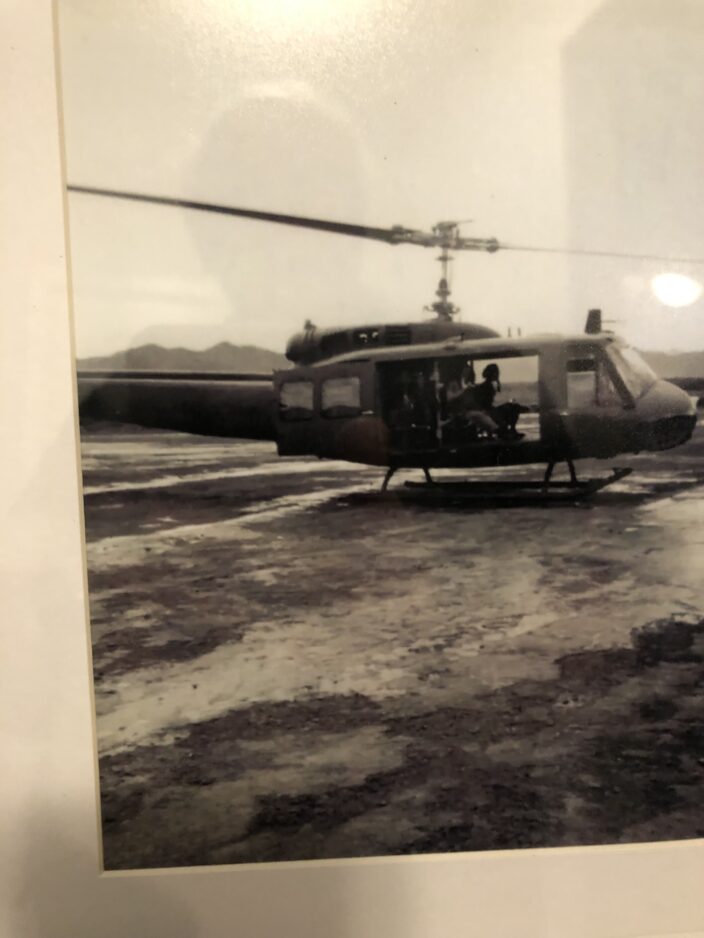
- Photo of the US Huey helicopter, taken moments after its return from the mission involving the punji stakes. Jim Slade is still in the back of the chopper.
-

- Jim Slade of Lehi holds a captured Chinese-made rifle he brought home from Vietnam.
-
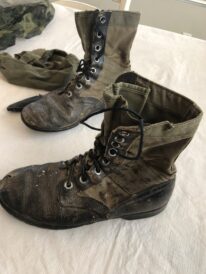
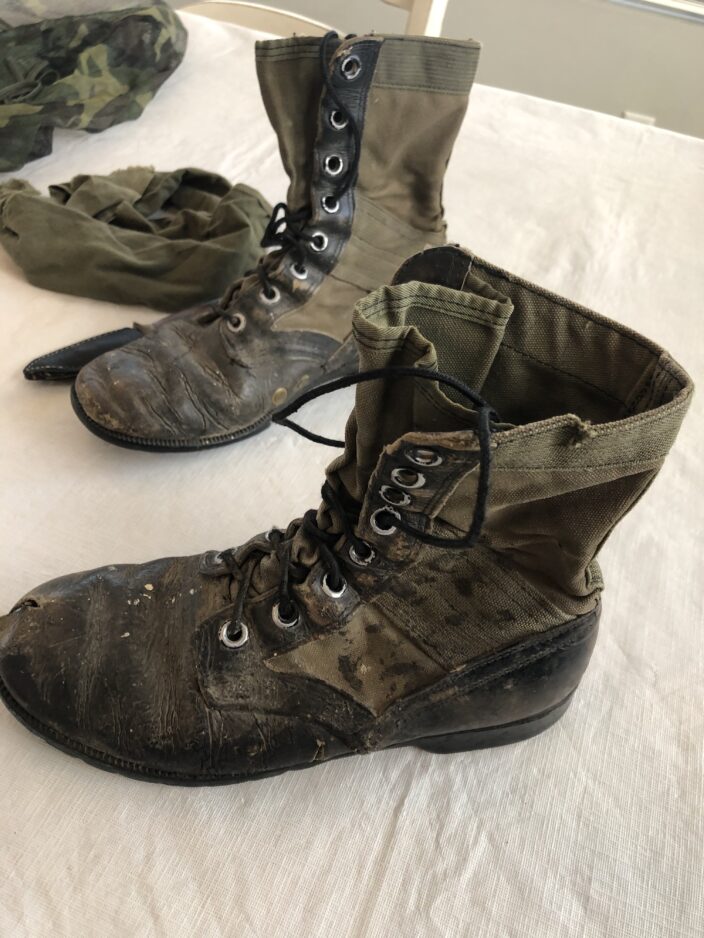
- Jim Slade’s lucky boots. The left boot shows three areas of damage, two of which resulted in injuries to Jim.
Americans everywhere owe an enormous debt to the men and women who fought for their country. To remember these brave individuals, the Daily Herald is pleased to share some of their stories.
This is the second article in a weekly series will share the experiences of Jim Slade of Lehi, who served as a soldier during the Vietnam War. It was not Jim Slade’s choice to serve in that war but when he was asked, he answered the call. A loyal American who has served admirably and who loves his country, Slade tells his children and grandchildren, “Freedom is not free!”
The blades of the US Army Huey helicopter made a loud whooping sound as it approached the landing zone. The pilot was looking desperately for a safe place to put down.
Jim Slade, US Army Ranger, and four other members of his LLRRP (Long Range Reconnaissance Patrol Team) were crouched in the chopper waiting to jump out. They were working a risky combat mission in war-torn Vietnam. Below the chopper in the landing area, was twenty-foot-high elephant grass. The pilot, who was flying only his second combat mission, couldn’t see the ground.
When Jim and his men jumped out they hit the ground hard and knew the distance was more like fifteen feet, much too high for a safe jump. Jim somehow made it without injury and quickly moved away from the chopper through the tall grass. Moments later he realized his team was not following him.
He headed back to the landing zone looking for his men. He found that they had been injured severely by Punjii stakes set exactly where they had jumped out of the chopper. Jim had also hit a stake but, while it sliced a one-inch cut in the toe of his boot, it did not penetrate his skin. One of his team members had a stake penetrate the sole of his boot, run up into his foot and his leg, coming out just below the knee. Another man had a similar injury but the stake exited his thigh above the knee.
Jim knew this was very bad and they could not continue on this mission. He also knew these men would need immediate medical evacuation to a hospital. Punji stakes were often laced by the Viet Cong (Vietnamese Communists or VC) with human excrement to cause infection. Recovery from a Punji stake injury often took weeks because of infection in the wound. He immediately got on his radio, calling back the chopper pilot, who by now was 30 or 40 miles away.
By the time the chopper got back, they were under heavy fire from the Viet Cong. They had heard it coming in and seized the chance to attack. Their goal was to bring it down and kill every American soldier on board. Bringing down an American helicopter and killing all of the men in the chopper would be a huge victory and a feather in the cap for the VC of that area.
Jim helped his team members scramble on board and the pilot took off, but now there were bullets coming in from all around. Some were crashing into and through the chopper.
One bullet hit the pilot’s control stick between his legs. It then continued upward, narrowly missing his face and nose and knocking off his helmet. He panicked and screamed, but somehow got the chopper off the ground.
Other bullets had also damaged the tail rotor, making the 75 mile ride back to the base extremely hazardous. The imbalance caused the tail end to vacillate and the chopper barely cleared the trees as it took off.
At the base, they unloaded the wounded men and got them headed to the hospital. Then they checked out the damage to the chopper. The main rotor blade had two bullet holes, one at each end of the blade. This meant that the blade, though damaged, was balanced and could turn without too much wobble. A chopper can only fly if the main rotor is balanced. The tail rotor was in bad shape, with just a small piece of metal holding it on.
After that inspection, Jim and his men realized that it was a miracle they had made it back to the base at all.
Check back next Saturday as Slade shares another of his experiences during his time in Vietnam.