Senate hopeful Mike Lee zeroes in on inflation, immigration, energy, Biden
Harrison Epstein, Daily Herald
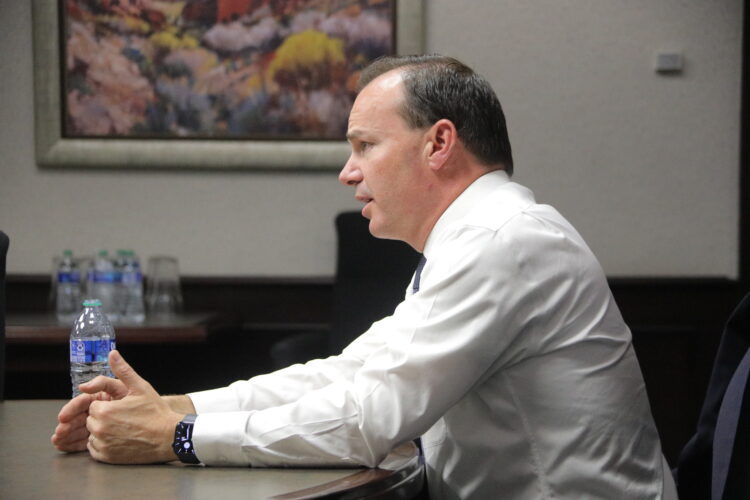
Republican U.S. Senate candidate Mike Lee sits for an interview with members of the Standard-Examiner and Daily Herald editorial boards at the Standard-Examiner office in Ogden on Wednesday, Oct. 26, 2022.Editor’s note: This is the fourth in a series of stories on U.S. Senate hopefuls Mike Lee and Evan McMullin, the major contenders for the post this cycle. Both candidates met with the Standard-Examiner and Daily Herald to discuss their candidacy.
OGDEN — In vying for his third term in the U.S. Senate, Republican Mike Lee says one of his broad aims is to rein in the power of the federal government, narrow its sphere of influence to those responsibilities specified in the U.S. Constitution.
RELATED: Sen. Mike Lee puts focus on inflation, limiting federal power in reelection bid
He faces a challenge from independent hopeful Evan McMullin.
Lee visited the Standard-Examiner offices on Wednesday and here’s where he stands on a range of other topics.
Donald Trump: Lee is a backer of the divisive former U.S. president. He didn’t hesitate when asked if he’d vote for him if he’s the 2024 Republican presidential nominee.
Under Trump, Lee said, the economy was strong, the U.S.-Mexico border was secure and inflation was under control. “I didn’t agree with everything he did. But he runs and he gets the nomination, you talking presumably about a rematch (with Joe Biden), absolutely I’m going to vote for him,” he said.
Lee was no fan of Trump during his 2016 presidential bid and actually voted for McMullin, who waged an independent presidential protest candidacy that year. Lee now views that 2016 vote as a mistake and said he’s been swayed to Trump’s camp by what he accomplished as president.
Democratic President Joe Biden gets low marks. “He has, in fact, increased federal spending. He’s increased the size, scope, reach and cost of the federal government,” Lee said. Moreover, he added, the U.S.-Mexico border is less secure under Biden.
Inflation: He blames inflation on Biden and spending initiatives pushed by Democratic lawmakers. Voting Republicans into office this cycle, he contends, will help counter that spending and, thus, inflation.
“You put the other party in charge of both houses of Congress to stop this reckless runaway spending,” he said. “In the United States of America, inflation has one cause — it’s Congress spending too much money.”
Health care costs: To deal with rising prescription drug costs, he calls for allowing importation of medicine from Canada and certain other countries. He also thinks the process to approve new drugs needs to be streamlined so they can get to market more quickly, bolstering competition.
“It’s competition that improves quality and brings down price,” Lee said.
Allowing Medicare to negotiate drug prices with manufacturers equates to price controls, he said, which will “tend inevitably to protect market incumbents, not encourage more competition.”
Generally, he thinks increased government involvement in health care tends to push prices for consumers up. He thinks expansion of personal health savings accounts, which aren’t taxed, could help chip away at health care costs and give consumers more control over their health care spending.
Ukraine: He voted for the first U.S. funding package for Ukraine to help it fend of the Russian invasion but voted against the second one because it contained out-of-place provisions that “appeared to be thinly veiled Green New Deal efforts.”
Broadly, he feels the U.S. has a role in defending Ukraine because if it falls under the dominion of Russia and Russian President Vladimir Putin, other nearby nations could fall as well. “It’s just that there’s no easy way to do it. It’s not a simple question of saying, ‘Well, we’ll stop him.’ OK. The question is how,” Lee said.
He thinks the situation could have been averted had the United States exported “significant quantities” of liquified natural gas to Europe. That would have reduced the continent’s dependence on Russian supplies, thus halting the revenue flows from natural gas that Russia needs to cover its military costs.
He had tough words for Putin, calling him a “vile dictator.”
Abortion: He said he typically doesn’t weigh in on issues up for debate by state lawmakers, like abortion, but said he backs Utah’s abortion law, focus of a pending court challenge. The U.S. Supreme Court ruling from last June striking down Roe v. Wade gives state authorities to set abortion laws and guidelines.
“It contains appropriate exceptions for cases of rape, incest and life of the mother,” he said of the Utah law, implemented after the Supreme Court ruling.
He doesn’t favor the federal proposal put forward by U.S. Sen. Lindsey Graham, a Republican, that would ban abortions across the country after 15 weeks of gestation. Utah’s law is “more aggressive,” thus with the Graham measure “you’d have less protection of human unborn life.”
He thinks Utah’s abortion law will withstand the court challenge. “I don’t think one can credibly maintain that the Utah constitution of 1896 prohibits protection of unborn human life in a way that would render that statute unconstitutional,” he said.
Immigration: The first step in addressing illegal immigration is securing the U.S.-Mexico border, Lee said. He said that was achieved under Trump thanks in part to his controversial “remain in Mexico” program, which Lee favored, but lost under Biden.
“It has to be to a place where we’ve achieved a degree of homeostasis, where we know who’s coming in and who isn’t, and they’re coming in lawfully and not unlawfully,” Lee said. The illegal entry rate doesn’t have to be zero “but it’s got to be something darn near close to that.”
He is not opposed to dealing with illegal immigrants in the United States, starting with “Dreamers,” those brought to the country by their parents when they were young, but only after achieving border security. “And I think there are ways that we can deal with others outside the category of the Dreamers who are here unlawfully, figure out who ought to be able to stay and under what circumstances,” he said.
Energy: He doesn’t foresee wholesale conversion to green energy anytime soon. It’s not that he opposes it, there just isn’t enough green capacity to meet U.S. energy needs, he said.
“We don’t have anywhere near what we would need to power automobiles and trucks and trains and other things that currently run on liquid fuels,” he said. “It’s nice to dream of those things and to live in a country where resources are available for research and development that could lead to those technologies. But serious discussions of phasing out use of fossil fuels by 2030, or anything even close to that soon, is folly and it’s doing the American people a grave disservice.”
All that said, he doesn’t think anyone would disagree “that it would be nice” to have an energy source that meets consumer needs without combustion, pollution. It’s just that those sorts of options are limited. “We’re nowhere near there,” he said.
China/Taiwan: He worries about China initiating some sort of effort to take over Taiwan, return it to China’s fold.
“The fact that we’re distracted in other places, the fact that we’ve got a president (Joe Biden) who’s behaving erratically and making weird comments, including weird comments specifically about China — it raises the risk,” Lee said. “And if they view us as distracted right now, I’m not sure what they might do.”
U.S. deterence efforts don’t have to rest solely with the military. Lee called for bolstering trade relations with other Asian and Pacific Rim nations and scaling back trade with China to hit that nation economically.
“That’s why I’ve advocated for a robust bilateral free trade agreement with India, with the Philippines, with a lot of other countries in the region. If we had those, I think you’d see China becoming less aggressive militarily,” Lee said.