Orem residents hear last public comment on Alpine Aqueduct Replacement and Resiliency Project

Courtesy Central Utah Water Conservancy District
Photo shows current pipeline of aqueduct project in Orem.
Orem residents impacted by the Alpine Aqueduct Replacement and Resiliency Project had their last formal public meeting on Tuesday before the Decision Document will be completed later this fall.
The infrastructure being replaced will bring water to much of the Wasatch Front, particularly in Orem and to residents in Salt Lake County.
The project began in 2021 with the first public meeting held Nov. 30 of the same year. Since that time, there has been several studies and options on where the new 108-foot pipeline will be located, according to Orem spokesperson Karen Tapahe.
During the first public meeting, which had 30 people in attendance, questions arose concerning construction timelines, safety, accessibility to homes, maintenance disruptions, rights of way and the pipeline alignment.
The last public meeting on Tuesday had only four residents show up — only one of whom lived on one of the streets that will be affected, according to Sarah Sutherland, Environmental Programs manager.
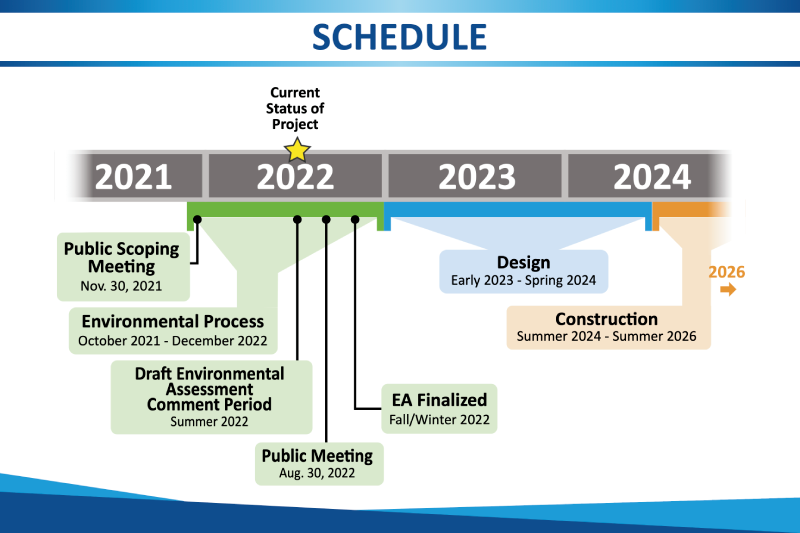
Courtesy Central Utah Water Conservancy District
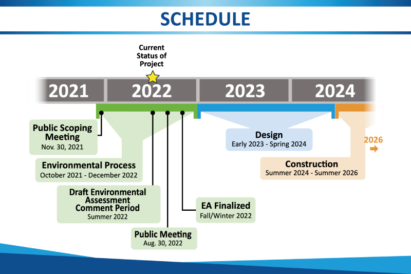
Aqueduct project timeline.
The construction design will begin in early 2023 with ongoing city and resident coordination. Actual construction will happen from summer 2024 to summer 2026.
This would be Reach 1 of the project which is at the mouth of Provo Canyon. This section is in the former Cascade Golf Course area, north of 800 North, including property owned by Todd Pedersen, Tapahe noted.
The City Council heard a presentation from Mike Wimpey, chief engineer for the Central Utah Water Conservancy District.
There are multiple pipelines in the area that serve not only Utah County, but parts of Salt Lake County as well. Over 1.5 million people along the Wasatch Front receive water through the Alpine Aqueduct with 60% of Orem’s drinking water coming from there, Wimpey noted.
Many of Utah’s aqueducts are reaching the end of their lifespans while others are running through geologically difficult areas where they can be hit by earthquakes or landslides. For this reason, infrastructure is starting to garner more attention statewide and from the Utah Legislature.
According to project management, the best option for the pipeline is to be laid east of the Wasatch Fault as there have been a number of failures and slides on the west side.
“In one case it completely saturated the land until the land slid. With the 2017 landslide, the land rippled up and our pipe essentially served as a buttress to holding up the hillside, which is not sustainable,” Wimpey said.
Residents have asked if there was any way for the pipeline to go down 800 North.
“Our geologic guys have explained that if that pipe ruptures on the west side the way the fault will rupture, you’re going to have significant damage all along the length of the pipe coming down that road,” Sutherland said. “The other critical issue with that is bringing it in on 800 North, we’ve got three other pipelines that are part of this regional water delivery facility that run on 800 North. So, if we have an earthquake and one of those pipelines ruptures, odds are good that it also wipes out the other two pipelines.”
The original pipeline was put underground in 1978, making them 44 years old. The expected lifespan of the new 108-inch pipeline is up to 75 years.
The Alpine Aqueduct Reach 1 is rated as high risk and must be replaced, according to Wimpey. The water starts at the Olmstead reservoir at the mouth of Provo Canyon and goes in and out of tunnels, both underground and above ground, up the hillside eventually to Salt Lake County.
“The preferred alignment alternative would be around the landslide area. Unfortunately that area is developed up to the toe of the landslide area,” Wimpey said. “There is no way to get around this landslide without impacting residents.”
The route would go down 1060 North with several variations of what the route would look like. CUWCD showed schematics of the street’s expected final look after the pipeline installation.
Construction would take entire street sections out of use rather than having just one side closed at a time. There are approximately 30 homes along the preferred route that would be impacted by construction.
It is not known how long homeowners would not have street access as the entire street will be torn up with about 3-4 homes being affected at any given time through the project.
The entire street section will be out of service for a period of time. “This is pretty impacting,” Jamie Davidson, city manager, said during the presentation.
Residents looking for more information, or to contact a member of the study team, can do so by calling 385-376-4400 or by email at info@alpineaqueduct.com. The 30-day comment period on the assessment ends Sept. 9.
-
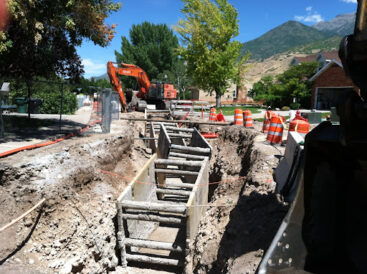
- Photo shows current pipeline of aqueduct project in Orem.
-
- Aqueduct project timeline.