Mapleton police, public works create traffic calming policy to guide city projects
-

- Old stop signs on the north and south side of the Main Street and Maple Street intersection in Mapleton were replaced with flashing stop signs earlier this week. They are photographed on Aug. 5, 2022.
-

- The Maple Street and Main Street intersection in Mapleton is shown on Monday, Aug. 8, 2022.
-
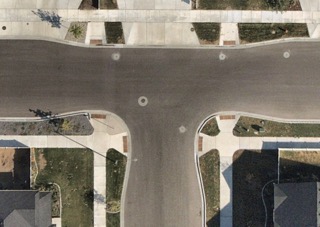
- Bulbouts at a T-intersection in Provo are shown in this undated photo.

Kelcie Hartley, Daily Herald file photo
Old stop signs on the north and south side of the Main Street and Maple Street intersection in Mapleton were replaced with flashing stop signs earlier this week. They are photographed on Aug. 5, 2022.
In response to a lack of procedure when dealing with safety complaints from residents, Mapleton police chief John Jackson and Rob Hunter, public works director and city engineer, developed a new city policy as a means to reduce speeding and improve street safety.
On March 15, Jackson presented the newly-created traffic calming policy to the city council, which received unanimous approval. The policy will use different techniques to help evaluate and prioritize projects concerning street safety.
“State-established warrants from the Utah Manual on Uniform Traffic Control Devices will be used for traffic signals, stop signs, school crosswalk zones, and school speed zones. … For all other measures, the City will use scoring criteria contained in Table 2 below. Locations scoring less than 30 points and do not meet a specific MUTCD warrant will not be a candidate for a traffic safety project,” the policy reads.
The scoring criteria evaluates an intersection’s traffic volume, average speeds, a three-year record of crashes in the area, the existence of sidewalks or crosswalks and its proximity to schools, trails and parks.
The city will add traffic signals, neighborhood traffic circles, roundabouts, raised crosswalks, lane striping and radar speed signs along with bulbouts, rounded curb extensions at intersections, to help reduce safety hazards at intersections that fail the evaluation, as well as install sidewalks on unfinished streets often used by children when walking to school.

Kelcie Hartley, Daily Herald file photo
The Maple Street and Main Street intersection in Mapleton is shown on Monday, Aug. 8, 2022.
“(This policy) will allow us to have a consistent response to residents that voice concerns (and) request things like speed bumps, stop signs, or additional signage. It will guide us in having a consistent response to these requests … (and help us) prioritize money used for traffic calming issues based on data-driven information,” Jackson told the Daily Herald.
Last year, the Mapleton police department received speeding complaints for more than 30 roads, from residential streets to Route 89.
To collect data, the city of Mapleton has been using two TrafficLogix data collection boxes, which are obscured from the view of passing drivers. The battery of this device lasts for one week and collects data on the number of vehicles passing by, average speed, the time when high-speed vehicles pass and more. It also gives police officers remote access to information being recorded in real time.
In 2022, data was collected from 154,000 cars on 35 different Mapleton streets using the devices. They found that 54.2% of drivers traveled at or below the speed limit while 45.8% of drivers traveled anywhere from 1-21 miles per hour over the speed limit.
Jackson said that concerned residents can receive a copy of the data collected by the TrafficLogix boxes from the department.
Courtesy Mapleton City
Bulbouts at a T-intersection in Provo are shown in this undated photo.
“I (also) want to avoid having a resident call to voice a speeding concern and simply hear ‘we’ll watch it.’ I want the resident to know that we will collect data on their road, report back to them the results and make follow up decisions based on data and consistent policy,” Jackson said.