Personal revelation requires cooperative forces, Elder Renlund says at BYU devotional


-
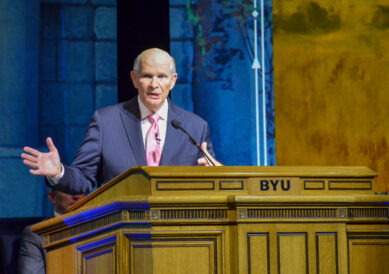
- Elder Dale G. Renlund of the Quorum of the Twelve Apostles speaks at a devotional for Brigham Young University’s Education Week at the BYU Marriott Center on Tuesday, Aug. 22, 2023.
-

- Elder Dale G. Renlund shakes hands with one of the people attending his devotional for Brigham Young University’s Education Week on Tuesday, Aug. 22, 2023. Renlund shook hands with each of the people sitting on the floor area of the Marriott Center.
Faith, reason and observation are the keys to receiving personal revelation, Elder Dale G. Renlund of the Quorum of the Twelve Apostles for The Church of Jesus Christ of Latter-day Saints told the audience at a devotional during Brigham Young University’s Education Week on Tuesday.
Renlund began by giving examples of how reliance on each of these actions alone can mislead a person. He gave a lesson — using Aristotle’s teaching that heavier objects will always hit the ground first, as they fall faster than lighter objects — to describe how reliance on reason alone, without faith and reason, is not reliable.
Sister Melanie Soares and Brother Ethan Brown helped Renlund test Aristotle’s reasoning. He had each person test which of two objects was heavier, a piece of paper or a hymn book. They agreed the hymn book was heavier. Renlund then dropped them both on the ground to see which hit first — it was the hymn book. He explained this demonstration shows Aristotle’s reasoning to be correct. He then crumpled the paper into a ball, had Soares and Brown check again, and the hymn book was still heavier. However, when he dropped the two objects, they hit the ground at the same time.
After Soares confirmed they hit the ground at the same time, Renlund said, “It’s amazing. When friction and air resistance are eliminated, heavy things and light things fall at the same rate.”
Reasoning alone led Aristotle astray in his teachings, Renlund said, adding that the same can happen to others as they attempt to understand the teachings of God, understand the miracles told in the Bible that Jesus Christ performed, and receive personal revelation.
“In the 1600s, Galileo had to couple observation with reasoning to prove Aristotle wrong,” he said. “Such methods can achieve truth, but not always reliably.”
Renlund also gave many examples of church members only relying on faith, and explained that faith without observation, reason and action is not sufficient. He gave the example of a man he knew who had life-threatening cancer. The doctors suggested chemotherapy and medication, but members of the church advised against the medication, telling him “that taking the medicine would demonstrate to God that his faith was not absolute.”
Renlund said the friend “invited me to his office in the hospital. Spread over his desk were 10-15 pills. He told me his situation, the advice of his doctors, and the advice of some church members. He said, ‘Dale, you are my bishop. If you tell me to take the pills, I will. If you tell me not to, I won’t.'”
Renlund remembered a passage of scripture he had recently read in the Book of Mormon which taught that simply sitting and waiting for the goodness of God to save a person is in vain without being paired with action. A person must take action with the means the Lord has provided, he said, and faith must be paired with reason and observation.
Renlund shared this with his friend and asked him what he thought the verses meant. The man told Renlund, “‘I think it means that I should take the pills and continue to exercise my faith.’ I agreed,” Renlund said.
His friend lived for eight more years, much longer than expected, according to Renlund. However, when faith is not combined with observation and reason, skepticism sets in, he said.
Renlund explained that unlike a scientific experiment where skepticism is valued to eliminate or minimize inclinations toward a specific outcome, when one of the prophets of old, Alma, compared faith to a seed and challenged others to try to have a particle of faith, “a favorable outcome depended on an inclination to believe.”
Having a desire to believe, he said, will grow faith, represented by the seed, and it will ensure that the seed is not cast aside accidentally through skepticism and unbelief, which can come when someone neutrally approaches the experiment of exercising just a particle of faith.
“When we start with an inclination to believe, observation leads to faith. As faith grows, reason facilitates the transformation of faith into revelatory knowledge, and revelatory knowledge produces added faith,” Renlund said.
He focused on receiving personal revelation, saying that observation, faith and reason are all needed to receive revelation. He gave five principles to follow to receive personal revelation:
- Principle 1 — Personal revelation requires work, including learning how the Holy Ghost communicates individually with us.
- Principle 2 — Personal revelation is facilitated by understanding and formulating questions from multiple angles.
- Principle 3 — Personal revelation usually requires depending on and acting on incomplete understanding.
- Principle 4 — Personal revelation is iterative.
- Principle 5 — Personal revelation requires humility to corroborate and not concoct impressions.
When receiving personal revelation, under Principle 5, Renlund made clear that revelation cannot be received for someone else. He gave the example of someone receiving revelation to marry another, saying that when one tries to seek revelation for another, it is easy to be deceived.
Sharing a story which made the entire audience laugh, he said, “Years ago, three acquaintances separately mentioned to me that they felt inspired that they were going to marry the same woman. None of the three had even gone on a date with the woman. I believe all three misinterpreted physical attraction and raging hormones as a spiritual prompting. None of the three ended up marrying the woman. Heavenly Father respects agency and is unlikely to send promptings that violate the agency of someone else. He may prompt us to further action, but coercion will never be part of His plan.”
In 2021, Mark Potter, a Latter-day Saint ward clerk, shared similar guidance to the members of his ward. He said when he was in college, he was in love with a girl named Kathy who he had been dating for some time. He asked God if he should ask her to marry him, to which he received the answer yes. When he asked the girl, she said she would need to pray about it. “It was an utter shock to me when she informed me that she had prayed and fasted and the answer the Lord gave her was no,” Potter said.
He was left feeling devastated, embarrassed and angry at God because he felt if the answer was a yes for him it should have been a yes for her. He said God answered him by saying, “It was right for you to ask her, and she was right in saying no.”
He was confused about God’s answer until a few years later when he was dating a woman named Marjorie, who he was in love with. Kathy moved into his same apartment complex and gave him a call. He said had he not acted on his revelation from God and asked Kathy to marry him all those years ago, he could have been confused about whether or not he was to marry Marjorie, since he had loved Kathy before. He married Marjorie soon after.
Potter said, “I learned an extremely important lesson: Two different people can receive two different answers to the exact same question. What is right for one person is not always right for another.”
In a talk in the New Era in January 1975, Elder Bruce R. McConkie of the Quorum of the Twelve Apostles, also advised that receiving revelation for yourself through the combination of faith, observation and reason is the way God intends. Although, he reflected on ways he could have consulted more effectively with God when he was choosing who to marry. He said, “Well, maybe it will be a little shock to you, but never in my life did I ever ask the Lord whom I ought to marry. It never occurred to me to ask him. I went out and found the girl I wanted; she suited me; I evaluated and weighed the proposition, and it just seemed a hundred percent to me as though this ought to be.”
He explained that revelation comes most effectively when a person uses agency to make a decision then asks God if their decision is correct. He explained that he made a decision then asked God what to do next with that decision. “Now, if I’d done things perfectly, I’d have done some counseling with the Lord, which I didn’t do; but all I did was pray to the Lord and ask for some guidance and direction in connection with the decision that I’d reached. A more perfect thing to have done would have been to counsel with him relative to the decision and get a spiritual confirmation that the conclusion, which I by my agency and faculties had arrived at, was the right one.”
Education Week, for youth and adults age 14 and older, goes through Friday and offers hundreds of classes to attend. To register, visit https://educationweek.byu.edu/registration.