Takeaways from the latest BYU Education Week



-
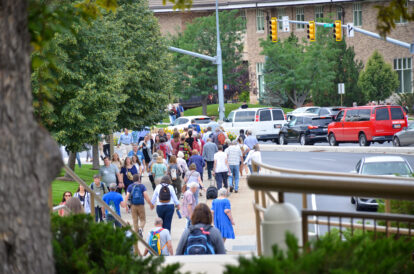
- People attending BYU Education Week walk to their next class or devotional on the Brigham Young University campus on Thursday, Aug. 24, 2023. Education Week was held from Monday through Friday, Aug. 21-25, 2023.
-

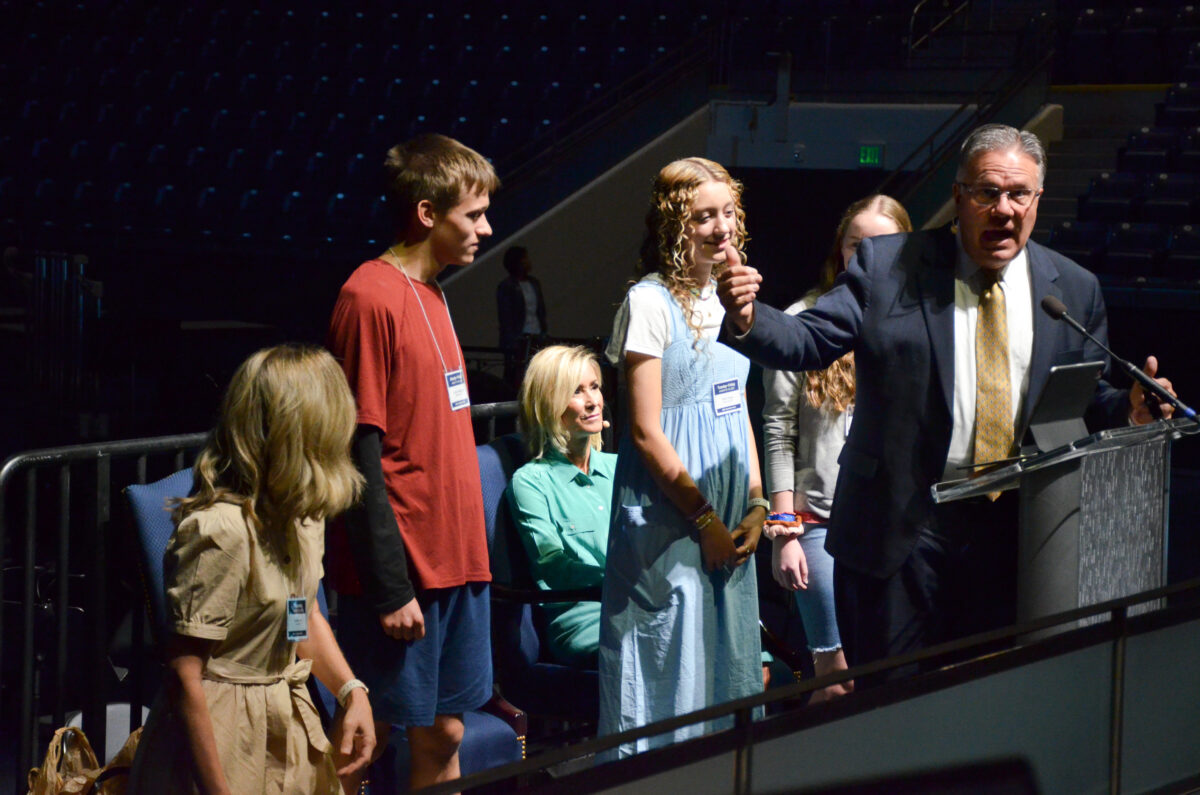
- Bradley R. Wilcox, second counselor in the Young Men General Presidency, speaks at a devotional for BYU Education Week on Thursday, Aug. 24, 2023. He used the group of participants by the podium to demonstrate the meaning of a birthright.
-

- Three women make their way to their next class at BYU Education Week on Thursday, Aug. 24, 2023.
-
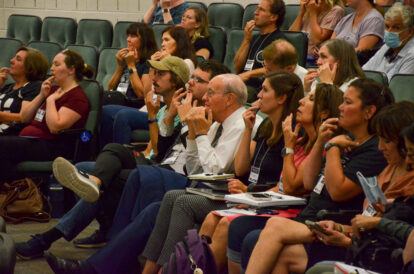
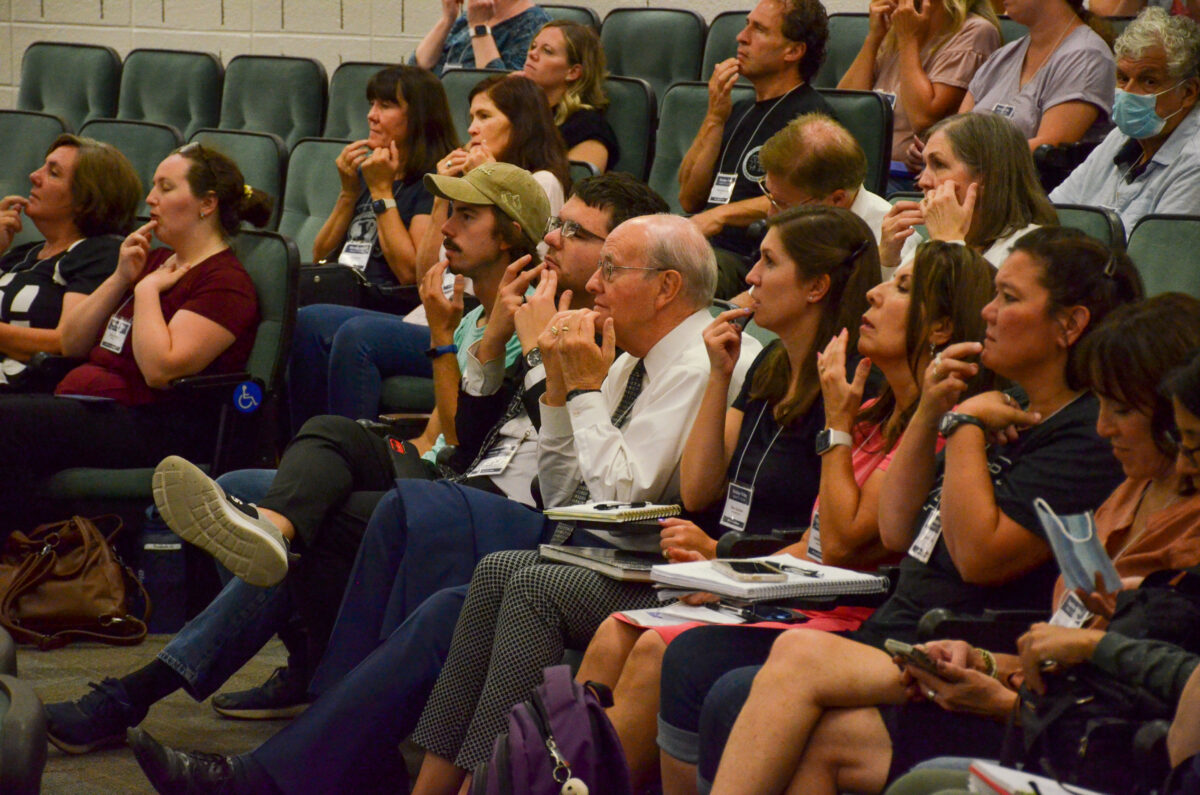
- Students in Janis H. Rowberry’s class during BYU Education Week on Thursday, Aug. 24, 2023, follow along to a video showing how to do meridian tapping, which calms stress and anxiety.
-
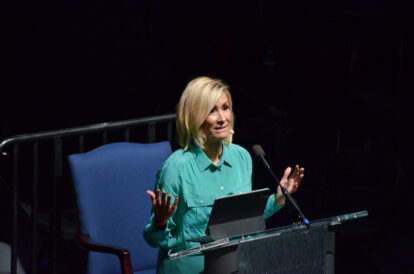
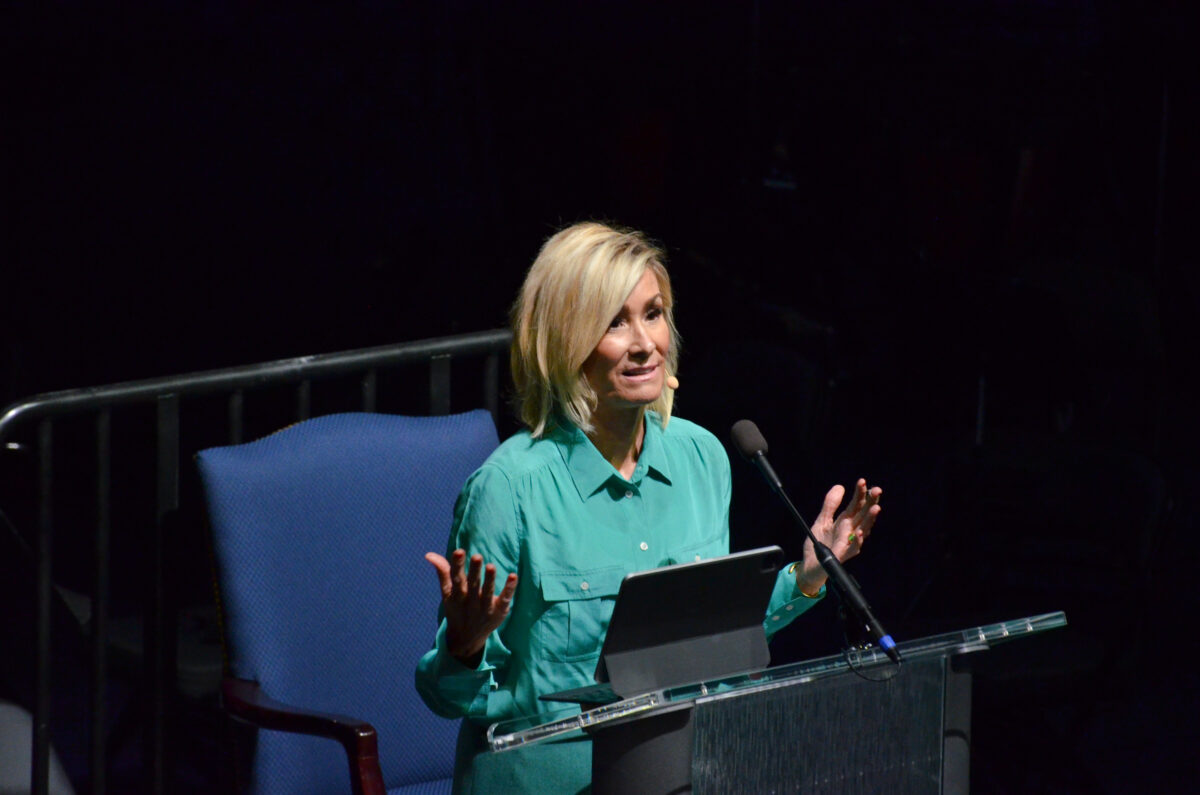
- Tamara W. Runia, first counselor in the Young Women General Presidency, speaks at a devotional for BYU Education Week on Thursday, Aug. 24, 2023.
-
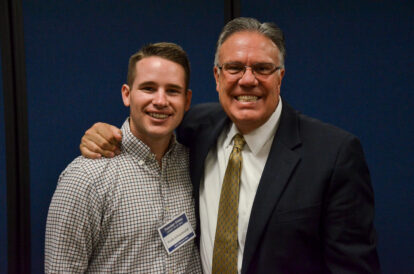
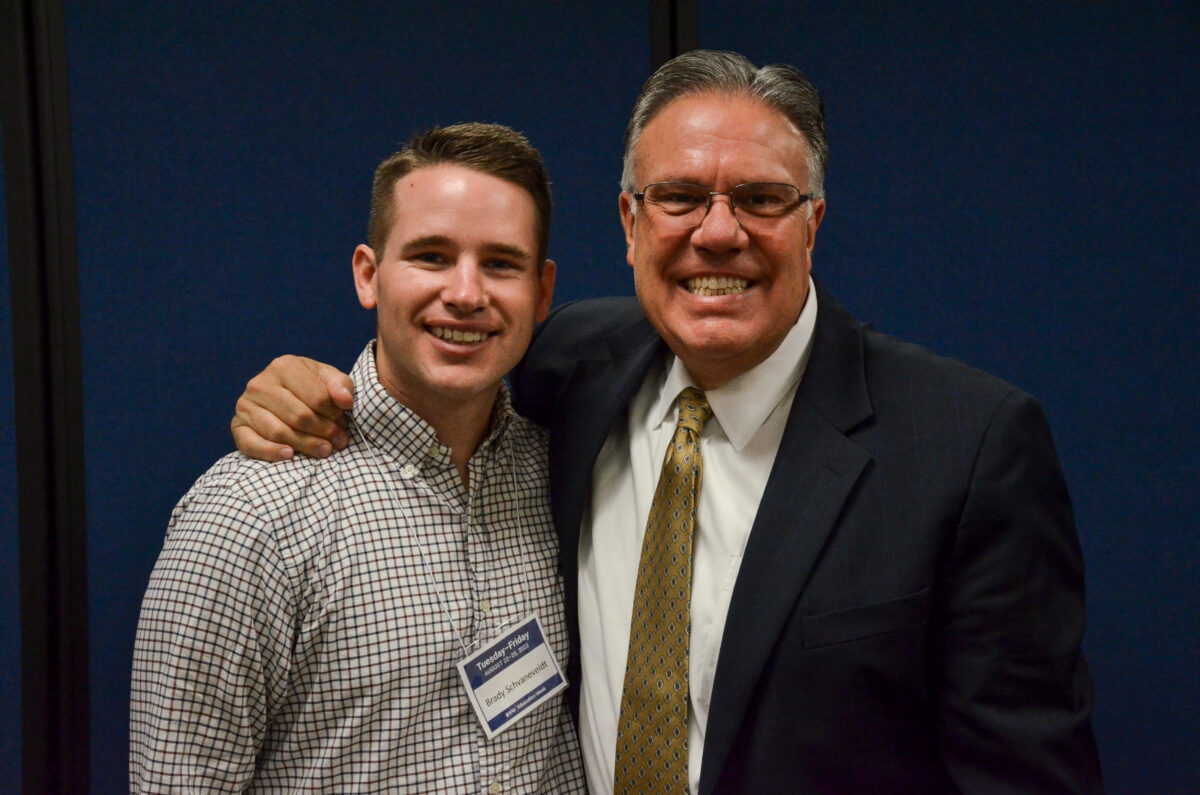
- Brady Schvaneveldt, left, stands next to Bradley Wilcox after Wilcox and Tamara W. Runia gave a devotional for BYU Education Week on Thursday, Aug. 24, 2023.
-
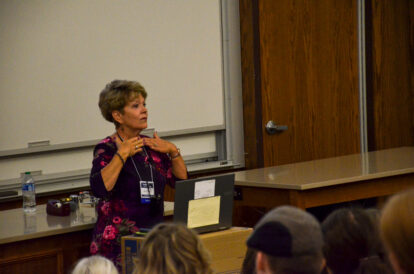
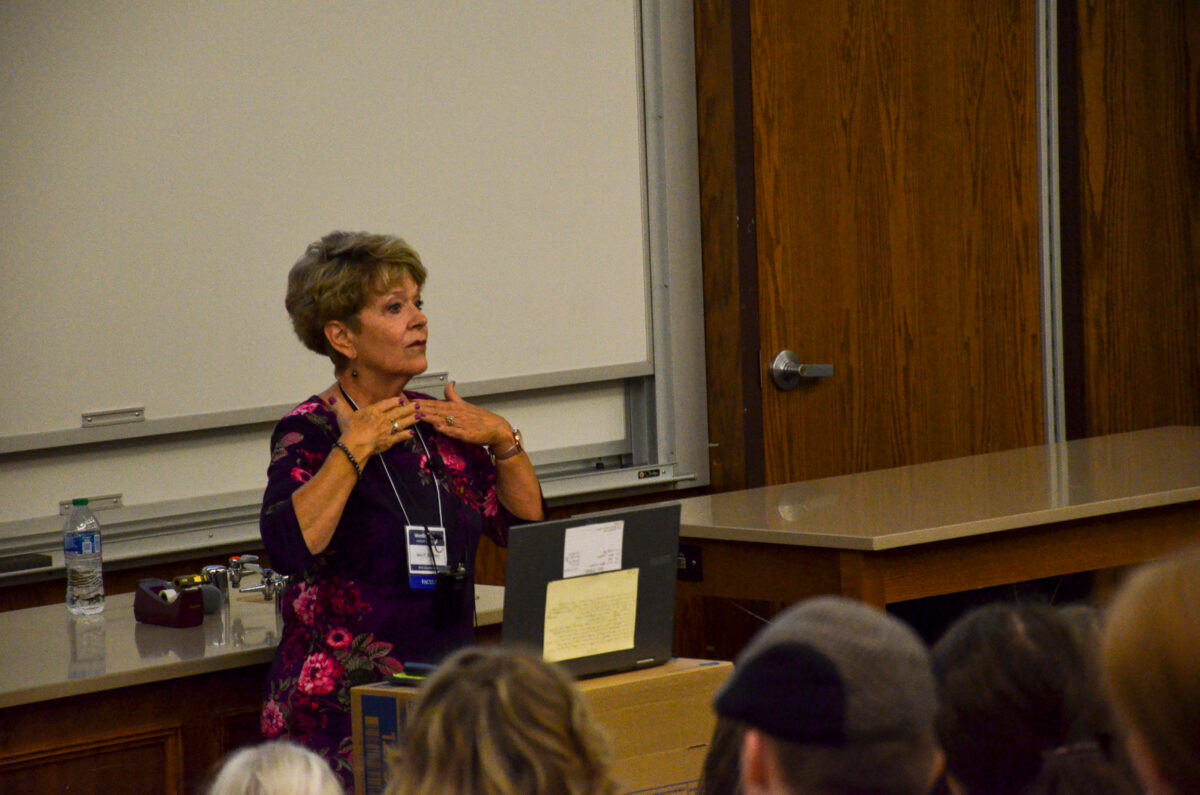
- Janis H. Rowberry instructs how to perform meridian tapping, which calms stress and anxiety, during her class titled “Break Free from Anxiety, Depression, and Fear: Learn to Thrive!” She taught the class for BYU Education Week on Thursday, Aug. 24, 2023.
-
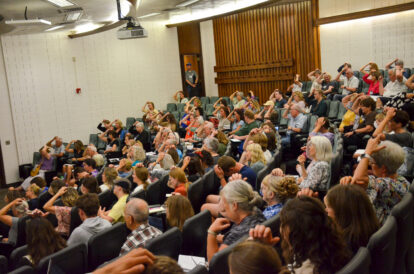
- Students in Janis H. Rowberry’s class during BYU Education Week on Thursday, Aug. 24, 2023, follow along to a video showing how to do meridian tapping, which calms stress and anxiety.
Brigham Young University Education Week brings 17,000 to 18,000 people from around the country and the world to the campus in Provo. In 2020, the Education Week went online, and in 2021 and 2022 the attendance slowly started to rise after the pandemic affected how many people came.
Bruce Payne, program administrator for BYU Education Week, said this year the number of attendees are back to what they had in 2019, and this year they had someone from all 50 states and from at least nine different countries. All of the data has not yet been collected for attendees, but as of the preregistration statistics, there were visitors from Australia, Canada, Chile, Germany, Hong Kong, Japan, Mexico, Turkey and the United Kingdom.
Attendees typically have over 900 classes and devotionals to choose from, which would take more than 20 years of attending BYU Education Week to complete if they were to attend all of them, Payne said. The classes range from tools to cope with mental health challenges, how to treat the environment, anatomy, history of The Church of Jesus Christ of Latter-day Saints, how to grow closer to Christ, and women exercising priesthood authority.
With so many options, Gail Moss who lives in Richfield, said it is hard to choose her favorite part of the week. “Depends on what class I’m in right at the moment,” she said.
Heather Call from Melisssa, Texas, said Education Week is a “unique experience to be able to come here.You don’t find the opportunity (often) to attend so many classes with professors and experts in the field.”
Bob Campbell, a BYU alumnus who lives in St. George, said this is his fourth year attending Education Week. He spent his career working for the U.S. Forest Service as a forest ecologist and said he noticed a difference in Education Week this year. “There is a lot more being shared now about our responsibilities with stewardship and caring for the Earth. I’m picking it up in several classes, and I’m liking it,” he said.
The planning for Education Week starts a year in advance, so planning for next year will start this fall. In addition to the paid workers who organize the event, go through applications for the classes and devotionals, and spread the word about Education Week, 500 volunteers help run the classrooms every year. The volunteers also get to attend the classes for free. Each volunteer shift lasts for three class periods, leaving time to attend other classes.
BYU values people continuing education after they graduate college, Payne said, so Education Week is a time for people to meet up with family or old friends and expand their minds through spiritual development and helping others. “I think that’s why it’s important to BYU. It’s an opportunity to reach out and give more people an opportunity to be here and to learn.”
Here are a few highlights from the week:
Youth devotional
The devotional by Tamara W. Runia, first counselor in the Young Women General Presidency, and Bradley R. Wilcox, second counselor in the Young Men General Presidency, focused on the gathering of Israel, but with new definitions and ways to understand what that means for Latter-day Saint youth. Runia and Wilcox spent their time connecting to the audience through laughter but also through seriousness when the topic called for it. Runia shared stories of her time at BYU that made the entire audience laugh.
They each took turns speaking about what it means to gather Israel, why it is important and whose responsibility it is. Gathering Israel is a term that members of the church use to describe spreading the gospel to all ends of the earth.
Runia said bringing the gospel to all of the earth is important because each person is a child of God. In recent years, she has heard people genuinely ask a question which quotes a Primary song, “Heavenly Father, Are You Really There?”
She said she has asked this question. “I have loved ones who have struggled with things that they didn’t ask for who have asked this question, ‘Heavenly Father, are you really there?’ I’ve had moments in my closet alone when I’m praying and trying to connect with heaven when I have asked those or said those words. Many of us probably have had that phrase pop into our minds on days when it feels like life can’t get any harder, and then it does.”
She explained this question is why the gathering of Israel is needed. “We all deserve to know over and over again that we have a heavenly Father who is really there. And that is why this gathering that we’re talking about is so important, because everybody deserves and needs to know this truth.”
Wilcox explained why members of the church have to gather Israel, and that in doing so they must work to keep their promises to God to live the standards of the church. People who are born into the church, which is called being born under the covenant, have a noble birthright, Wilcox said. He explained a birthright means they were given more in the form of knowledge of the gospel. Since they have been given more, the responsibility to share the gospel with others falls on them.
Speaking to the audience, he said, “I hope you realize that you have been given much temporarily and spiritually. … We have been given much. Is it really too much for God to ask us to do something that he doesn’t ask his other children to do?” He said this in reference to sharing the gospel and living different standards of dress, language, substance use and others that not all people live.
“A birthright does not make you better than everyone else,” he said. “He (God) gives you the responsibility to live better, so that you can help everyone else, and that’s what sets us apart.”
Wilcox added to his message in an interview with the Daily Herald: “And quit complaining about your responsibility — get out there and do your work, because you’ve already been blessed. So now get out there and bless others.”
Finally, they explained what it means to gather Israel. Runia said this generation is the most inclusive and welcoming generation she has seen and they are needed for these days. “I think from before they came to this earth. They were endowed with eyes to see past differences, past outward appearances and present circumstances. They welcome and invite in real and authentic ways.” She said treating others with this inclusion, love and care is the best way to gather Israel.
She explained to never ignore a prompting to include someone or to talk to someone, because they may need the support. Part of the inclusion to gather Israel is including those who are not usually invited, who are not usually included or given a seat at the table. She said, “His (Jesus’) message is that there is room for all and we’re not just to invite them. We’re called to go and help bring them and to gather them and travel with them because some people can’t make that journey by themselves.”
Brady Schvaneveldt, who just graduated from the Education Leadership and Foundations masters program at BYU, said he has known Wilcox since he was in high school and reached out to Wilcox for help when he was struggling spiritually. Coming to Education Week and listening to the devotional, Schvaneveldt said there has been a recurring theme of reframing questions to God in the message in all of the classes he has attended, which he said is probably the spirit, not the teachers.
He explained, “Instead of asking the same question over and over again and not feeling like you’re getting answers or maybe like a church history thing that you’re stuck on, I just think I get stuck sometimes spiritually and in my mind. I keep asking the same question or trying to fight the same problem over and over. What I’ve learned here is the power of reframing and having God help you do that. It’s like changing your question up, trying to find different angles to look at something versus just running into that concrete wall over and over again.”
Mental health class
The class titled “Break Free from Anxiety, Depression, and Fear: Learn to Thrive!” was taught by Janis H. Rowberry, a licensed therapist. She provided attendees with tools to cope with anxiety and panic attacks that they could implement in their own lives. One of the techniques was the worry box.
As Rowberry explained, the worry box is a simple way to lessen stress and worry by limiting the amount of time your mind is allowed to focus on the worry. She said she has a worry box, and each day she has an index card that she can spend 15 minutes writing down whatever is causing her to worry that day. She said to write down a problem and a solution on each index card, then when the timer goes off to put all of the worries in the worry box.
Then, 15 minutes later when the worry enters her mind again or a new worry arises that she forgot to put in her worry box, she tells the part of her brain that is worrying — which she named Herman — that her time to worry is up for the day, and she will address it tomorrow. She said to have one index card that is allowed to have 50 worries on it, so when one arises, write it down then tell your brain you will address it the next day.
Giving the worry a name helps to recognize it when it comes to the surface of your mind, she explained. Telling your brain that the problem will be addressed tomorrow helps to release that worry until the next day. With all of this extra time not spent worrying, Rowberry said, “what do you do with the next 23 hours and 45 minutes? You’re PPG: I am present, I am positive and I am grateful, as President (Russell) Nelson told us.”
Moss, from Richfield, echoed the same thing, saying that she is able to trust the guidance from the teachers or therapists and have confidence in them because they are professionals. She said she has struggled with anxiety over the past year, and through Rowberry’s class she was able to learn specific techniques that can be used in different situations or settings to calm her stress and anxiety.
Preparing for a mission
Ashley Bekmeszian from Herriman and Austin Sosa from West Jordan attended Education Week together after Sosa’s mom encouraged him to go. Bekmeszian has been called to serve a mission in Seattle and Sosa is preparing to turn in his papers to receive a mission call.
Bekmeszian said one of the classes prepared her for her mission by letting her know that it would be hard, especially on her mental health. She said the class’s teacher explained the same tools to deal with stress at home may not be available on a mission, so he provided alternative tools for coping. “It kind of helped open my eyes a little bit to (the fact that) the mission is going to be really hard, but he gave me different things I could think about for coping.”
Sosa added that Education Week has helped him prepare to serve a mission because, “It just makes me more aware of what I need to do and why I need to prepare spiritual-wise.” He explained some of these preparations are to be more active in his scripture study and prayer and “bringing Christ more into my life, because I don’t think I think about Him enough in my daily life.”