Utah Supreme Court hears arguments in sexual assault lawsuit against Provo OB-GYN


-

- Women who are suing Dr. David Broadbent for alleged sexual assaults wore teal at a Utah Supreme Court hearing regarding their case on Friday, Oct. 20, 2023
-
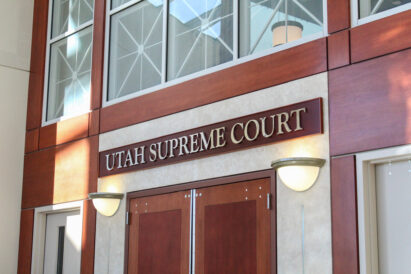
- The entrance to the Utah Supreme Court chambers in Salt Lake City, pictured Friday, Oct. 20, 2023
The Utah Supreme Court heard oral arguments Friday regarding a lawsuit brought against Dr. David Broadbent, a Provo OB-GYN who was sued by 94 women for allegedly sexually assaulting them during appointments.
The lawsuit was dismissed by 4th District Court Judge Robert Lunnen in October 2022 on the grounds that the lawsuit should be brought under Utah’s malpractice law instead of as a sexual assault case, as the alleged abuse happened in a medical setting.
The case was appealed to the Utah Supreme Court, which will make the decision to either overturn the district court’s ruling or uphold it.
Many of the women who have made allegations against Broadbent filled one side of the courtroom dressed in teal blouses, a deliberate color choice to raise awareness about sexual assault.
The argument made by the attorney representing the 94 women is that the case does not fall under medical malpractice — which comes with stricter parameters like a two-year statute of limitations — because the alleged abuse is not under the umbrella of medical care.
Friday, the court only heard the oral arguments, and a decision will be made later on.
Terry Rooney, the plaintiff’s attorney, said they intentionally chose to pursue this case as a sexual assault claim instead of a medical malpractice claim.
“Our clients did not come to us complaining about medical care,” he said, standing in front of the justices. “They came to us complaining about being assaulted by a physician.”
Since the lawsuit was filed, first with just four women, more than 200 have come forward with allegations against the doctor. Their stories include allegations of being inappropriately touched by him without warning or any medical explanation and having him make inappropriate comments, often sexual in nature.
The arguments surrounded the definition of health care and medical malpractice and whether the alleged assault of multiple patients falls under the definition of health care as part of Utah’s malpractice law.
At the time of the case being filed, health care was defined in the Utah Health Care Malpractice Act as any act or treatment by a medical provider “for, to, or on behalf of a patient during the patient’s medical care, treatment, or confinement.”
Because the health care definition is care that is meant to be “for, to, or on behalf of the patient,” Rooney said this cannot include sexual assault.
“We don’t believe anything about sexual abuse is for, to or on behalf of the patient,” he said.
Since the case’s lower court dismissal, the Utah Legislature has amended the state’s malpractice law.
The Legislature made the clarification that health care does not include an act that is sexual in nature that was committed under the guise of providing treatment, even if the victim believed at the time the act was medically appropriate. However, because the change was made after the lawsuit against Broadbent, it cannot be applied to the case.
Rooney referenced the Legislature’s change earlier this year, arguing the law was never intended to protect medical providers who commit sexual assault.
The defense included attorneys representing Broadbent as well as Intermountain Health and MountainStar Healthcare, who are also defendants in the suit, as Broadbent treated patients within hospitals operated by both companies.
Caroline Olsen, the attorney representing Intermountain Health, argued on behalf of all the defendants, stating that the argument isn’t just about what constitutes health care but also the definition of medical malpractice.
Olsen argued that the definition of medical malpractice includes any act that occurs during a medically indicated exam or procedure.
She referenced the definition in the Utah Health Care Malpractice Act, which states malpractice is related to any action by a health care provider “relating to or arising out of health care rendered or which should have been rendered by the health care provider.” In her arguments, she emphasized the “any action” portion of the definition.
“That is what the complaint alleges for every claim, that their pain and suffering relates to, or arises out of something, an act that occurred during the provision of a medically indicated exam or procedure,” she argued.
After the hearing, Stephanie Mateer, one of the many women who have brought allegations against Broadbent, spoke with reporters, saying she was initially stressed about how the judges would interpret the law.
“But as the case went on, I got more and more confident that they’re going to see this our way and they know as well as we do that sexual assault is not health care,” she said.
She said she believes the defense is trying to use the medical malpractice law to get out of being held responsible. There are many more protections for doctors under this law, she said, and the statute of limitations for malpractice would remove many women from the lawsuit.
Mateer said it was “really powerful” getting to stand alongside the other women.
“I got together with some of the other women last night and kind of before today and it really helped me to feel the strength and feel empowered to come today and stand together knowing that I’m not the only one,” she said.
Ashton Sorenson, another woman suing Broadbent, told the Daily Herald she feels “a lot more positive” after the hearing.
“I think a lot of us felt hopeful for the first time,” she said.
Sorenson also said she feels empowered standing with other women and coming together.
“It kind of breaks my heart looking around seeing all the teal and just everyone that’s been affected by this,” she said. “But we’ve formed so many friendships out of this and just that connection with someone that’s gone through something similar to you. That means everything and it makes me feel not so alone.”
Local News
Private voter info to become public, but some Utahns, including police, can get exemptions

Dallin H. Oaks sustained as president of The Church of Jesus Christ of Latter-day Saints in solemn assembly during general conference