New president plans to ‘become BYU’ through collaboration, conversations and relationships


-

- C. Shane Reese speaks during a BYU devotional at the Marriott Center on Tuesday, March 21, 2023.
-

- Brigham Young University President C. Shane Reese, Cosmo the Cougar and Provo Mayor Michelle Kaufusi address the crowd before the Stadium of Fire concert at LaVell Edwards Stadium in Provo on Saturday, July 1, 2023.
-

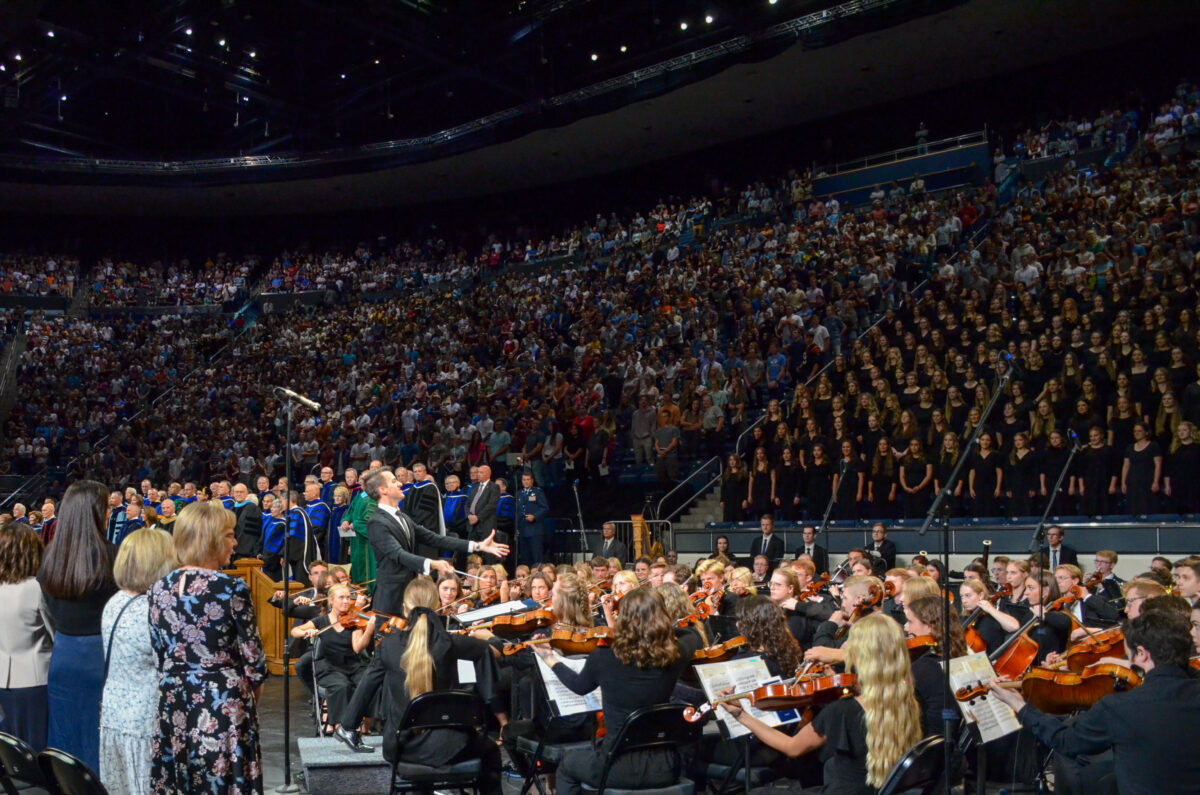
- A choir and orchestra perform the opening hymn for C. Shane Reese’s inauguration as the 14th president of Brigham Young University at the Marriott Center on Tuesday, Sept. 19, 2023.
As academic vice president for Brigham Young University, C. Shane Reese made a habit of reading the foundational addresses from previous leaders of the university and The Church of Jesus Christ of Latter-day Saints, which laid out the potential of BYU. Through this exercise, Reese said he gained an understanding that the path forward for BYU was evident.
“Shane Reese doesn’t have to invent a vision for the university. That vision has been so clearly articulated. What we need to do is become that,” said Reese, who was inaugurated as the 14th president of BYU on Sept. 19.
Reese said he makes it a priority to be where the students are to create connections, whether that means sitting in the student section at athletic events, walking around campus, seeing them at devotionals or opening his office for those who request individual meetings.
Reese was a statistics professor before he became academic vice president then president of BYU, and before coming to Provo he was a researcher at Los Alamos National Laboratory in New Mexico. He said he enjoys the interaction with students, which he missed about the classroom when he became academic vice president. “It is because of the students that I’m at BYU, so having those relationships matters to me. It’s so critical,” he said.
President Spencer W. Kimball of the Quorum of the Twelve Apostles explained part of BYU’s vision in his “Education for Eternity” address to BYU faculty and staff in 1967: “Where all universities seek to preserve the heritage of knowledge that history has washed to their feet, this faculty has a double heritage — the preserving of the knowledge of men and the revealed truths sent from heaven.”
This charge, Reese explained to the Daily Herald, is the responsibility of the faculty to lead students toward fulfilling their potential. His own responsibility, then, is to ensure the right faculty members are hired to ensure this generation “becomes BYU,” fulfilling what Kimball said many times: “In all the world, the Brigham Young University is the greatest institution of learning.”
In a 1975 address titled “The Second Century of Brigham Young University,” Kimball said: “While the discovery of new knowledge must increase, there must always be a heavy and primary emphasis on transmitting knowledge — on the quality of teaching at BYU. Quality teaching is a tradition never to be abandoned. It includes a quality relationship between faculty and students. Carry these over into BYU’s second century!”
Reese explained that BYU — founded in 1875 — is almost halfway through its second century. “So this becomes this pivotal moment for us as a university,” he said, an opportunity to fulfill past prophecies for the students currently at BYU.
Faculty is a main focus for Reese as president. “We expect those who stand in front of our classroom, in front of our students, to be exceptional in their fields. But we also expect them to be deliberate and intentional in their expressions of faith, and their building (of) the restored gospel of Jesus Christ, building strength and testimony in those kinds of premises of the restored gospel of Jesus Christ.”
When he interviews someone, he said he explains he is asking them to simultaneously fill two roles: to be excellent in their field and to “be deliberate and intentional and sharing your feelings about the gospel of Jesus Christ.”
He explained he understands this can be a challenge for faculty, which is why he does not expect perfection when he hires a new professor or member of faculty. He found sympathy in the fact that when he began at BYU, he did not have this intertwining of a religious and academic mission completely figured out.
It is a “false dichotomy,” Reese said, to say a university must choose between a religious mission and an academic mission. “I don’t think you have to choose between high quality and scholarship, excellent teaching and reinforcing the truths of the restored gospel of Jesus Christ. So, for us, that’s sort of the vision of becoming BYU is that we have these paired aspirations rather than competing interests,” he said.
Reese enjoys interviewing candidates himself because he said it is exciting when someone wants to be a part of the vision. “If someone really has that urge, that desire to be a part of that. We’re gonna find a way. We have faculty resources to help them be successful. We have mentors and models that can help them be successful. There’s ways to learn it, and it really just takes a willing heart,” he explained.
The responsibility of becoming BYU is placed not only on the faculty, but also on the students.
The relationship between students and faculty has grown stronger, Reese said, through changes to the university’s honor code because it encourages conversations. The main conversations are about dress and grooming standards, which under the new honor code handbook has four principles.
- Represent the Savior Jesus Christ, the Church, and the Church Educational System.
- Preserve an inspiring environment, without distraction or disruption, where covenants are kept in a spirit of unity so the Holy Ghost can teach truth.
- Promote modesty, cleanliness, neatness, and restraint in dress and grooming.
- Maintain an elevated standard distinctive to educational institutions of the Church of Jesus Christ.
Reese said he loves the principle-based approach, which has been in the works for over a year and aligns more closely with the church manual “For the Strength of Youth.”
“They (the four principles) really help our students become agents — agents who get the opportunity to both decide what that looks like for them, but also to hold themselves accountable,” he said.
He explained that he has already seen a difference in faculty and student interaction since the new honor code was set in place. A faculty member calling out a student for not being in compliance with dress and grooming standards has been replaced with conversations about the student’s commitments to the principles.
“Those principles permitted us to have, I think, some really meaningful conversations. … It really has been a remarkable thing, and the power has been in having so many on our campus community being willing to have those principle-based conversations,” Reese said.
As a professor, when students were not in compliance with the standards, he said there was often something deeper going on in their life. “With this principle-based approach and the invitation for people to have discussions, I think it opens the door for those conversations to happen,” he said. “And it often will lead to someone being able to share something that they’re really struggling with, and they might need some help.”
Reese said he hopes his interactions with BYU students, no matter how brief, are meaningful to them because they are meaningful to him. “I love our students,” he said. “They’re incredible. They’re bright. They’re capable. They have such incredible potential, and you see it in their eyes. I mean, it really is something for me. I light up when I’m with students. They’re amazing.”
During Reese’s presidential inauguration, Fritz-Carl Morlant, president of the BYU Student Service Association, shared a small inside joke about pie being for eating not for charting, which any student who has taken Reese’s statistics class would understand.
Reese explained the joke to the Daily Herald, saying, “My students who have been in my statistics class know that I get a little wound up about pie charts. They’re just a horrible way to display data. … Actually, I do love pie. But pie charts are like the bane of my existence,” he said, laughing.
This small joke, which earned laughs from the entire audience of students, pointed toward a lighthearted relationship between the students and Reese.
The Big 12
Since joining the Big 12 athletic conference, with competiton just beginning this school year, Reese said despite being one of only a few faith-based institutions, “There’s no push back for what we’re trying to accomplish. It seems like they’ve welcomed us with open arms and been very understanding about our religious observance. The most important of which, for the Big 12 I’m sure, is Sunday play.”
He said the Big 12 has been willing to make adjustments to conference schedules to respect BYU’s Sunday play policy. Under this policy, BYU does not compete on Sundays as a way to keep the Sabbath day holy.
The Big 12 does not just affect the athletic department of BYU. Being part of the conference connects all of the other academic departments with the other Big 12 institutions. Reese said already, the Big 12 law school, business, education and engineering deans have held meetings to discuss future collaboration.
In addition, during the year leading up to BYU’s official start in the Big 12, Reese met monthly with the other Big 12 academic vice presidents to discuss issues that are consistent across institutions. These monthly meetings were open for many of BYU’s other departments as well.
“We love that we have another way to go out and make connections across the country,” Reese said. “So, we just think it’s going to have lots of really positive ramifications for the campus.”
Local News

BYU: Water on the mountain: Researchers studying rock glaciers as potential high-mountain reservoirs
The ‘wild west stage:’ The Atlantic reporter counsels UVU students on the dangers of the rising betting industry