Voters in 2 Utah County cities to decide on recreation, arts and parks tax measures
Curtis Booker, Daily Herald
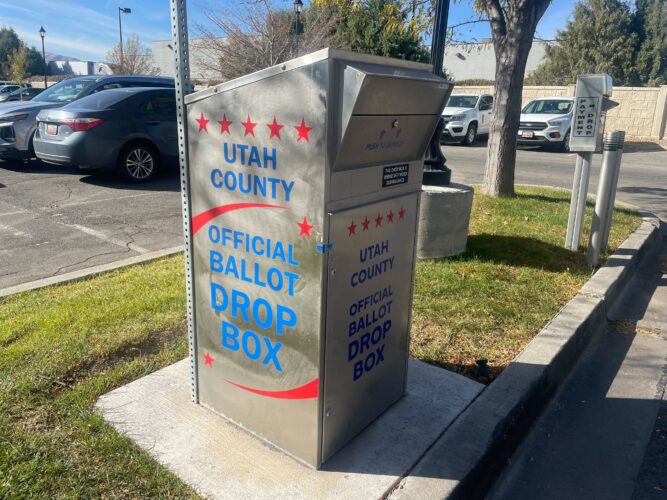
A ballot drop box outside of the Saratoga Springs city offices is shown Friday, Nov. 1, 2024.Aside from the races for the White House, Utah governor’s desk, several congressional seats and ballot measures, voters in the cities of Saratoga Springs and Mapleton also will see RAP tax questions on their ballots.
The recreation, arts and parks tax, or RAP, is a 0.1% sales tax added to the regular sales tax that cities can use to fund a variety of items, charging an extra penny for every $10 spent, or 10 cents for every $100 spent, on qualifying purchases within city boundarie.
Sales tax on food would remain unchanged if voters approve of the measure, according to a voter pamphlet that went out to residents last month.
Cities in Utah County such as Orem, Provo, Lehi, and American Fork, among others, already have similar taxes in place that help generate monies for the arts, as well as recreation and parks projects.
In Saratoga Springs, voters will see a yes or no question on their ballot for Proposition 13: “Shall the City of Saratoga Springs, Utah, be authorized to impose a .1% sales and use tax for the purpose of funding recreation, cultural, and zoological facilities, and botanical, cultural, and zoological organizations within the City?”
Mapleton voters will see a similar question for Proposition 5: “Shall Mapleton City, Utah be authorized to impose a one-tenth of one percent (0.10%) sales and use tax for the purpose of funding recreational and cultural facilities in the City of Mapleton?”
City Council members in fast-growing Saratoga Springs voted in favor of a resolution to add the RAP tax question to the ballot during their meeting on Aug. 6.
Some factors include that neighboring cities already have implemented such a tax and that roughly 70% of the RAP tax would be via purchases made by residents who live outside of Saratoga Springs.
“Not only do they shop here, but they recreate at our parks (and) various facilities, impacting our park system,” said Council member Micheal McOmber during the Aug 6 City Council meeting.
Funding from the additional tax on non-food sales could go toward supporting municipal and nonprofit organizations in efforts to grow arts and cultural festivals, art programs, literacy programs, live entertainment offerings as well as improvements to parks, trails, recreational fields and city marinas, according to the Saratoga Sprints city website.
“Saratoga Springs is one of the largest and fastest growing cities that hasn’t started their RAP (tax) program,” said Shara Young, a Saratoga Springs resident of 16 years and volunteer for the Arts Council, in an email. “The RAP (tax) will grow our city in cultural and performing arts, art programs and education, literacy programs, theater, music enrichment, live concerts, entertainment, parks, trails, botanical gardens, recreation fields with accelerating Phase 3 of Patriot Park for us all to enjoy and bring in revenue for the city from visitors.”
Saratoga Springs also has property to build a third phase of Patriot Park but hasn’t had the funding to construct it, according the city’s website.
“People want these things, but they don’t understand that, by not voting for this, that would make some of those venues 10 to 12 years away, versus being able to get them (built) in the coming years,” McOmber said.
The council held a public meeting to hear arguments for and against the measure in efforts to ensure the community understood the pros and cons of the proposed increase.
Mapleton also has a variety of projects that could be funded with the approval of a RAP tax.
“Recreation, arts, parks, and trails are fundamental elements of Mapleton’s identity,'” a city official said in an argument for the RAP tax in a voter pamphlet. “Our City’s core values of ‘open space,’ ‘active lifestyle,’ and ‘small town feeling’ are brought to life through these opportunities we provide for our residents.”
According to the online version of the pamphlet, no arguments were submitted against the proposed RAP Tax.
Mapleton also held two public hearings where citizens could support or oppose the issue.
In both cases, according to state law, if voters approve the RAP tax proposals, they would automatically go away after 10 years, and must be reapproved by voters.
Local News
Transforming the mall: Provo Towne Centre redevelopment plan goes through the legislative process

Utah aims to host critical minerals lab, hoping for federal recognition — and funding