Utah lawmakers condemn courts while anti-gerrymandering supporters urge ‘hear our voice’
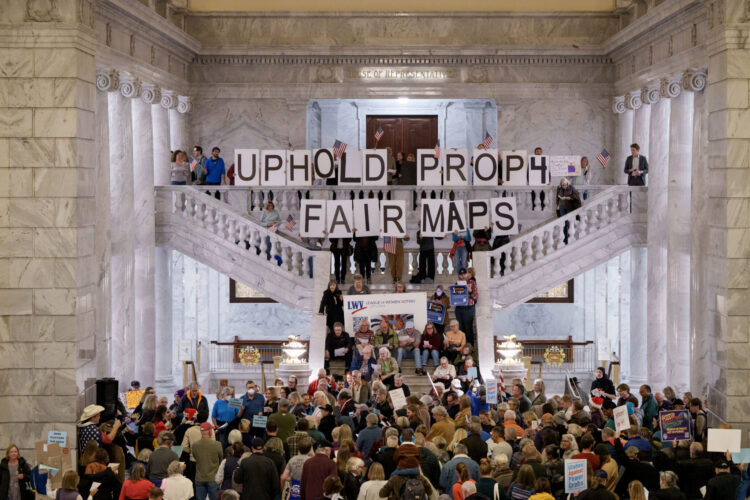
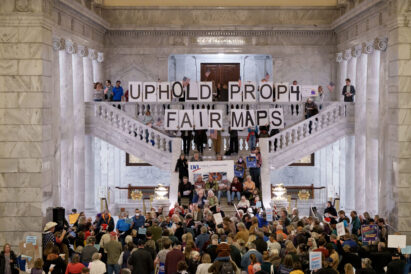
People protest the legislature’s efforts to undo the state’s new congressional maps before a special session of the legislature at the Capitol in Salt Lake City on Tuesday, Dec. 9, 2025. (Photo by Spenser Heaps for Utah News Dispatch)
To the tune of “Jingle Bells,” more than 100 supporters of anti-gerrymandering efforts in Utah gathered outside the House and Senate chambers on Tuesday night and sang: “Hear our voice; hear our voice; hear us as we say: Don’t ignore the voters ’cause we’re fighting back today.”
While holding signs that read “Gerrymandering is naughty” and “Make elections fair again,” the protesters’ singing echoed throughout the Utah Capitol’s rotunda as lawmakers gaveled in for a special session largely focused on facilitating the Republican-controlled Legislature’s legal fight against the state’s court-ordered redistricting process.
The legal battle over drawing the state’s electoral boundaries has resulted in a congressional map that created a single Democratic-leaning district and three heavily Republican districts.
During Tuesday’s special session, the Legislature passed a series of bills aimed at creating a window of time to allow for a different congressional map to be put in place ahead of the 2026 elections if they’re able to successfully appeal the case to the Utah Supreme Court in coming months.
In addition to approving legislation to delay congressional candidate filing deadlines and change court rules to ensure lawmakers’ appeal goes directly and quickly to the Utah Supreme Court, the Legislature also passed a scathing resolution that strongly condemned the courts’ actions in the redistricting case.
The resolution’s sponsor, House Majority Leader Casey Snider, R-Paradise, said on the House floor that the court’s handling of the case has damaged trust in the institution.
“I am afraid that I cannot look my constituents in the eye and tell them they can trust this judiciary any longer,” Snider said. “The court has done this to themselves. The reputation that they have lost and now tarnished they have done and lost by themselves.”
The resolution — which isn’t a binding law but rather a legislative measure to send a message — says the Legislature “rejects the court-ordered, special interest groups’ map and any map that does not reflect the will of the people through their elected legislators.” It adds that the Legislature “urges the judicial branch to safeguard and follow the text of the Utah Constitution.”
In their ongoing redistricting fight, Republican Utah lawmakers have accused 3rd District Judge Dianna Gibson of violating the Utah Constitution when she picked a map that was drawn by the plaintiffs in the lawsuit and not adopted by the Legislature, which they argue has the sole authority to redistrict under the Utah Constitution.
But Gibson, in a legal analysis filed Friday, addressed those criticisms, writing the remedial process she ordered and the court’s authority in the matter “is firmly rooted in both federal and state court precedent.”
“While a state court’s role in redistricting is new to Utah, this judicial function is neither new nor novel,” Gibson wrote. “It is well settled that when the political branches fail to enact lawful electoral maps, the judiciary’s duty to provide an effective remedy is not discretionary.”
Instead, Gibson wrote the courts have a “fundamental obligation to uphold constitutional rights and to ensure a lawful electoral map is in place, including by adopting one proposed by a party in the proceedings.”
How we got here
While Republican Utah lawmakers continue to fight the redistricting rulings and accuse the judiciary of violating separation of powers, Gibson’s court-ordered map was the result of a yearslong court battle over not only gerrymandering, but also Utahns’ constitutional rights to alter and reform their government through ballot initiative.
Utah’s redistricting lawsuit started years ago — after pro-democracy groups including the League of Women Voters of Utah and Mormon Women for Ethical Government and a handful of Salt Lake County voters sued. They alleged the Utah Legislature violated their constitutional rights after the Legislature repealed and replaced Proposition 4, a 2018 ballot initiative that voters narrowly approved to create an independent redistricting process with neutral map-drawing criteria.
The case wound its way through the courts for years before the Utah Supreme Court last year handed the plaintiffs a major win in a unanimous decision that sent the case back to Gibson’s courtroom after she initially dismissed it. That ruling made clear the Legislature’s power has limits when it comes to repealing or changing “government reform” ballot initiatives.
The Utah Supreme Court’s decision incensed Republican lawmakers, who said it created “super laws” that lawmakers can’t change, and top legislative leaders characterized it as a “blow” to the “very fabric of our republic.”
That decision set the stage for the rest of the redistricting case and Gibson’s most recent rulings. In recent months, the debate over Utah’s redistricting process has reached a boiling point — culminating in lawmakers’ heated clash with the judiciary.
Special session debate
In addition to the resolution condemning the courts, lawmakers passed the following bills to facilitate their appeal to the Utah Supreme Court:
- SB2001: A bill sponsored by Sen. Scott Sandall, R-Tremonton, and Rep. Karen Petersen, R-Clinton. For 2026 congressional candidates only, the bill delays the candidate filing period by about two months, to March 9-13. For congressional candidates gathering signatures to qualify for the ballot, the bill also allows those candidates to gather signatures statewide — not just in the district they’re running for, as they’re required under current law. It would also set a window of time to file a notice of intent to gather signatures from Jan. 2 to March 13, with signature thresholds staying the same.
- SJR201 and SB2002: A resolution and bill sponsored by Sen. Brady Brammer, R-Provo, and Rep. Jefferson Burton, R-Salem, meant to change court procedures to ensure the state’s redistricting case appeal — and other future cases relating to elections or redistricting — don’t get hung up on a dispute over attorney fees before the Utah Supreme Court can consider issues at the heart of the appeal. They also make clear the Utah Supreme Court has “exclusive and original appellate jurisdiction” on election and redistricting cases, meaning they can’t defer the case to the Court of Appeals.
Democrats in the House and Senate argued against the resolution condemning the courts and the other bills.
After Gibson voided the state’s 2021 congressional map as the result of an unconstitutional process and ordered a new map to be put in place in time for the 2026 elections, Rep. Doug Owens, D-Millcreek, said “the court gave us an ample chance to follow the law” by allowing the Legislature to submit a preferred map to the court for consideration.
But the court found Legislature’s map, known as map C (which was supported by the Utah Republican Party as the least damaging option) did not follow Proposition 4’s neutral map-drawing criteria to the greatest extent practicable — and was drawn in violation of Proposition 4 because lawmakers’ retained redistricting expert drew it with an application that had partisan data on display.
“And so she chose a map that followed neutral criteria, and it happens that it has a (district) with a Democratic majority,” Owens said. “The reality is that if you have a neutral map, it produces a Democratic-leaning district.”
But Republicans pointed out Gibson’s map selection resulted in congressional districts that are highly partisan and uncompetitive, which they argued wasn’t the intention of Proposition 4.
“We didn’t create more competitive districts,” said Rep. Stephanie Gricius, R-Eagle Mountain. “We created four districts where there’s one party that will always win them.”
‘Hear our voice’
While GOP lawmakers focused on protecting their representative form of government from what they viewed as an “activist” attack from the judicial branch, the rally outside their chamber doors had a different message — that lawmakers need to stop fighting and listen to Utahns who have been calling for “fair maps” and independent redistricting for years.
“The very people who are supposed to be representing us have chosen to fight us,” said Sarah Buck, an activist with the progressive group Salt Lake Indivisible. “There’s something so wrong with what’s happening in this moment.”
Elizabeth Rasmussen, executive director of Better Boundaries — the anti-gerrymandering group that successfully sought Proposition 4 in 2018 — said Tuesday’s special session made it “very clear that the Legislature is pretty incapable of being told ‘no’ or following anyone’s rules but their own.”
“They don’t want to follow what the Constitution says. They don’t want to follow what the courts say. They don’t want to follow what the people have said through a ballot initiative process,” Rasmussen said.
The fact that the governor and lawmakers felt this matter was so important it required a special session “is very telling how they feel about their power currently,” she said.
“So it’s not a shock that this happened today, but it is disappointing that after eight years they continue to push back against everyone and everything that’s saying, ‘No, we don’t want you to do this,'” she said. “But they’re just going ahead anyway.”
Rasmussen said legislators should end the fighting and accept Gibson’s court-ordered map so candidates and voters can have certainty ahead of the 2026 elections.
“At the end of the day, Utah is still a pretty red state,” she said. “We just want to make sure that everyone has equal footing. I mean, isn’t that the point of our country, so that people can have an equal say in how their government’s run? That’s all we’ve been fighting for this whole time.”
Utah News Dispatch is part of States Newsroom, the nation’s largest state-focused nonprofit news organization.
Local News
Putting the ‘house’ in firehouse: New Orem fire station in Vineyard built like a residential home

Springville elementary worker arrested on suspicion of possessing child sex abuse material; Nebo School District confirms man’s termination