What Utah leaders say about Trump’s preemption on AI state regulations
Senate Majority Leader Kirk Cullimore believes the federal order will not interfere with Utah’s plans to govern how AI interacts with consumers
Alex Brandon, Associated Press
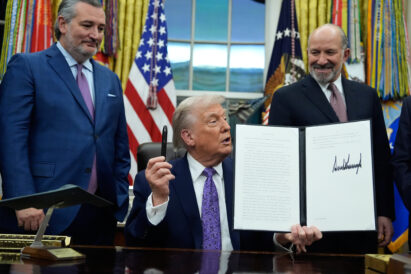
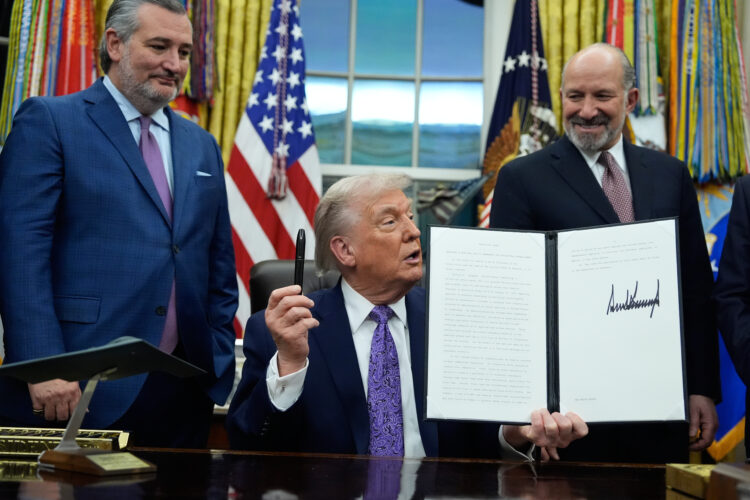
Flanked by Sen. Ted Cruz, R-Texas, left, and Commerce Secretary Howard Lutnick, President Donald Trump displays his signed AI initiative in the Oval Office of the White House, Thursday, Dec. 11, 2025, in Washington. (AP Photo/Alex Brandon)After President Donald Trump signed a much anticipated and controversial executive order aiming to preempt states from governing artificial intelligence, Utah leaders have some concerns, but ultimately they say it won’t stop them from trying to regulate the technology, especially in children’s hands.
The Republican-controlled Utah Legislature and Gov. Spencer Cox have shared mixed thoughts on both social media and AI, encouraging energy expansion to accommodate the data centers that sustain them, but also deeply criticizing their role in people’s mental health.
They have championed legislation reining in deepfakes and chatbots used for mental health or legal advice. They also have plans for more next legislative session. And, earlier this month Cox said he’d defend the states’ ability to act to address digital issues.
Herriman Republican Rep. Doug Fiefia, who co-chairs a national task force on state AI policy, described the order as “an overreaching act that fundamentally disregards the Tenth Amendment and the necessary role of the States in technology governance.”
While he supports the idea of a national framework, he said in a statement that the standard must be developed through a proper legislative process in Congress that ensures full debate and transparency, “not through unilateral action that threatens state funding with no federal standard to replace it with.”
“States must retain their authority as ‘laboratories of democracy.’ Because AI is evolving so quickly, States are closer to the ground and uniquely positioned to adjust quickly and develop tailored regulations,” he said. “Bypassing Congress undermines policy stability and dangerously ignores the need for critical state guardrails.”
Only a law passed in Congress can guarantee that the framework aligns with all states’ needs, he said.
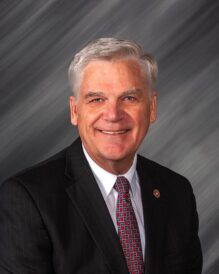
However, Senate Majority Leader Kirk Cullimore, R-Sandy, said the order shouldn’t interfere with Utah’s future plans to regulate AI.
“I think he’s looking more at California, Colorado, New York, who are looking to regulate the models of AI, which can stifle the entrepreneurship, stifle the innovation,” Cullimore said. “And, they’re imposing values that don’t necessarily represent all Americans on these regulations, on the baseline models of AI.”
He referred to examples like one cited in the order that bans “algorithmic discrimination” on so-called high-risk AI systems in Colorado.
However, Cullimore believes the order will still allow Utah lawmakers to continue on their quest to make AI safer for consumers, giving states space to regulate the use of AI as it interfaces with citizens.
The order creates a task force to review and challenge state laws in court. According to the text, its goal is to ensure a national standard on AI.
It also calls for a federal department to make legislative recommendations that don’t preempt states on AI law relating to child safety protection, data center infrastructure, state government procurement and use of AI, among others that will be determined in the future.
“I have some concerns, but that seriously decreases my concerns,” Cullimore said.
Still, Cullimore worries about executive orders acting as legislation, something he described as “not proper” for any administration.
He also worries about the states’ ability to regulate the interface between business and consumers, a topic that states have traditionally managed.
For example, in Utah, Cullimore said, companies have developed therapy chatbots that have been studied at an AI learning lab for future policy recommendations in the state.
“So it’s actually encouraging people to use AI and to develop it because they have the confidence that they’re operating within appropriate boundaries with state law,” he said. “And so I think there are appropriate ways that states should and could regulate the uses of AI, and that will actually encourage innovation and encourage entrepreneurship.”
Cox’s office did not reply to a request for comment Friday. However, before Trump signed the order Thursday evening, Cox said on a social media post that “an alternative AI executive order focused on human flourishing would strike the balance we need: safeguard our kids, preserve our values, and strengthen American competitiveness. States must help protect children and families while America accelerates its leadership in AI.”
Utah News Dispatch is part of States Newsroom, the nation’s largest state-focused nonprofit news organization.