Advocates, nurses say a Utah law takes away power from survivors of sexual assault
Annie Knox, Utah News Dispatch
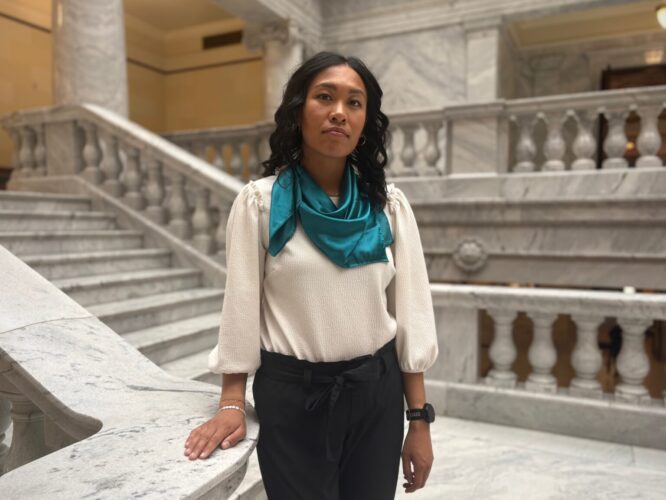
Sherry Huang, a sexual assault nurse examiner, poses for a portrait at the Utah Capitol on April 1, 2026.A phone call from last fall stays with Sherry Huang, a Utah nurse who cares for those seeking medical attention after being sexually assaulted. Huang didn’t know who the voice belonged to, but it sounded panicked.
“She wouldn’t even tell me her name. She wouldn’t give me any information, because she was so scared of law enforcement finding out, and she did not want to report,” Huang recalled Wednesday.
She encouraged the patient, who had disclosed she was pregnant and bleeding, to go to a hospital for scans and medication. But if Huang and her colleagues treated the caller, they couldn’t promise not to tell the police.
Utah is the last state in the nation still requiring health care providers to report the names, contact information, injuries and whereabouts of adults who undergo rape exams, said Julie Valentine, a longtime sexual assault nurse examiner and a professor of nursing at the University of Utah.
Such mandatory reporting laws are commonplace when it comes to abuse of children and vulnerable adults. But Utah’s law applies to everyone, Valentine said, including adults who do not wish to file a police report or pursue criminal charges against a perpetrator.
Valentine was among those urging lawmakers to change that this year, describing the current law as a barrier to health care for many. The bill, HB459, failed to gain traction during the 2026 Legislature, an outcome Valentine described as “heartbreaking.”
The measure faced pushback from the Utah Chiefs of Police Association, which didn’t provide comment for this story in response to multiple requests.
The change would have allowed Utahns to choose whether to notify law enforcement after the exam, in which specially trained medics like Valentine and Huang primarily focus on identifying injuries and coordinating treatment. If a patient so chooses, they also collect samples that are sometimes later used as evidence. The exams must be done within six days of an assault, and at that early stage, Valentine noted, many aren’t certain if they want to involve police.
Valentine anticipates nurses could get more victims in their doors for an exam if Utah were to change its law, and in turn, those patients would be more likely to opt to report to law enforcement. She said Utah’s on its own after Michigan recently changed its policy to join the rest of the states and the U.S. military in leaving the choice to patients.
“We are outside of the norm — way outside,” Valentine said.
She and Huang joined advocates and lawmakers at the state Capitol on Wednesday, a national day of awareness and advocacy against sexual assault. They cheered the passage of a new law banning polygraph tests for survivors of alleged sexual crimes and approval of a yearly allocation of $300,000 to keep a helpline for survivors staffed and running. But they also said there’s more to be done.
Utah’s top Democrat in the House of Representatives and a longtime sponsor of legislation addressing sexual assault, Rep. Angela Romero, told Utah News Dispatch she plans to look into the issue this summer and discuss it with police and health care providers.
“This is definitely something I’m interested in exploring,” said Romero, of Salt Lake City.
The bill’s sponsor in the 2026 Legislature, Republican Rep. Tyler Clancy, is leaving the job for a different post helming the state response to homelessness.
Romero sponsored a 2017 law mandating the testing of sexual assault evidence kits that were collecting dust in Utah police stations. She said after the state solves one problem, it often learns of other related issues that need attention.
In a 2025 report, researchers at Wichita State University in Kansas wrote that the lack of anonymity under laws like Utah’s may discourage people from seeking medical care after they’re assaulted.
And while it’s technically not out of compliance with federal law, the report says, Utah’s law may go against the spirit of the Violence Against Women Act, which says a person can’t be required to help police investigate just because they received a sexual assault exam.
Huang, the nurse, said she and her colleagues try to restore a patient’s sense of agency by obtaining consent in the course of the exam, but the law conflicts with that approach. From what she gathered, the patient she spoke with on the phone last fall did not go to a hospital — an outcome she attributed to Utah’s policy.
“If we didn’t have that, then I think she would have, for sure, just gone in and gotten the help that she needed for her and her baby,” Huang said.
Utah News Dispatch is part of States Newsroom, the nation’s largest state-focused nonprofit news organization.