BYU: Cougars rank ahead of Princeton, Yale with one of the top admission yield rates in the country
Bryn Perrins/BYU
Brigham Young University has ranked No. 5 in the nation for its percentage of admitted students who go on to enroll.Much has been made of Brigham Young University’s recent ranking in the College Football Playoff race — the Cougars had one of the best records and resumés in the country yet were left out of the playoffs. Fortunately, no one can hide BYU’s academic reputation from prospective students.
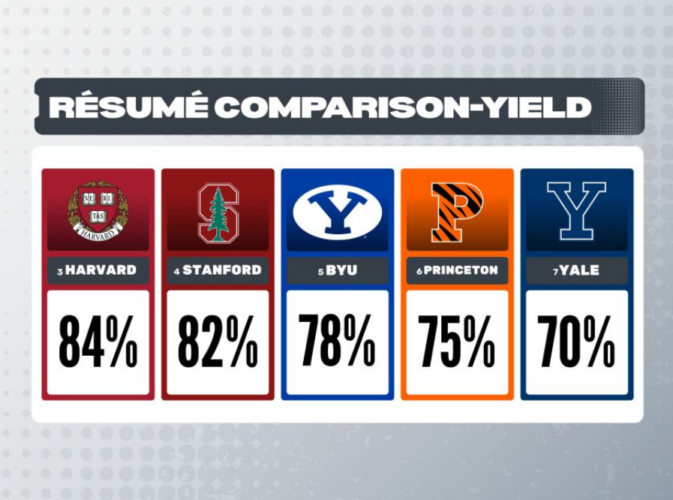
Data recently released from the National Center for Education Statistics show that when it comes to yield rate — the percentage of admitted students who go on to enroll — BYU is elite. The Cougs’ 78% rate is good enough for No. 5 in the country, placing it just behind Harvard and Stanford and ahead of Princeton and Yale.
“A high yield rate suggests that a college is a ‘first choice’ school for many students,” educational technology writer Brandi Stacey wrote in a piece on yield trends. “Schools with the highest yield rates — typically Harvard, Stanford and other elite institutions — are often considered the most prestigious.”
Average college admission yield rates for U.S. four-year colleges hovers around 30%, with private schools closer to 33% and public schools closer to 25%. Schools in the top 10 in the nation are significantly higher than those averages.
According to the NCES data, the University of Chicago has the highest yield rate at 88%, followed by MIT (86%), Harvard (84%), Stanford (82%) and BYU. Rounding out the Top 10 were Princeton (75%), Yale (70%), Dartmouth (69%), Penn (68%) and Brown (65%).
BYU has been ranked in the top five nationally for yield rate for at least 20 years and has earned the top spot twice. What makes BYU’s high yield mark even more impressive is that its enrollment is significantly larger than every other school in the Top 10.
The report was based on the most recently available data reported to the NCES, which came from the 2024-2025 academic year. Just where BYU ranks for the current year won’t be known until schools nationwide submit their IPEDS data to the Department of Education toward the end of the academic school year.
Yield is one of several data points reported to the Department of Education. That data is kept by the National Center for Education Statistics. To see some of BYU’s other academic rankings, check out the Facts & Figures page at byu.edu/facts-figures.