Utah’s top natural resources official steps down after 4 years in the job
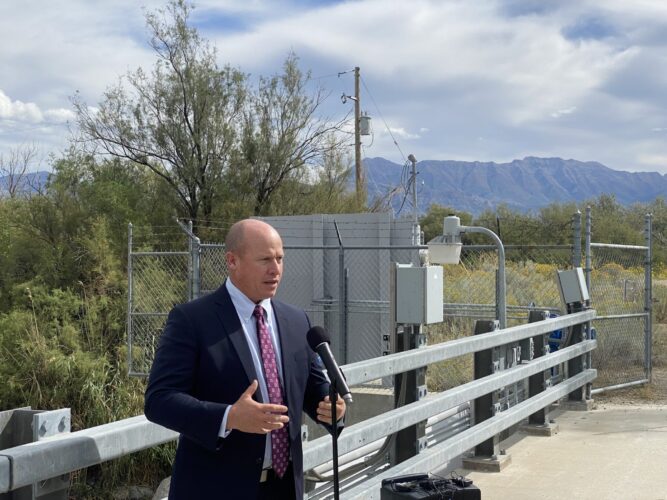
Utah Division of Natural Resources Executive Director Joel Ferry speaks during a news conference on the north shore of Utah Lake, announcing a 10,000 acre-foot donation of water to the Great Salt Lake on Monday, Sept. 16, 2024. (Kyle Dunphey/Utah News Dispatch)
Joel Ferry, commissioner of the Utah Department of Natural Resources, is leaving the post after four years. But that doesn’t mean he won’t have a role in shaping the state’s approach to matters of water and energy development going forward.
Ferry said in an email to employees Monday that he’s stepping down to focus on his family, their farm and consulting in government affairs. In an interview Tuesday, he said it’s been “the job of a lifetime and a dream come true.”
Gov. Spencer Cox announced Tuesday that he has appointed State Forester Jamie Barnes to succeed Ferry, praising her expertise, calling her trusted and saying she “understands that responsible stewardship requires strong relationships, practical solutions and a willingness to work through difficult issues.”
If confirmed by the Utah Senate, Barnes is expected to take over on Aug. 31. She’s set to oversee roughly 2,500 employees and a wide range of state agencies, from those handling water rights and energy development to wildfire response, recreation and state parks.
The transition comes in a year of record heat, historic low snowpack, aggressive wildfires and prolonged drought in Utah. What’s more, the drying Great Salt Lake is teetering above its 2022 historic low, threatening its fragile ecosystem and raising public health concerns about dust rising from its lake bed containing arsenic and other metals.
The change also follows new agreements with federal agencies that state leaders say will enhance Utah’s role in managing public lands.
The right time’
Ferry called his move “100% a personal decision. It was the right time.” He told Utah News Dispatch he’ll consult and lobby on his own rather than for a firm, but plans to follow restrictions on doing so.
State law requires state officials to wait a year after leaving public office to lobby, but makes exceptions for those representing themselves or a business they’re associated with.
Ferry, a member of Cox’s cabinet, said the governor’s office asked him what could be done to keep him but he’d made his decision.
“My kids need a dad again,” he said. Ferry attended just three of his sons’ high school lacrosse games last year because he was either traveling or working late during the others, he said.
In a prepared statement, Cox said Ferry secured record funding and water rights for the Great Salt Lake and praised his leadership and work on Utah’s Operation Gigawatt initiative.
Ferry’s departure follows that of Brian Steed, Utah’s first Great Salt Lake commissioner. But their exits shouldn’t be taken as any sort of sign, Ferry warned.
“It’s by no means a sort of signal or indication that, you know, we’re giving up or that we think the Great Salt Lake is not a solvable problem,” he said.
He’s optimistic about the lake’s future and said recent strides in protecting it include the purchase of the defunct U.S. Magnesium plant at the lake’s edge, along with its water rights, and new policies to ease the process of compensating farmers for water they don’t use and better track what flows toward the lake as a result.
A fifth-generation Utah farmer, Ferry’s own ranch is the last along northern Utah’s Bear River before it reaches the Great Salt Lake, he said.
“I’m personally connected, generationally connected to the Great Salt Lake, and I’ll now be able to advocate even stronger for results and for outcomes,” he said.
‘A problem solver’
Ferry said Barnes is a leader with a command of the issues, and this season’s furious wildfires burning throughout the state would have been worse if not for her team’s efforts to mitigate and prepare.
Those factors show him “we’re in good hands and things are going to move forward in a really positive way,” he said.
In an interview Tuesday, Barnes said she’s honored to be tapped for the job.
“These are big issues facing the state, but I’m a problem solver,” Barnes said.
Utah’s state forester since 2021, she began her career in the department a decade earlier, joining as a paralegal after a stint in criminal and civil law.
Her experience goes beyond fire. She’s also examined policy and worked on issues relating to mineral extraction and to rivers and lakes, including the Great Salt Lake.
“Our future depends on natural resources for our future generations, so making sure that we’re protecting and conserving those is very important to me,” Barnes said.
She told Utah News Dispatch she values collaboration.
“I think in Utah we do relationships right,” Barnes said. “We know how to sit down at the table and look at an issue, and you know, look at it from whatever side someone’s managing from, but understand the differences that get to that common ground.”
Barnes has a master’s degree in natural resources from the University of Idaho and a bachelor’s in criminal justice from Weber State University.
Utah News Dispatch is part of States Newsroom, the nation’s largest state-focused nonprofit news organization.
Local News

‘5 minutes before the miracle’: How Provo fighter Court McGee turned addiction into two-decade MMA career

A bond that runs deep: Brigham Young High School Class of 1961 gets together for another reunion in Provo