Gov. Cox quickly signs bill with late-night change that could disqualify Prop 4 signature removals
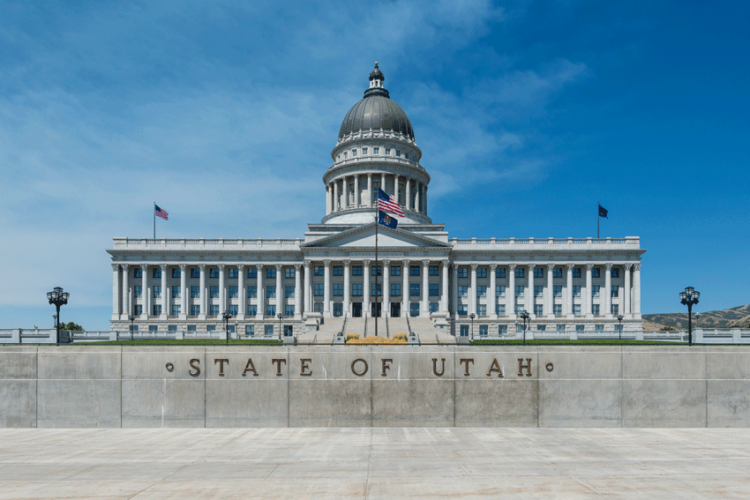
It was 10:56 p.m. — just over an hour left until midnight, the Legislature’s deadline to pass any bills — on Friday night when the Senate changed a bill to include a ban on prepaid postage for signature removal requests.
Four minutes later, the Senate voted 21-7 to pass the bill, HB242. Less than 20 minutes later, the House voted 57-12 to give final legislative approval to the bill.
Then, the next morning, Gov. Spencer Cox signed the bill, and it instantly became law. The governor’s office did not immediately return a request for comment Monday about why he signed the bill so quickly.
The ban on prepaid postage for signature removal requests has the potential to be a death knell for an effort to block a push to put an anti-gerrymandering law voters approved in 2018 back on the ballot this fall.
The Proposition 4 repeal — spearheaded by the group Utahns for Representative Government, which was founded by Utah GOP Chair Rob Axson — is seeking to ask voters this November to decide whether the anti-gerrymandering law that created an independent redistricting process with neutral map-drawing standards should stay or go.
As of Monday morning, county clerks had verified the group had collected 165,893 valid signatures statewide — well above the 140,748 required to qualify. The effort also needs to hit specific thresholds in at least 26 of 29 Senate districts, which it appeared to have done, according to the validated signatures posted on the lieutenant governor’s website.
However, the question hasn’t officially qualified for the ballot yet. Under Utah law, voters have up to 45 days to remove their signatures from the petition by submitting a formal written request to their county clerks. The deadline to do so is 5 p.m. on April 22.
Opponents of the repeal, including the anti-gerrymandering group and original sponsor of Proposition 4, Better Boundaries, have been encouraging voters to remove their signatures.
So far, more than 6,000 voters have successfully removed their signatures. Salt Lake County Clerk Lannie Chapman told Utah News Dispatch on Monday that her county has fielded more than half of those — about 3,900.
The Legislature’s last-minute ban on prepaid signature removal requests comes after Utahns for Representative Government filed a lawsuit two weeks ago, urging a judge to force county clerks to reject any signature removal requests that were submitted using prepaid postage.
The lawsuit alleged that the prepaid envelopes amounted to an unlawful bribe — though Utah law was mum on whether prepaid postage for signature removal requests were illegal. But now, under HB242, it is.
Notably, HB242 included a provision that exempts signature removal requests with prepaid postage as long as it’s postmarked “on or before the effective date of this bill,” which was Saturday.
It’s possible some voters could have sent requests using Better Boundaries’ envelopes after that date that may be invalidated due to the ban.
However, clerks are facing “uncertainty” over how to enforce the new ban, Weber County Clerk Auditor Ricky Hatch told Utah News Dispatch on Monday. He said it could be potentially difficult for clerks to differentiate.
“What is prepaid postage? What if a sponsor of the removal effort hands you an envelope and a stamp? Does that count as prepaid postage or is that just postage?” he said.
The ban on prepaid postage caught clerks off guard, and they didn’t weigh in on the altered bill before it passed. The change was only briefly discussed publicly ahead of Friday’s vote.
“We kind of scratched our heads a little bit” when they saw the amended bill at 11 p.m. on Friday, he said.
Hatch said clerks will be working together along with the lieutenant governor’s office to set some “guidance” for clerks under the new law. “What we don’t want is to have a significant variation in how counties interpret the law and how we would enforce it,” he said. “It’s better for all the parties involved if the counties are approaching this similarly.”
Hatch, however, said he didn’t have an answer when asked whether the new law would disqualify Better Boundaries’ prepaid envelopes.
“I don’t know yet. It’s to say, just because it’s all still so brand new. We’re rule followers, so we’re going to follow the law,” he said, but clerks are also waiting for further guidance before disqualifying removal requests.
Meanwhile, the lawsuit over the prepaid postage hasn’t yet been heard by a judge. On Monday, 4th District Judge Kraig Powell recused himself from the case, citing a rule in Utah’s judicial code of conduct that requires judges to disqualify themselves in any proceeding in which the judge’s impartiality might reasonably be questioned. Now the case will be randomly reassigned to another judge.
Elizabeth Rasmussen, executive director of Better Boundaries, said Monday that the new ban on prepaid postage isn’t stopping the group’s efforts, but rather it’s shifting them.
“The legislature has once again changed the rules for their own benefit midway through the process at the expense of everyday Utahns,” Rasmussen said in a prepared statement. “This bill was obviously planned to pass as the clock ran out with little public input. This type of legislative behavior is what happens when there’s no check on your power. We continue to remain focused on helping those tricked or misled to remove their signatures.”
Axson didn’t return a request for comment Monday.
However, Utahns for Representative Government said in a post on X Sunday that it supported the provision “that was public for a week which clarifies existing law.”
That post also referred to 3rd District Judge Dianna Gibson — the judge who ruled the Utah Legislature acted unconstitutionally when it repealed and replaced Proposition 4 with a law that allowed lawmakers to ignore the independent redistricting commission and adopt their own 2021 congressional boundaries.
Gibson later voided that 2021 congressional map as the result of an unconstitutional process and ordered a court-ordered redistricting process to replace the map for the 2026 elections. That ultimately resulted in a map that created one Democratic district and three Republican districts — which the Utah GOP and Republican lawmakers have criticized continually.
“If a Democrat judge can toss Utah’s congressional maps at 11:40 (p.m.) before the midnight deadline, a Republican legislative majority can confirm existing statute at 11:19 (p.m.),” the post by Utahns for Representative Government said.
The change to ban prepaid postage for signature removal requests was briefly discussed during a Senate committee meeting on Feb. 26.
During that hearing, Sen. Todd Weiler, R-Woods Cross, asked the bill’s sponsor, Rep. Karen Peterson, whether she would be open to an amendment to her bill to include a ban on prepaid postage on the Senate floor. Peterson said she would. Beyond that, the issue wasn’t discussed publicly, and it wasn’t specifically debated on the Senate and House floor after the bill was changed to include the ban.
Utah News Dispatch is part of States Newsroom, the nation’s largest state-focused nonprofit news organization.
Local News
Gov. Cox quickly signs bill with late-night change that could disqualify Prop 4 signature removals

Saratoga Springs man suspected of killing wife charged with murder, remains at large