
Guest opinion: Broadband infrastructure key for communities
-

- Keven J. Stratton
-
- Travis Sheetz, a worker with the Mason County (Wash.) Public Utility District, installs fiber optic cable on a utility pole, Aug. 4, 2021, near Belfair, Wash.

Courtesy photo
Keven J. Stratton
During the past few years, billions of dollars in federal investment has been focused on speeding up broadband infrastructure deployment. If the pandemic did one thing here in Utah, it was highlighting just how important broadband is for each one of us, and in particular for those in rural communities.
Unfortunately, as is the case with so many large federal investments, we also saw needless delays, and also taxpayer funds squandered due to bureaucratic inefficiencies. When it comes to avoiding those same mistakes with broadband deployment, the key lies in regulating something most of us rarely think about: utility poles.
Utility pole regulation, and attachment delays, might not be the most glamorous topic, but it’s one that needs to be discussed if we are going to ensure that unserved, rural families finally get the high-speed internet access they need, and in a timely manner.
The American economy at large also has skin in the game when it comes to expediting broadband deployment. A recent study conducted by an economics professor at Western Carolina University and pole attachment expert estimated that pole attachment delays bleed between $491 million and $1.86 billion from the American economy each month. Amid historic inflation and continuing supply chain issues, losing over a billion dollars from our economy each month is something we cannot afford.
Utility poles serve as the backbone of our communications infrastructure. In order to expand high-speed internet infrastructure to the unserved areas, internet providers require access to the poles so that they can fasten the necessary technology. To do this, they first must be granted access to poles by the pole owners, which are usually electric companies, co-ops, municipalities or utility companies.
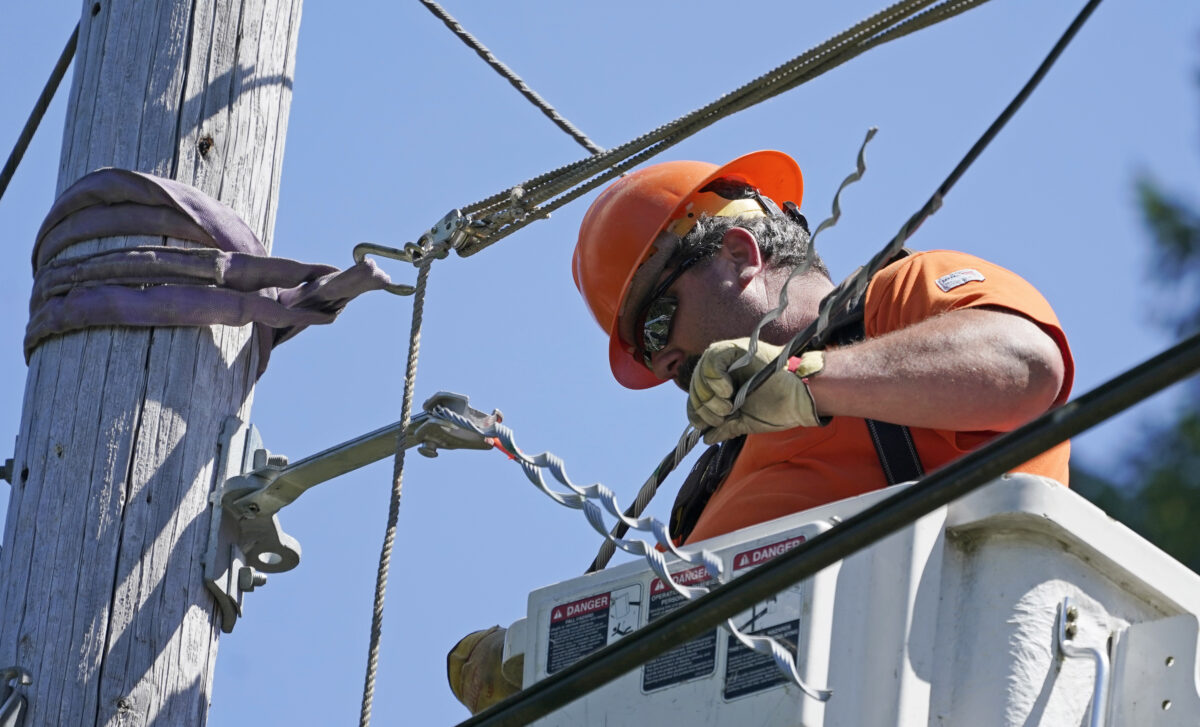
Ted S. Warren, Associated Press
Travis Sheetz, a worker with the Mason County (Wash.) Public Utility District, installs fiber optic cable on a utility pole, Aug. 4, 2021, near Belfair, Wash.
As things stand, forming an agreement between providers and pole owners for access to is often an unnecessarily difficult process, filled with delays from bureaucratic red tape, overly complicated rules and unclear timelines.
To overcome these problems, Congress needs to take action. To speed up the pole attachment process, our elected leaders like Senator Mike Lee, who have a demonstrated record of advocating for rural Utahns, can push for a more straightforward procedure for resolving the disputes between providers and pole owners. Congress can also set up clearer timelines for negotiations to make sure that negotiations do not stall between providers and pole owners, and also establish a more consistent cost-sharing system. By creating these transparencies in how the pole access process functions, we can avoid disparities and confusion during contract negotiations and ensure that broadband is being expanded as quickly as possible.
Congress can make a profound, positive impact on the lives of unserved Americans and the wellbeing of our economy by implementing a few straightforward, common-sense solutions. Let’s modernize our pole system to make sure billions in federal funding does not go to waste.
Keven Stratton represents District 48 in Orem in the Utah House of Representatives. He has served in the legislative body since 2012 and is chair of the House Natural Resources Committee.
Opinion

DE RUGY: When businessmen enter the Beltway, it’s business as usual
MCCLURE: The bridge generation is feeling its age
Millennials are a cultural infrastructure, like an older overpass everyone depends on, but it's starting to carry ...
BARONE: Who wins the re-redistricted House?
As President Donald Trump's job approval sinks to or below 40% (depending on which poll you're looking at), betting ...