
Utah Attorney General, Governor Cox release letter backing the Big 12 in its dispute with Texas Tech, Brendan Sorsby
Pool photo by Rick Egan, The Salt Lake Tribune
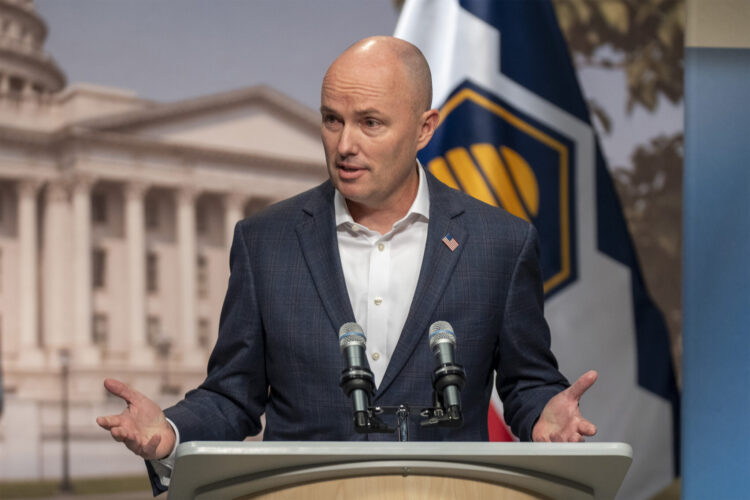
Utah Gov. Spencer Cox conducts a news conference broadcast by PBS Utah in Salt Lake City on March 20, 2025.The state of Utah, specifically State Attorney General Devin Brown and Governor Spencer J. Cox joined the chorus in support of the Big 12 Conference in its efforts to fight against the injunction provided for Texas Tech quarterback Brendan Sorsby last week by a Texas Judge. The injunction lifted the NCAA’s year-long suspension, allowing Sorsby to face a minimal two-game suspension in the wake of admitted gambling improprieties engaged in by the former Cincinnati quarterback, who transferred to Texas Tech after last season.
“Utah cares deeply about this issue,” wrote Brown in a letter that was released early Monday morning. “Utah is one of only two states with a comprehensive constitutional and statutory prohibition on gambling. Utah Constitution article VI, section 27 bars its Legislature from authorizing any game of chance under any name or pretense. Utah Code sections 76-10-1101 et seq. makes gambling a criminal offense. This is not incidental–it reflects a foundational public policy judgment, embedded in our Constitution, that gambling corrupts fair competition and erodes public trust.”
“Brendan Sorsby wagered roughly $90,000 on sports over four years, including approximately forty bets on games involving his own team (the NCAA even asserts that, in a few instances, he bet that opposing players would “overachieve” in games against his school),” Brown continued. “That conduct, if it occurred within Utah, would be criminal under Utah law. The NCAA declared him permanently ineligible for his actions. Sorsby’s court challenge demonstrates an unwillingness to take accountability for his actions, and Texas Tech’s support for that challenge suggests that Texas Tech does not fully understand the seriousness of Sorsby’s misconduct … Indeed, Texas Tech is threatening to allow a player to compete in college athletics despite the fact that this player previously placed dozens of prohibited wagers while a member of a college team and presently claims to have a medically diagnosed addiction to gambling.”
Brown then delved into matters outside of the believed legal consequence of the Texas court and Texas Tech’s actions.
“The harm from Texas Tech’s proposed course of action is not merely legal–it is structural. When an athlete wagers on games in which he competes, every play becomes suspect. Fans, players, broadcasters, and schools alike operate on the foundational premise that competition is honest. Every student-athlete in the Big 12–at BYU, the University of Utah, and every other member school–trains, competes, and sacrifices on that premise. Texas Tech’s support of Sorsby’s efforts to avoid what was previously a uniformly accepted consequence of this type of misconduct does not merely bend a rule. It places the integrity of every game he plays in question and, by extension, puts the integrity of the Conference itself at risk. No member institution should be compelled to compete on those terms, and neither should any honest athlete.”
Brown then directly addressed the statements made by Texas Attorney General Ken Paxton in threatening action against any further moves to bar Sorsby from playing this coming season.
“Utah is home to two Big 12 member institutions–Brigham Young University and the University of Utah–and we write because what happens next matters to both schools and to every honest athlete who competes in this Conference. The Texas Attorney General recently asserted that the Big 12 Conference would violate federal and state antitrust laws by penalizing Texas Tech if the University fails to take appropriate action in response to Brendan Sorsby’s egregious and admitted misconduct. That assertion is incorrect. We concur in the response provided by Oklahoma Attorney General Gentner Drummond on June 12, 2026, and write separately to reinforce his analysis and to add the perspective of a state with a long-standing and unambiguous legal and public policy commitment to the proposition that athletes do not gamble on contests for which they have skin in the game. We also are heartened to see the Conference filed legal action to confirm its legal rights earlier this morning. We support this litigation and similar efforts.”
“We join Attorney General Drummond in recommending that the Big 12 take action against Texas Tech under Bylaw 3.6. Texas Tech is engaging in conduct materially adverse to the best interests of the Conference as a whole,” Brown concluded. “The school has publicly expressed an intention to allow an athlete to participate in competition despite the athlete’s repeated and serious past misconduct and a substantial risk of future misconduct and, when the Conference moved to enforce its own rules, attempted to use antitrust law as a shield against accountability. We also note that the injunction Sorsby obtained runs against only the NCAA, not the Big 12. The Conference is not a party to that proceeding, is not bound by that order, and its independent enforcement of its own bylaws is not action in concert with the NCAA. Texas Tech’s previous consent to the Conference’s bylaws also renders Sorsby’s particular legal theories inapplicable to any action between Texas Tech and the Conference. In short, the Conference’s authority to act is unimpaired, and it should act. All student-athletes who compete with integrity deserve a conference and schools that defend them. Our offices stand ready to assist the Big 12 in its affirmative litigation and should Texas Tech seek to penalize it for doing so.”
BYU
Big 12 launches new sportsmanship campaign
College Roundup: Mortensen leads No. 18 BYU to 3-1 victory at Kansas State
BYU vs TCU info box
When: Saturday, 5 pm MST Where: Amon G. Carter Stadium, Fort Worth, Texas TV: ESPN (Tom Hart (PxP), Roddy Jones ...