
Provo’s Two Temples: The story as told by Prof. Richard O. Cowan
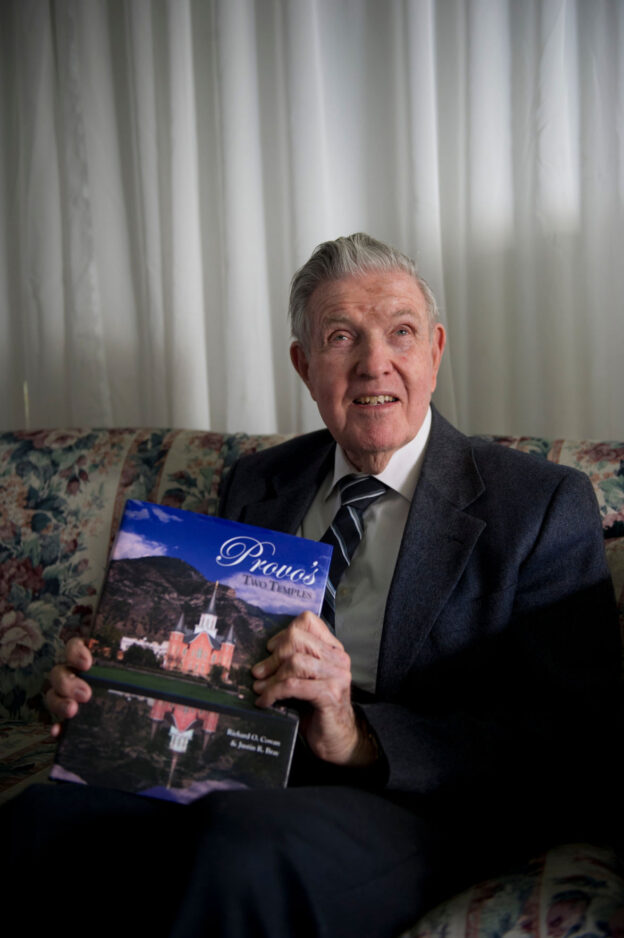
Richard O. Cowan holds his recently published book, "Provo's Two Temples", while posing for a portrait at his home in Provo on Monday, Nov. 9, 2015. Cowan has previously written about the history of the tabernacle.
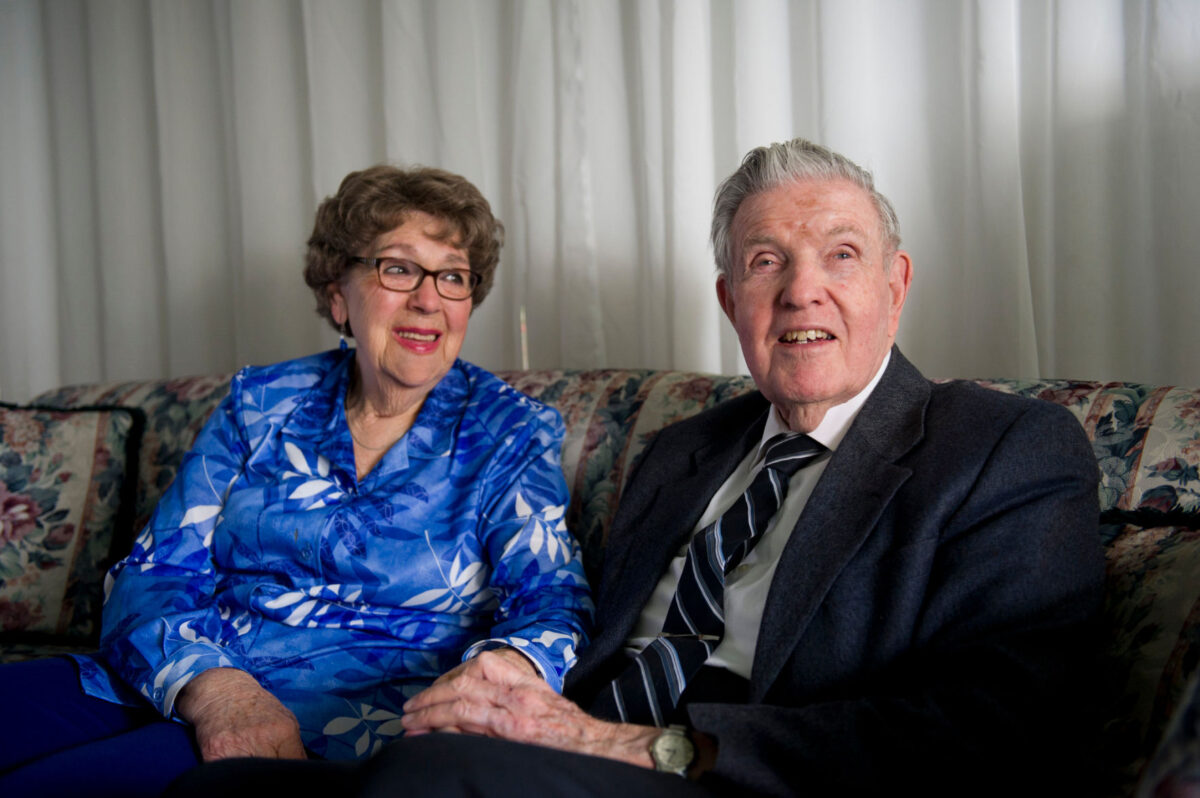
Richard O. Cowan poses for a portrait with his wife, Dawn, at his home in Provo on Monday, Nov. 9, 2015. Cowan recently published a book on Provo's two temples and has previously written about the history of the tabernacle.
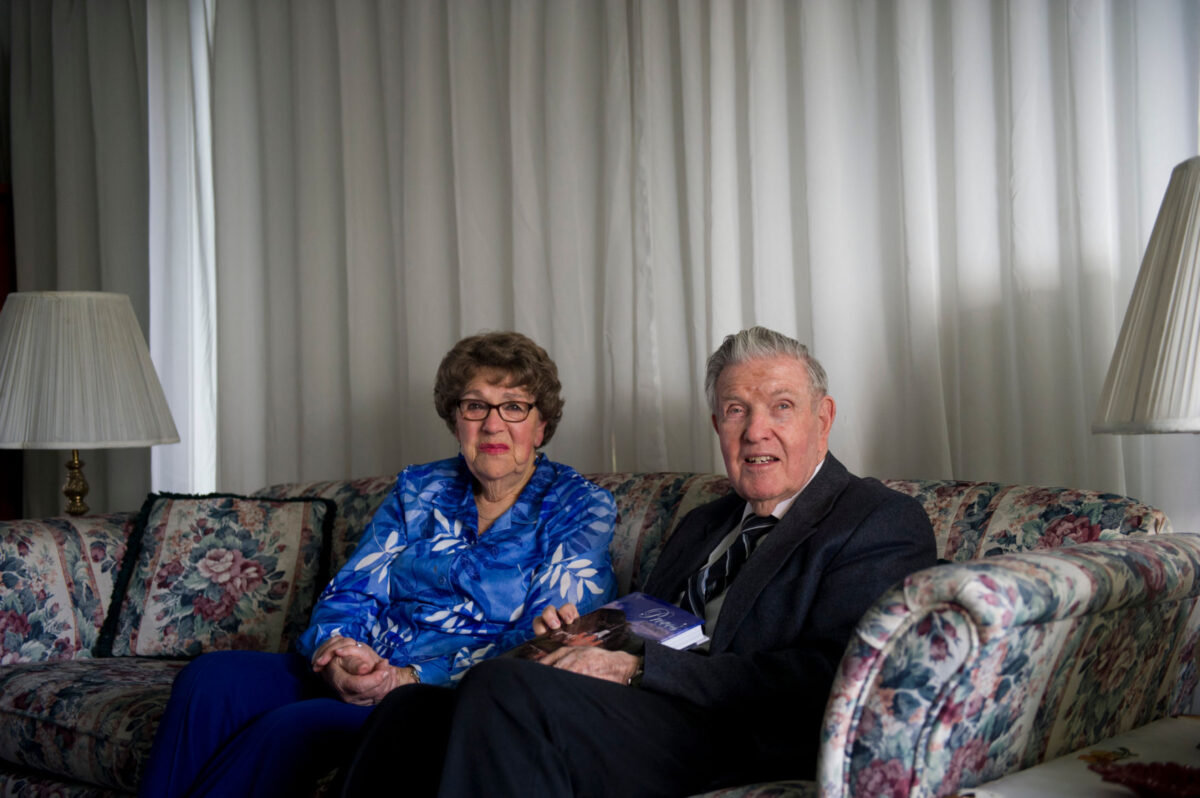
Richard O. Cowan holds his recently published book, "Provo's Two Temples", while posing for a portrait with his wife, Dawn, at his home in Provo on Monday, Nov. 9, 2015. Cowan has previously written about the history of the tabernacle.
The Church of Jesus Christ of Latter-day Saints has built two temples in Provo — one built from the ground up, the other built from the ashes of a beloved historic building.
BYU professor Richard O. Cowan co-authored “Provo’s Two Temples” with Justin R. Bray and shared his insight on the history behind both temples in October 2015.
“The best of two decades after the first of the Latter-day Saints settlers established their homes here, Brigham Young is quoted as talking about their needing a temple on the hill just north of the community and so it quickly became known as temple hill,” Cowan said.
Skilled at humorous anecdotes, Cowan added that in 1911 when BYU built the Maeser Building on that hill, the residents said, “Well, it can be a temple of learning.”
The site of the Provo City Center Temple where the Provo Tabernacle was built in 1883, later dedicated in 1898, was also not the original site the pioneers chose. Initially, they began building that first meetinghouse by the Provo River east and south of Fort Utah.
“I’ve always assumed that that meant it was on 5th West and 5th North over here where we have the Pioneer Museum at North Park,” Cowan said. “You know, I’ve always understood that is where they moved, which is true, but that isn’t the site that Brigham Young had recommended.”
The builders soon learned that perhaps the church president’s advice should have been followed.
“It’s interesting that that location proved to be bad right from the onset,” Cowan said. “The first season the river flooded and flooded that site; and Brigham Young as early as the fall of 1849 recommended that it be built in a different location.”
Young had mapped out the city with the public square where Pioneer Park is at 5th West and Center streets. The Saints began construction on Provo’s first meeting house.
“Well, after 3 years, they had made almost no progress whatever,” Cowan said. “Brigham Young came back to Provo and he brought the whole First Presidency and the Quorum of the Twelve, held a three-day conference in which he chewed out the 2,000 settlers that they were not following his counsel and he had indicated the location that he had earlier said, ‘This is where you should be building the meetinghouse.'”
They commenced to build on the correct site the following year. The lintel over the door to the original meetinghouse was restored and interestingly was dated as 1861.
“In other words, they anticipated completing the building quicker than it actually was,” he said.
According to Rich Talbot, director of the Office of Public Archaeology at Brigham Young University, the first tabernacle was dedicated by President John Taylor in 1867.
“Brigham Young saw it and told them, ‘You’ve already outgrown it,'” Talbot said.
This tabernacle ran north to south unlike the Provo Tabernacle that was placed east to west, just south of the smaller edifice.
The Provo Tabernacle was designed by architect William Harrison Folsom, who also designed many other notable Utah buildings including the Manti Utah Temple, the Salt Lake Tabernacle and the Old Salt Lake Theater.
An unusual feature he designed for the tabernacle was the entries to the building. People could enter the tabernacle from the north, south or east of the building to find seating on the main floor.
If they wanted to access the balconies, there were four towers, one on each corner of the tabernacle, which people could enter and climb up the circular stairways to get to their destinations.
Built during a time of great difficulty and persecution for the practice of polygamy, the Provo Tabernacle was not the only demand placed on settlers in the area. At the same time, they had been asked to help with the Salt Lake Temple and to build a center for education where the Provo Library stands today.
“For about 30 years, the two Provo Tabernacles stood side by side,” Cowan said.
The older Provo Tabernacle was torn down in 1919. Being made of adobe, it had not been built to last.
Hope of a temple at the site Young indicated on top of the hill north of the university was nonexistent a century after his directions.
“When my wife and I moved here to Provo in 1961, the people living here in the Provo City Stake were attending the Salt Lake Temple, and the students were assigned to the Manti Utah Temple District. That was the situation when we got here,” Cowan said.
There were 13 temples in service church-wide, the most recent one in Utah having been dedicated almost three-quarters of a century earlier.
“So the question was, ‘Is the time right for a new temple built in Utah Valley?’ ” he said.
In 1950, about 4,600 students were on campus and that moved to 10,000 a decade later; and Latter-day Saint membership in Utah Valley also increased from around 4,500 in 1940 to about 100,000 in 1960.
At the time, 52 percent of all temple activity was being accomplished in just three temples — Manti, Salt Lake and Logan. With that activity, church leaders knew there needed to be a new temple to relieve the other temples of overcrowding.
“Well, the suggestion was what about putting it on the little park next to the tabernacle. I think the sense of the group there was that it was too small, no parking and so on. Interestingly, that is just where they are building the temple now but in a different way,” Cowan said.
Instead, the temple committee chose the Provo Utah Temple site north of BYU on a hill where it stands today.
Emil B. Fetzer was selected to be the architect of the Provo and Ogden Temples, which were to be built simultaneously as basically twin temples. He was instructed to design an economical and efficient building.
In January 1972, the open house was conducted at the Provo Utah Temple and welcomed 246,000 people. The organizers for the Provo City Center Temple open house are expecting at least 500,000 to 800,000 people.
“Just like we are interested in the new temple now, people back then were quite interested as well,” Cowan said of the Provo Utah Temple.
Once dedicated, the Provo Utah Temple, with its community’s large number of Latter-day Saints and its efficient design, immediately became the most productive temple throughout the church and held that position for 25 years until the dedication of the Mount Timpanogos Utah Temple divided the activities in Utah Valley.
Then the Jordan River Temple in Salt Lake Valley became the single most productive.
“I wondered at the time of the announcement of the Payson and the Oquirrh Mountain temples if that would divide the activities there and allow the Provo Temple to once again become number one,” Cowan said. “Well, I’m telling you even before those temples went into service, the Provo Temple had increased over the years and in the year 2009, we understand that President (Merrill J.) Bateman, who at that time was that temple president, mentioned that that temple had probably accomplished more ordinances than any temple in the history of the world during a single year.”
Concluding a presentation of the two temples and their history, Cowan smiled and said, “One might ask what would be the impact of the Payson Utah Temple and the Provo City Center Temple on the Provo Utah Temple.”
He paused as he looked out at the audience.
“Well, stay tuned, we’ll have to see,” Cowan said.