How you own property affects estate planning
This second part of the two part article will discuss Co-Ownership of Property and Community Property.
Co-ownership of property
Ownership as Joint Tenants with Rights of Survivorship and ownership as Tenants in Common are two common forms of co-ownership in Nevada. A main difference between these two forms of co-ownership relates to what happens when one co-owner dies.
If the property is owned as Tenants in Common, the surviving co-owner does not automatically own the deceased owner’s interest. In contrast, if property is owned as Joint Tenants, the surviving co-owner will automatically own the deceased owner’s interest.
Significantly, the surviving co-owner of property owned in Joint Tenancy will “inherit” the property of the deceased owner regardless of what the will of the deceased owner states.
Because many people do not understand the significance of owning property as Joint Tenants, they mistakenly believe their will “supersedes” all other considerations. This misunderstanding has resulted in many estate administrations that were very different from what the deceased person intended.
Additionally, because the difference between Joint Tenancy and Tenants in Common is very subtle, many people that own property as Tenants in Common are surprised to find out that the surviving co-owner does not automatically “inherit” the property.
Because the surviving co-owner of property held as Tenants in Common does not automatically receive the property upon the death of the other owner, a probate proceeding will be required. The probate court will require that the property be conveyed pursuant to the terms of the deceased owner’s will or the state intestate statute.
Community property
Community property is a form of marital property that exists in nine states. If you were married and acquired assets in California, Nevada, Arizona, Washington, Idaho, New Mexico, Texas, Wisconsin or Louisiana, you likely own community property.
As noted, Nevada is a community property state. Even if you moved from Nevada to a state that is not a community property state, like Utah, you will own community property if you acquired it in Nevada.
For estate planning purposes, it is often very important to maintain the community property status of your property.
Maintaining the community property status of property can save taxes. Briefly stated, the surviving spouse can inherit community property from the deceased spouse and receive a “full stepped up tax basis.”
What that means is that the surviving spouse can sell the property and only have to pay a capital gains tax on the appreciation from the date of the deceased spouse’s death to the time of sale. Therefore, if the surviving spouse sells property shortly after the time of the other spouse’s death, there will be no capital gains tax.
Significantly, this is not the case with co-owned, marital property that is not community property. If the co-owned, marital property is not community property, the surviving spouse would inherit the property with only a “half stepped up tax basis.”
This means that the surviving spouse would have to pay a capital gains tax on half the appreciation from the time the couple originally acquired the property.
This is a brief review of different forms of property ownership. There are many other issues that should be considered when determining the form of property ownership that is right for you and the effect your current titling of property has on your estate plan.
Scott Halvorsen is a local attorney residing with his family in Mona. He can be reached at 435-610-1701, at www.utlivingtrusts.com or at PO Box 607, Mona, Utah 84645.
News
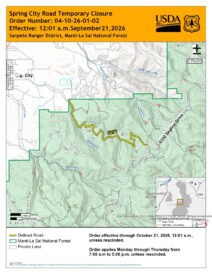
Spring City Canyon Road to Temporarily Close for Forest Work
Public Hearing Set for Sanpete County Rural Healthcare Sales Tax Proposition
MANTI — Sanpete County residents will have an opportunity next month to learn more about and comment on a ...