
Local former cycling coach remembers early days in career of Lance Armstrong
With the 2009 Tour de France concluding today, it appears that Lance Armstrong’s bid for an eighth championship in his return to the sport’s biggest event will end coming up short. It still doesn’t diminish the fact that his participation after 3 ½ years in retirement sparked renewed interest in the 21-stage race, especially in the United States.
For Bob Bills, 55, of Heber City, however, the focus on Armstrong has a personal touch, bringing back 20-year-old memories of when he first brought Armstrong into the sport.
“A champion cyclist is who he was and that’s why he had to come back,” Bills said. “He had to prove to himself he could still do it.”
Bills was first introduced to Armstrong more than 20 years ago and, as the coach of the U.S. junior national team, played a big role in the superstar turning his attention to competitive cycling. Together, the coach and the phenomenal athlete changed the sport in the United States forever.
After years of competitive skiing and cycling, Bills worked with a junior cyclist named Darin Dewsnup in 1985. When Dewsnup started having success on the national junior team, the requests for Bills’s instruction increased dramatically.
In 1988, Bills was named the head of the U.S. junior national team, which at that point did little more than hold a couple of camps and compete in the junior world championships.
A request from the Peruvian National Team to add a Peruvian cyclist to one of the camps resulted in a windfall for the U.S. team, since in return the Peruvians provided Bills with the complete East German training program. Eastern Europeans dominated the sport at that time, so having the program set the stage for the U.S.A. to join the elite teams.
“It was vastly different than what we were doing,” recalled Bills. “It focused on cross-training and the process included kids that competed in other aerobic sports. It looked at kids genetically instead of just on the group of traditionally top cyclists as we were doing.”
In expanding the pool of individuals that might make the junior national team, Bills talked to a friend in Texas who mentioned a pair of kids — juniors in high school — who were dominating in triathlons: Chann McRae and Lance Armstrong. Bills asked a rider from Texas named Eric Harris what he thought about the two young riders.
“He looked surprised when I asked,” Bills said. “He said, ‘I know what you’re thinking. No. 1, they’ll never do it because they make too much money riding in triathlons. No. 2, if they did, they would change everything you’re doing with the cycling team.’ “
The duo were invited to a camp in February 1989, but only McRae was able to come. Although he had a lot to learn about the technique used in team cycling, he blew away the field in a race, finishing 20 minutes in front of the nearest junior rider.
“I thought, ‘oh my gosh,’ ” Bills said. “I was blown away. I asked McRae if Armstrong was as strong as he was and he said, ‘Bob, what I did to everyone in that race, Lance does the same thing to me.’ “
Bills pushed to get Armstrong to Colorado Springs for a camp in April of that year. His first personal memory of the man who would become internationally famous was hearing about how Armstrong sped through the security gates and got kicked off the campus.
But Bills soon learned of the drive and determination of the two new riders. He remembered the team going for a 75-mile ride and when they returned, Armstrong and McRae would be off on an hour-long run or head to the swimming pool.
At the end of camp, each of the riders took an ergo-meter test where they went as long as the could at 90 rotations per minute while the difficulty increased. Armstrong not only lasted far longer than anyone else, according to Bills, but his heart rate shot so high that the physiologist administering the test had to stop him.
“Even though he had no say in the decision of who would be on the team, the physiologist turned to me and said that this kid made the team,” Bills said. “We all laughed but that was Lance. That was the way he was.”
With Bills using the new program and Armstrong pushing the team to new heights, the U.S. junior team quickly outdistanced what it had been able to do in the past.
After a 17th place finish at the junior world championships the year before, the American team pursuit squad — led by Armstrong — knew it had a shot at greatness in the competition in Moscow.
“Before the race, Armstrong got up and pointed at each of the other three riders until they looked away,” Bills said. “He said, ‘I am going to win today. I don’t care which two of you stick with me (since the pursuit time officially ends when the front wheel of the third rider crosses the finish line), but two of you will, got it?’ “
In the race, Armstrong would slowly accelerate and pull the other riders up behind him for a minute, Bills remembered. Then the other riders would go in front for only a few seconds each before Armstrong would go back to the front. A crash kept the U.S. team from winning that year but they still took third, thanks mostly to Armstrong’s drive.
“One of the Soviet officials at the end of the race told me right then, ‘Lance Armstrong, world champion,’ ” Bills said. “Armstrong was just a 17 or 18-year-old kid but he predicted it right then.”
It was the beginning of a dramatic new level of cycling on the U.S. national team.
“Everything changed,” Bills said. “We worked harder than we ever had before. The work ethic greatly improved. U.S. cycling went up a whole notch.”
After that first year, however, Bills and Armstrong began going their separate ways. Bills was put in charge of the logistics for the entire U.S. cycling team while Armstrong and McRae started riding for Motorola.
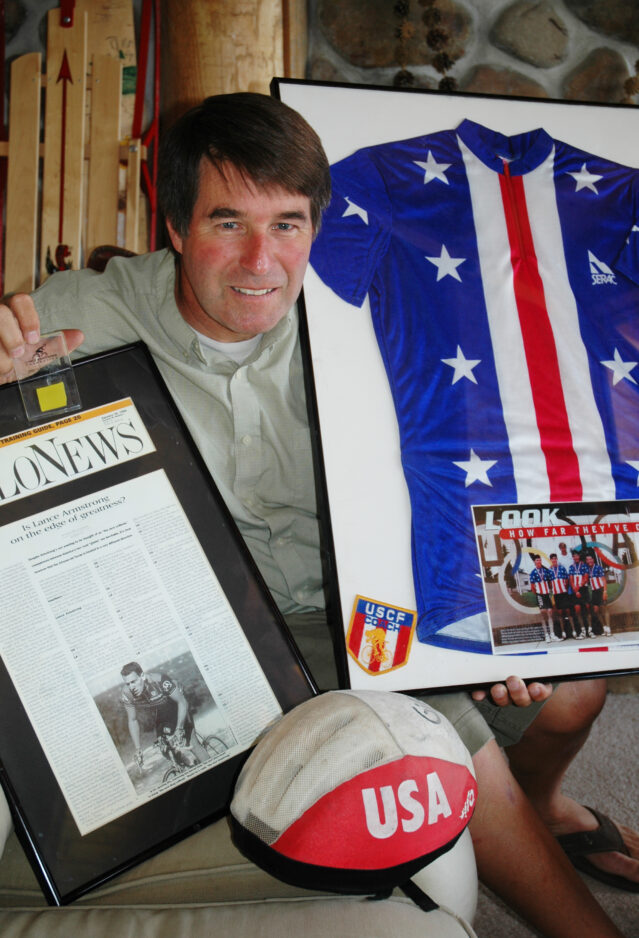
That didn’t mean that the rising young cycling star forgot who helped get him going. In an interview with VeloNews Magazine, published on Jan. 16, 1995, Armstrong said the following about his old coach: “In fact, if it wasn’t for Bob Bills, I probably wouldn’t be riding a bike right now. There’s no doubt I owe him a lot.”
Bills said he doesn’t talk a lot about his experiences with Armstrong, since it’s been so long ago and they don’t keep in close contact. He has photos and articles from the U.S. junior team days, as well as a “LiveStrong” wristband and a piece of the 2002 Tour de France yellow jersey from Armstrong.
He said he still thinks of Armstrong and all of the others, however, when he sees road bikers out riding in their colorful jerseys.
“Riders compare themselves to Armstrong, want to be like Armstrong, wish they could ride with Armstrong,” Bills said. “It’s a huge feather in my cap that I brought Armstrong in — but he’s just one of the many riders I worked with. He’s been the best cyclist but it’s just as important to me to see where all of the others have ended up.”
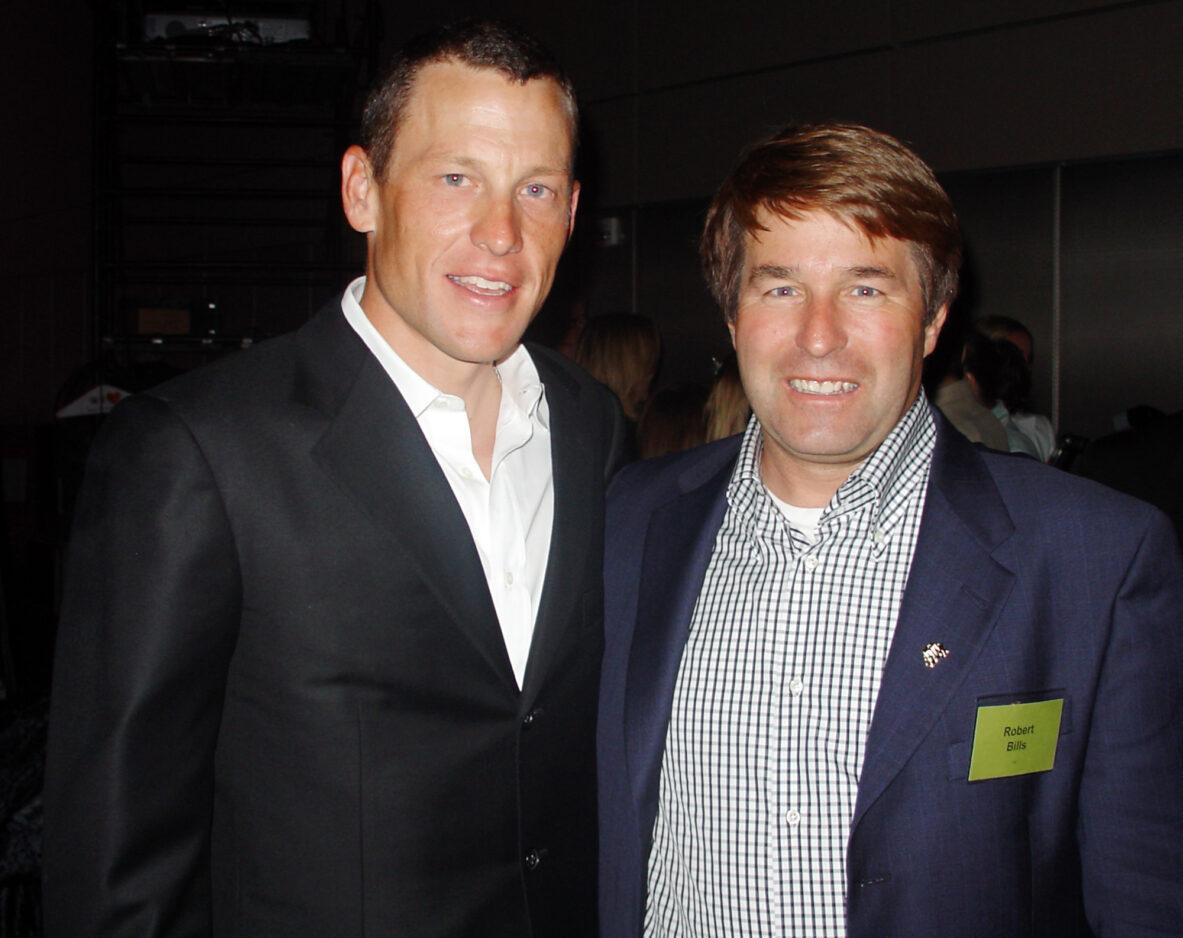
His most recent contact with the famous rider was a few years ago when he was flown back to meet with Armstrong at an event put on by the Lance Armstrong Foundation.
“He told me to meet him backstage after his speech,” Bills said. “Armstrong was one of those guys that would swear in almost every sentence but his speech was perfect and articulate. When I got backstage though, he said, ‘Bills, how the ___ are you?’ and I was like, now that’s the Lance Armstrong I know.”
• Jared Lloyd can be reached at jlloyd@heraldextra.com.