Order in chaos: BYU has a method to the madness of frequent defensive substitutions


-
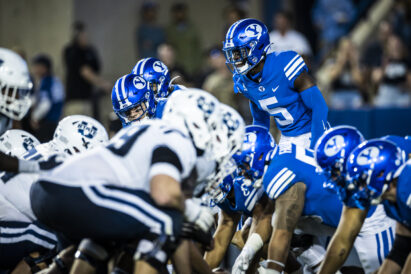
- BYU’s George Udo (5) lines up with the defense against Utah State during a college football game at LaVell Edwards Stadium on Thursday, September 29, 2022.
-
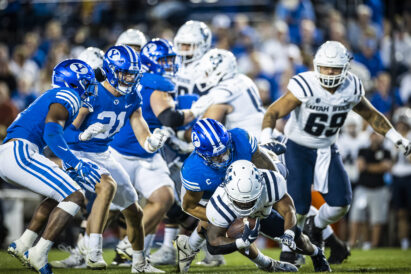
- The BYU defense swarm tackles a Utah State ball carrier during a college football game at LaVell Edwards Stadium on Thursday, Sept. 29, 2022.
-

- BYU’s Caden Haws (left) and John Nelson bring down a Utah State ball carrier during a college football game at LaVell Edwards Stadium on Thursday, Sept. 29, 2022.
BYU football coaches rotate 25 or more players into each game on defense for all the reasons you might expect.
But there’s also a big picture reason, one that lines up with head coach Kalani Sitake’s “love and learning” mantra.
“Kalani’s print, if you will, is to find the overlooked guy, the downtrodden guy that has something to offer and then create a role for that person,” BYU Assistant Head Coach Ed Lamb said. “The most common conversations we have with Kalani is to talk about personnel. He says, ‘I see this particular player and I think he can have a role somewhere. What kind of role can we create?’
“That’s why our players here value this experience. We don’t have a lot of guys going into the transfer portal to look for an increased experience. Most of our guys feel like we’re looking out for them and creating the very best role that we can for them.”
College football has evolved over the years from two-way players to platooning on one side of the ball to situational substitutions to keep up with the intense pace, physicality and offensive creativity of the game.
“We didn’t create substitution packages,” Sitake said. “That’s part of college football. The majority of our starters still get the majority of the reps. We’re going to use different personnel sets. Wyoming switched from three tight ends to two tight ends and to two backs and two tight ends to four wide outs and three wide outs, so we’re going to match up our talent.
“If anyone on defense is tired, we have a fresh backup at 100% who is better than anyone is who fatigued. That’s been a huge emphasis for us, is to trust our teammates, trust our scheme and let players make plays. We also need to be smart because when you get fatigued is when injuries start to set in.”
Making all of those substitutions requires the coordination of coaches and staffers, who have just a few seconds to identify personnel substitutions for opponents. Sometimes the Cougars sub in 11 new defenders based on the situation.
The 40-second clock between plays keeps the Cougar coaching staff on their toes.
Former BYU safety Gavin Fowler, a grad assistant, sits in the coaches booth during games. He is responsible for identifying the opponent’s personnel and informing defensive coordinator Ilaisa Tuiaki, who then responds with the Cougars substitutions and play calls.
“There was a time when I was that guy (Fowler),” Lamb said. “There’s a lot of pressure and to get it wrong puts the defense in a bind. It’s more important than the play call. Maybe you can be more aggressive or less aggressive by design on certain plays, but once you know down and distance, the score of the game and the personnel, there’s usually only three or four plays that the coach has the ability to call. So in a lot of ways, our personnel identifier is doing the most important job.”
Most offenses line up in formation, then look to the sideline for the play call. That gives the offense the last look in identifying defensive personnel.
“We check and then they counter or fake check and sometimes we get caught in the middle of a check,” Lamb said. “So you have to kind of read the demeanor of the offensive line and the quarterback.”
The constant substitution is an adjustment for players who may have never come off the field during their high school days.
“Our subs keep us fresh on defense, and with our rotation it definitely seems like there are dudes out there making plays,” BYU cornerback Kaleb Hayes said. “We’re very comfortable with what we do. We have to stay locked in because in that moment you lose focus, bad things come around.
“It’s hard. I’m a very selfish guy. However, in this game you have to be unselfish as well, and selfless. You know that your brother has your back and they are able to make plays. At the end of the day, we’re here to win and we have that common goal. It’s about contributing as much as you can for a bigger purpose.”
With 25 or more defenders getting into the game, the most important aspect of coaching is making sure all of those players are focused on their job. Lamb said there is a ready list prepared before each game and only those players who can keep up with the changes and alterations will play.
“The advantages that we’re looking to gain with our substitution patterns are the ones we have gained,” Lamb said. “We’ve got a lot of returning experience so I think we’ve got a competitive defense year in and year out. A lot of the reason we’re playing a lot of guys is that we’ve got some guys playing through injuries.
“I’m not sure there is a cookie-cutter answer to why we do it. But we definitely are open to the ideas of young players getting valuable experience and keeping our guys that are the clear starters as healthy as we can.”
Back in 2000, Sitake was a fullback on the BYU football team. He was featured in a story in the Daily Herald and asked about sharing time at his position. His response tells you all you need to know about why he coaches the way he does.
“I don’t mind it at all,” Sitake said in 2000. “I’m a team player. I’m not in it for the fame or glory. I do exactly what the coaches ask of me. The only thing I really care about is if the team plays well. There are a lot of guys here who are really unselfish. There are a lot of players, like the offensive line and those that don’t get a lot of playing time, that also deserve credit.”