Whitney Johnson Catt helps BYU Athletics focus on diversity, inclusion and belonging


-
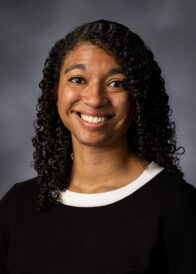
- Whitney Johnson Catt is the Associate Athletic Director for Student Athlete Development, Diversity and Inclusion at BYU.
-
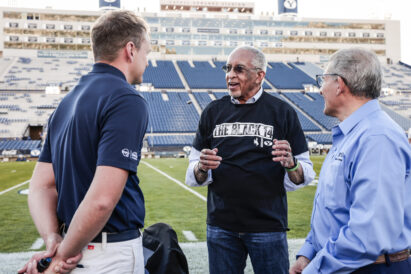
- A member of the “Black 14” talks to BYUtv’s Spencer Linton before the start of a game against Wyoming at LaVell Edwards Stadium on Saturday, Sept. 24, 2022.
-

- BYU’s Micah Harper reacts to a defensive play during a game against Wyoming at LaVell Edwards Stadium on Saturday, Sept. 24, 2022.
-
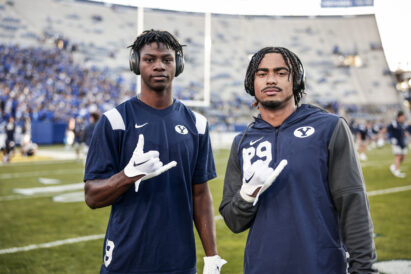
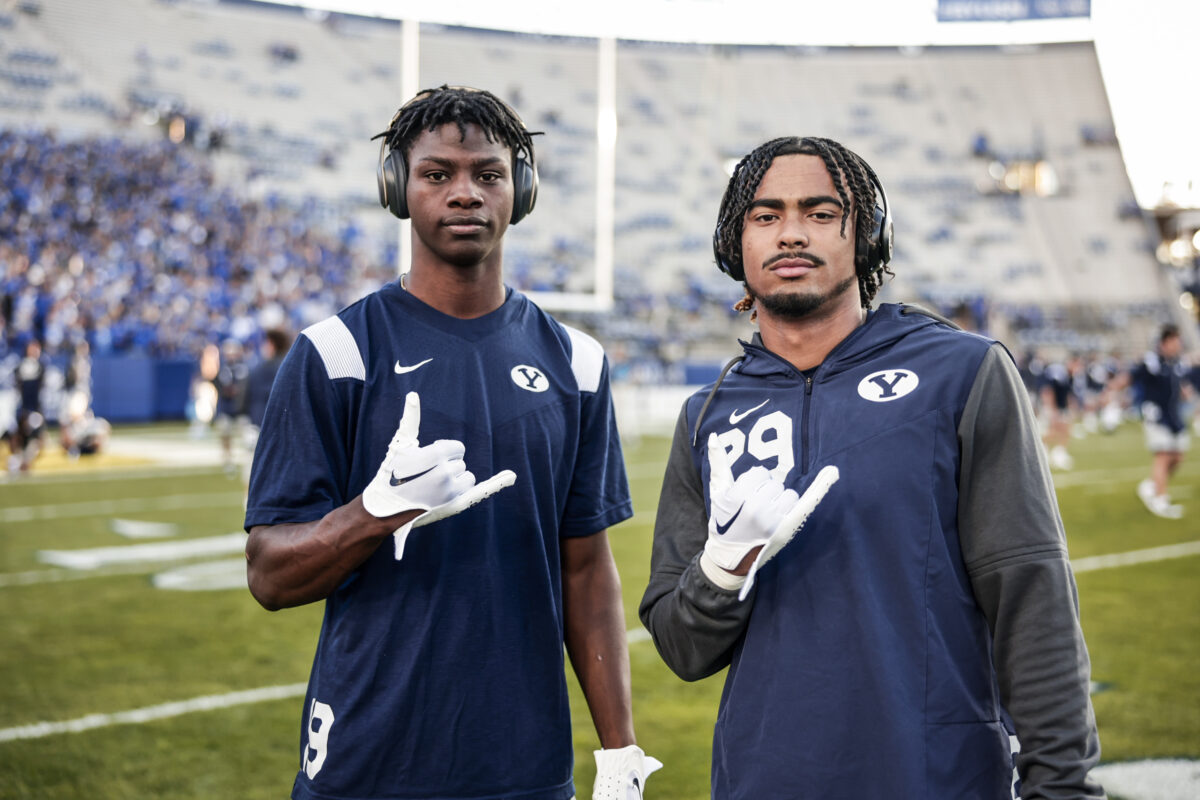
- Two BYU football players pose for a photo before a game against Wyoming at LaVell Edwards Stadium on Saturday, Sept. 24, 2022.
Whitney Johnson Catt’s full title at BYU is “Associate Athletic Director-Student Development, Diversity and Inclusion.”
The length of that title doesn’t really begin to describe what she does or how important her work is at the university with student-athletes in the core areas of race/ethnicity, international, LGBTQ and with student-athletes of other faiths.
“The student development piece is helping to prepare them for life after college, making sure that they’re ready and that they have the resources and competence needed for all of that,” Catt said. “Then the diversity and inclusion piece is to make sure that they feel like they belong and that they have all the resources to thrive here at BYU.”
Catt was an All-State basketball player at Lone Peak High School in Highland, graduating in 2011. She competed at the college basketball level at New Mexico and Southern Utah, earning a bachelor’s degree in Organizational Leadership and a Masters in Business Administration. Catt worked for Indiana University, the NCAA and the Church of Jesus Christ of Latter-Day Saints before being hired at BYU about 18 months ago.
Catt is a board member of Return on Inclusion and Untold Athletics and an active member of Women Leaders in College Sports. She participated in the 2019 NCAA Common Ground V in Austin, Texas as well.
There was no blueprint to follow when Catt was hired into a position new to BYU.
“I came into a really positive situation where things just kind of aligned for this role to take off,” she said. “The first thing was that a report had just released on what diversity, inclusion, race and belonging looked like here at BYU. So I had that to really give me a good look at what I was walking into. I felt like our mission and vision for the athletic department was in a really good place.”
Catt said the department has three essential strategic goals: Building bridges of understanding, developing student-athletes, coaches and administrators to be leaders and providing opportunities for diverse individuals to enrich the campus community.
Catt added that no two days are the same in her job, but her work can essentially be broken down into five categories: Data collection using focus groups and surveys, community building and special events, education and professional development and finally partnerships. She said she meets once a month with BYU’s coaches for training on diversity, equality, inclusion and belonging.
“It’s been really fun feeling the passion that the coaches have for this work,” Catt said. “We do trainings that help coaches understand how to navigate difficult situations and how to engage in crucial conversations. What do you do when someone says something inappropriate? How do you handle that? How do you troubleshoot it? How do you check your own biases and make sure you aren’t the one saying anything inappropriate? How do you apologize when you say something inappropriate because we all do at some point, right?”
A real-time case study occurred last month when a Duke volleyball player claimed she had been taunted with racial slurs during a game against BYU in the Smith Fieldhouse. BYU investigated the matter and said they could not find any evidence that the slur occurred.
“It’s unfortunate to say this, but that situation kind of took us by surprise,” Catt said. “Something did happen and we reacted immediately. There were a lot of individuals who had the best of intentions and did the best they could in the moment. With that being said, There were things that we could have done and should have done and now that we know we can do better.
“The Monday after it happened our support team got in a room and really talked through the details. It’s in a crisis situation where you really see people’s true character. Together as a team in that room, it was really empowering for all of us to be open and honest and to talk through this transparently. It was a phenomenal case study and this won’t be our last crisis situation in belonging.”
Catt was quick to point out that she isn’t the only person on campus doing the work of inclusion. For instance, BYU has a new Office of Belonging, with Carl Hernandez as the school’s new vice president for belonging. The office and the new position were two of 26 recommendations to reduce prejudice made after a major campus study on diversity, equality and belonging.
“I know there are some people who think BYU does nothing as it relates to these efforts,” she said. “That just not true. We’re not perfect at all and we probably make more mistakes than we have success. That’s the same with any institution. But there are a lot of good resources at BYU that need to be acknowledged.”
Catt admitted that before she came to BYU she had heard a lot about the biases and cultural issues that are inherent to a mostly-white, conservative institution.
“It’s so important to recognize that there are students and people here at BYU that really suffer and have a very difficult time adjusting to the culture,” she said. “Some people come here and feel marginalized and feel miserable. But there are so many amazing things happening on campus. There are so many resources. There are some phenomenal people doing amazing work here.”
Catt meets with student-athletes on an individual basis every day and enjoys those personal contacts.
“It’s my favorite experience to meet with someone one-on-one, because that’s where true mutual understanding takes place,” she said. “That’s where I get to know an individual and where I feel like I can really help.”
Catt told a story about a BYU student-athlete from Mexico who was invited on a community activity, an assembly at an elementary school in an economically challenged town with the students made up mostly of Hispanic and Latino minorities.
“When our student-athlete was introduced to the kids, they just cheered and went wild,” Catt said. “It was amazing for them to see someone who looked like them that was a successful Division I athlete. And that athlete had a wonderful experience.”
How does Catt measure the success of her work?
“That’s an excellent question,” she said. “I’ve had to learn to measure my success on an individual level. When I first got here there was a lot of talk about wanting to increase the number of diverse students and employees at BYU, and that’s not a good goal. There are a lot of factors that go into something like that and I can’t base my success on that. I feel like if I can help one person on a daily basis, whether it be a student-athlete, a coach or an administrator, that they can feel more belonging, that’s what I want to do.
“I never thought I’d be in this role or in this work. Now that I am, this is a dream job in a lot of ways. My hope is that I can do this forever and participate in the work of belonging forever, because it’s something I’m passionate about and it’s very important.”