
Justin Anderson returns to BYU football with more recruiting experience
George Frey
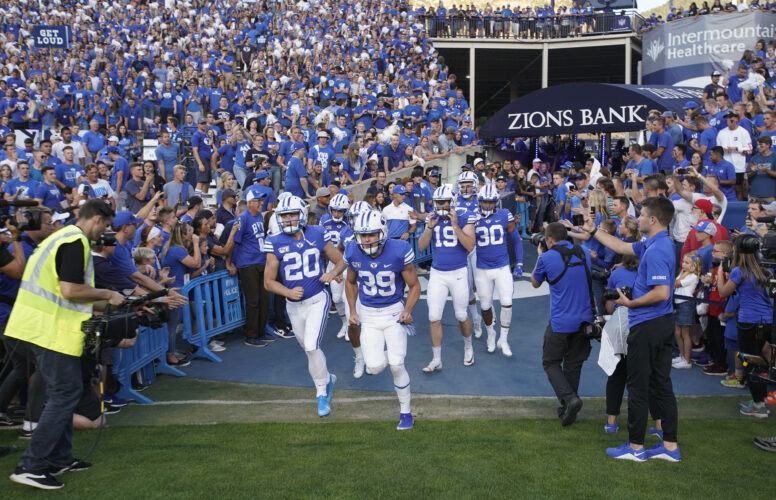
FILE - BYU football players enter the field to warm up for an NCAA college football game against Utah in Provo, Utah, in this Thursday, Aug. 29, 2019, file photo. A deal BYU has made available to its football players could test how much allowing athletes to be compensated by outside companies for name, image and likeness can be used as a competitive advantage. On Thursday, Aug. 12, 2021, BYU announced Built Brands —- a Utah-based company that makes protein-heavy snacks —- will give the opportunity for all 123 members of its football team to be paid to promote its products. (AP Photo/George Frey, File)
Justin Anderson’s career in football has crisscrossed the country as well as weaving between playing, coaching and support responsibilities.
BYU has had a prominent role in that, as Anderson was a Cougar player in 2000-02 and then returned to do an internship in 2008 and be a graduate assistant coach in 2009. After leaving for other opportunities, he came back for 2015 in a support role as well.
And now, seven years later, Anderson is back once again.
“It’s great to be back,” Anderson said in a teleconference on Wednesday. “I’m from here. I was born and raised in Orem. My family is here. Things have changed but it is exciting to see the growth of BYU. I played with (head coach Kalani Sitake), with Coach Aaron Roderick, with Coach Jernaro Gilford, so I was really excited to come back and be around some amazing men, and an amazing university that gave me a lot of great opportunities. It’s a place that I believe in strongly. I think it is going to continue to grow and I’m excited to be a part of that growth.”
BYU head coach Kalani Sitake announced on Monday that Anderson will once again be the director of player personnel for the Cougars.
Since Anderson was at Virginia for most of the time since he left (going with Bronco Mendenhall when he took the Cavalier job), he was asked multiple times his assessment of BYU’s talent level compared to Power 5 programs.
His response included a caveat that he hadn’t been back very long but he seemed pretty confident in what he had seen.
“Last year when we (Virginia) played them, I thought they looked great,” Anderson said. “I think they have done a great job here. They have had success beating Power 5 programs so to me they have a Power 5 roster. You can’t beat those teams if you are not competing talent-wise. I hope I can help them grow and build and improve, but I think honestly they have done a great job.”
He explained that teams have to be true to themselves and believe in their own processes more than outside viewpoints.
“It’s about knowing what you want, evaluating the talent and executing in recruiting,” Anderson said. “If you know what you want spects-wise, character-wise, when you evaluate players who fit those dynamics, that’s when you have success. It’s when you start to say, ‘well, so-and-so offered X’ where you get into trouble. You have to trust your eyes and build your roster, not someone else’s roster. You are building based on your schemes, your personnel, your fit. When you execute that properly, that’s when you have success. I’ve made some friends in the NFL and that’s the advice they’ve given me. That’s been really valuable advice for me.”
One of the things Anderson brings is an understanding of player personnel and how programs have had to adapt their processes with the changing times.
“It’s changed a lot in just the seven years since I was at BYU,” Anderson said. “The growth of the recruiting departments and the focus on recruiting and retaining players has been at a high level at a lot of places. Social media has created a new avenue to recruit and identify players. You’ve got to be able to evolve, As you evolve you grow and learn and try to stay ahead of the game.”
Two of the most significant changes have been the explosion of transfers via the transfer portal and the addition of name, image and likeness (NIL) financial deals. Anderson said teams have to take those elements into consideration.
“I think it is a matter of balancing your roster,” Anderson said. “It’s knowing who you have and having a plan of where you are going and what you would like to accomplish. I think all that stuff ties in. The transfer portal and NIL are here to stay, so it is who fits your program and the culture you are trying to build. I don’t think it is different elsewhere and I look forward to doing that here at BYU.”
BYU
BYU 1-on-1, Christmas Edition: Pop-Tarts Bowl preview and holiday wishes
BYU football: Cougars will play Pop-Tarts Bowl without running back LJ Martin
Coming home: Neilson tabbed as new BYU women’s volleyball coach
PROVO, Utah — BYU Director of Athletics Brian Santiago has announced the hiring of Rob Neilson as the seventh ...