LLOYD: Savoring having BYU and Colorado athletics prepare for joint future in Big 12
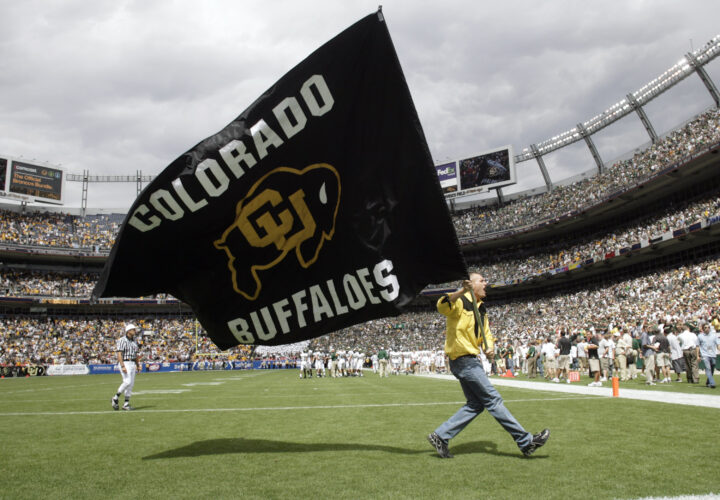
FILE - An unidentified cheerleader carries the school flag across the end zone to mark a Colorado touchdown in the third quarter in Colorado's 31-28 overtime victory over Colorado State in an NCAA college football game in Denver, Sept. 1, 2007. Colorado is leaving the Pac-12 to return to the conference the Buffaloes jilted a dozen years ago, and the Big 12 celebrated the reunion with a two-word statement released through Commissioner Brett Yomark: “They’re back.” (AP Photo/David Zalubowski, File)
The news on Thursday that the University of Colorado had officially decided to return to the Big 12 conference in 2024 shouldn’t really have surprised anyone.
Yes, there was the obvious reasons for the Buffaloes to make the move, most notably the lack of stability from a long-term Pac-12 television deal — or, to put it more bluntly, the lack of guaranteed money.
But the seeds of this decision were sowed more than a dozen years ago when the then-Pac-10 made a bold move to attempt to destroy the Big 12 by luring away Colorado, Texas, Oklahoma, Texas A&M, Texas Tech and Oklahoma State.
Seeing an opportunity, the Buffaloes were the first to agree to switch conferences — only to have none of the other invitees join the party.
Rebuffed for various reason, the Pac-12 turned to Utah as its backup choice and became the Pac-12 that we’ve known since 2011.
But Colorado — which had few natural ties to the Pac-12 — never seemed to fit in with the league, struggling to succeed in many of their sports and rarely seeming to be major players in the big decisions.
I probably paid more attention to the Buffaloes than many in Pac-12 markets did, including in Utah, since I lived only 20 minutes from Boulder during the glory days of Colorado football in the 1990s.
I was at a 1991 Orange Bowl watch party surrounded by CU fans looking on in stunned disbelief when Notre Dame’s Raghib “Rocket” Ismael caught a Buffalo punt at the 10-yard line in the final minute of play, broke three or four tackles and cruised into the end zone for what appeared to be the go-ahead touchdown for the Irish.
I recall the jubilation that erupted around me when the punt was called back on a clipping penalty, allowing Colorado to hang on for the 10-9 win and finish the year with an 11-1-1 record. That was enough to earn the Buffaloes enough votes to win the Associated Press national championship (the first in school history), although unbeaten Georgia Tech (11-0-1) was named the champs by the UPI Coaches Poll.
I remember watching the final dramatic play as Colorado quarterback Kordell Stewart launched the ball 71 yards in the air on the last play of the game at Michigan, only to have it tipped in the air and hauled in for the game-winning touchdown by Michael Westbrook.
Every day I went to school and saw CU T-shirt, sweatshirts and hats. I’ve been to Folsom Field and seen other Buffalo sporting events. Eventually many of my high school friends went on to college in Boulder and became Colorado alumni.
My road took me to BYU and eventually to covering the Cougars professionally. That meant very few opportunities to see showdowns between the two universities who had been so prominent at different points in my life.
But not anymore.
Which is why I join many of my fellow BYU fan friends from those days in Colorado in being thrilled to see the Cougars getting set to be joined by the Buffalos in the Big 12.
Folsom Field is a similar venue to LaVell Edwards Stadium, with mountains towering picturesquely in the background. Boulder and Provo are diametrically opposite when it comes to politics and philosophy, but they are both great college towns in their own ways.
I do want to make one thing very clear, though: BYU and CU may become travel partners but they are not rivals.
No teams that have only played twice in football since 1947 and only a handful of times in other sports are rivals.
Please, please, please, Big 12 … don’t make the same blunder the Pac-12 did with Utah and Colorado and try to manufacture some sort of ridiculous fake “rivalry” significance. Let it be what it is.
BYU’s rivals are Utah and Utah State with Wyoming and Boise State having secondary rivalry status.
Colorado’s biggest rivalry was always with Nebraska, with Colorado State and Oklahoma being secondary.
Maybe that will change in the next 20 years with the Cougars and Buffaloes developing a rivalry, but I will refuse to label it as such until then.
It’s kind of an ironic piece of trivia that after Texas and Oklahoma bolt for the SEC and Colorado joins in 2024, there will be three teams in the Big 12 that are listed as having won national titles in football:
- Colorado (1990)
- BYU (1984)
- Texas Christian (1938)
I hope the league adds to that list at some point in the near future, but that is easier said than done.
The landscape of college football tilted again this week and who knows exactly what dominos will fall in the days and weeks to come, but those can be addressed when they happen.
For right now, I’m just looking forward to seeing the Cougars and the Buffaloes competing against each other for years to come.