PREECE: The state of high school wrestling in Utah
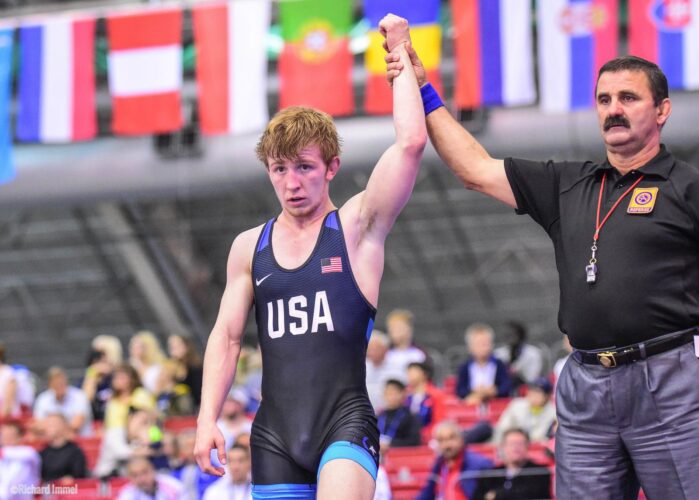
Richard Immel, USA Wrestling
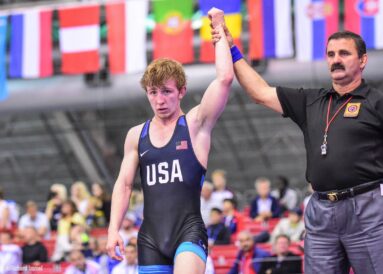
Utah Valley University sophomore Taylor LaMont gets his arm raised in victory after competing at the 2017 UWW Junior World Championships in Tampere, Finland. Next week, LaMont will again compete at the UWW Junior World Championships for Team USA at 60 kg in Trnava, Slovakia.
The large school wrestling classifications are set to hit the mats Wednesday through Saturday at the UCCU Event Center on the campus of Utah Valley University.
The competition should delight hardcore wrestling fans, but what is exactly the health of the sport and what are its underlying challenges going forward?
In many ways, wrestling in the Beehive State is in a good place. Since going to a business model, USA Wrestling Utah has provided huge benefits for wrestlers of all ages across the state. Utah has some of the largest youth club programs in the country. In recent years, the Sanderson Wrestling Academy, started by Cyler Sanderson (younger brother of legendary Penn State head coach Cael Sanderson) is giving wonderful training opportunities for some of the state’s most elite wrestlers. Sanderson now has two academies, one in Davis County and one that opened up in northern Utah County just last year.
The numbers
Girls wrestling, which was sanctioned by the Utah High School Activities Association (UHSAA) in 2021, saw an explosion of participants in the first five years. But it might surprise some that the numbers plateaued a bit for the 2025-26 season.
Chad Blevins, who works as the State weight management director along with his assistant athletic director and assistant boys wrestling coach duties at Mountain View High School, reported 1,700 female wrestlers went through the state mandated hydration procedures, virtually unchanged from the previous season. Meanwhile, boys participation has held steady over recent years and actually increased by 100 wrestlers with 4,300 athletes going through hydration procedures this season.
In regards to girls wrestling specifically, numbers are still struggling a bit in rural areas and smaller classification schools. At the 3A level, 13 high schools had representatives but only six reached double digits in numbers though every girl that competed at divisionals qualified for the state tourney.
While boys have six classifications, girls combine both the 1A and 2A together for the state meet where a total of 22 schools will be represented but only four programs are in the double digits in participants.
There was some good news on the 6A front where all 17 schools have programs this season. Lone Peak will have its very first competitor. Some programs like American Fork and Bingham have been off and on with participation but both schools sent wrestlers to this year’s state meet. Returning 6A champs Mountain Ridge boasts 24 competing wrestlers while Cedar Valley, Copper Hills and Westlake will have 22 girls hitting the mats.
In 5A 29 schools qualified wrestlers with Box Elder and Wasatch leading the way with 19 qualifiers. Northridge has 18 while Salem Hills qualified 16.
The 4A classification might be the most healthy in regards to overall numbers. Bear River and Uintah will bring the most qualifiers with 22 while the Mustangs will bring 20. Both Orem and Timpanogos will be represented this year with a pair of wrestlers each.
Quality of competition
For the boys, the biggest issue might just be overall quality, along with the huge chasm that exists between the top and struggling programs.
In regards to the overall quality, only three home-grown Utah products have become NCAA Division I All-Americans that have graduated in the last 17 seasons-Maple Mountain’s Taylor LaMont, Layton’s Terrell Barraclough and Box Elder’s Brock Hardy, who is still competing at Nebraska.
Utah’s truest golden years in boys prep wrestling were from 1994 to 2009. In that 15-season span, the State of Utah produced three NCAA Champions in Wasatch’s Cael Sanderson, Orem’s Aaron Holker and Matt Brown of Cyprus. Sanderson won four titles and went 159-0 in his collegiate career and also won an Olympic gold medal. His older brother Cody Sanderson was a 2-time NCAA runner-up and other runners-up included Springville’s Jason Chamberlain, Tooele’s Andrew Hochstrasser and Uintah’s Ryan Lewis. Cyler Sanderson, who prepped at both Timpanogos and Wasatch, was an All-American as were Mountain Crest’s Ethen and Luke Lofthouse, Taylorsville’s Justin Ruiz, Viewmont’s Ben Kjar and current Uintah head coach Phillip Keddy. Although his collegiate career was cut short by injury, Provo’s Nathaniel Holt, at age 19, was the youngest freestyle competitor at the 2008 U.S. Olympic Trials.
Female wrestlers from Utah have had better success in recent years. Though women’s college wrestling is in its infancy, ALA’s Sage Mortimer, Springville’s Marlynne Deede and Pleasant Grove’s Brooklyn Hays have made big splashes on the international scene while becoming All-Americans in college.
While girls wrestling is still developing both in numbers and quality, there are also some other concerning trends in boys wrestling. So much can happen in a generation. In 1998 Taylorsville won the 5A state title and Provo tied Payson for the most individual champs at the 4A state meet with three. But in 2026 Taylorsville didn’t qualify a single wrestler for the 5A tourney and Provo just one for the 4A meet.
Salt Lake Valley and Salt Lake City proper schools are especially struggling. Brighton was the last Salt Lake Valley school to win a title in 2001 and West in 1994 was the last school from the Salt Lake School District to win a trophy placing second to Pleasant Grove. And from the looks of things, this trend looks to continue for the foreseeable future.
Note: Day 1 of 6A wrestling completed after the Daily Herald’s print deadline. Full team and individual results can be found at www.trackwrestling.com or the UHSAA website at www.uhsaa.org. And be sure to check out the photo gallery of Wednesday’s 6A competition.